Reader Question: What are some keys to a great opening scene?
Or how to grab the attention of a script reader right away?
Or how to grab the attention of a script reader right away?
Question from Keith:
What are some principles you use for opening scenes? What makes an opening scene really hook the reader, and get behind our “hero” for the long haul?
This is a great subject because as we have discussed before, an opening scene can be hugely important to a script.
For starters, much of how you approach an opening scene is influenced by the story’s genre. For instance, if you’re writing an action or action-adventure movie, you’ll most likely want to begin the story with a bang, a ‘hard’ opening sequence that generates a high level of energy (as opposed to a ‘soft’ character-based opening). Good examples that come to mind: The bank robbery in The Dark Knight, Agent Smith and his guys trying to capture Trinity in The Matrix, the escape from the prison chain gang in 48 Hrs.
If your story is more character-driven, then you look for an entertaining way to introduce your main characters and set the plot into motion. Some good examples:
- Juno: The opening scene introduces the story’s Protagonist Juno, staring at an abandoned living room set (“It started with a chair”), a snippet of a flashback where Juno drops her drawers and straddles a naked Paulie Bleeker (who is seated in the aforementioned chair) — obviously initiating intercourse — followed by an abrupt transition back to the present by a barking dog, and ending with Juno swigging down the contents of a big jug of Sunny Delight. That is an effective opening because it creates so many questions in the mind of the reader, immediately creating curiosity which compels us into the story to find out the answers.
- Little Miss Sunshine: In 5 pages, the script provides one ‘snapshot’ after another of all the story’s key characters, beginning with Olive who studies with rapt attention a videotape of a beauty contest. This approach not only creates curiosity, it also gives the reader an immediate sense of the characters’ and their respective core essence.
- How about the opening scene of Sideways:
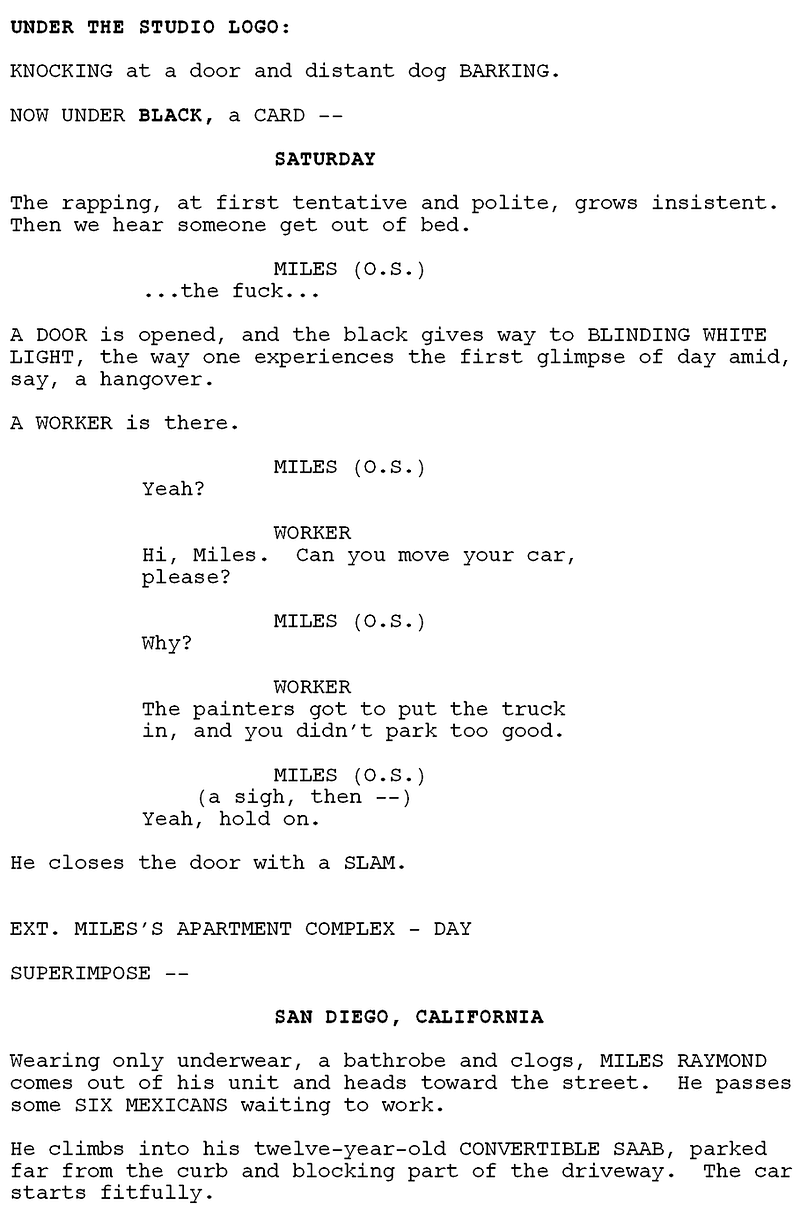
It’s a ‘soft’ opening, not much in the way of action, but it’s funny and provides immediate insight into Miles’ character — the hangover reference in scene description and the line “you didn’t park too good” strongly suggesting that Miles has issues with alcohol. Again we’re curious. Again we get a key insight into the character. Plus we establish a theme: The world (the white light) intruding on Miles’ life (darkness), a foreshadowing of his journey to come.
If you’re writing a comedy, it is important to write an opening scene that will elicit some laughs from the reader and establish the tone of your story’s humor. A good example of that is the recent horror-comedy hit Zombieland which uses misdirection for comedic purposes — moving from a shot of an American flag accompanied by the song “This Land is Your Land” to post-apocalyptic images — then introduces a zombie, who zeroes in on the cameraman shooting the footage, a brief chase, which the cameraman loses:
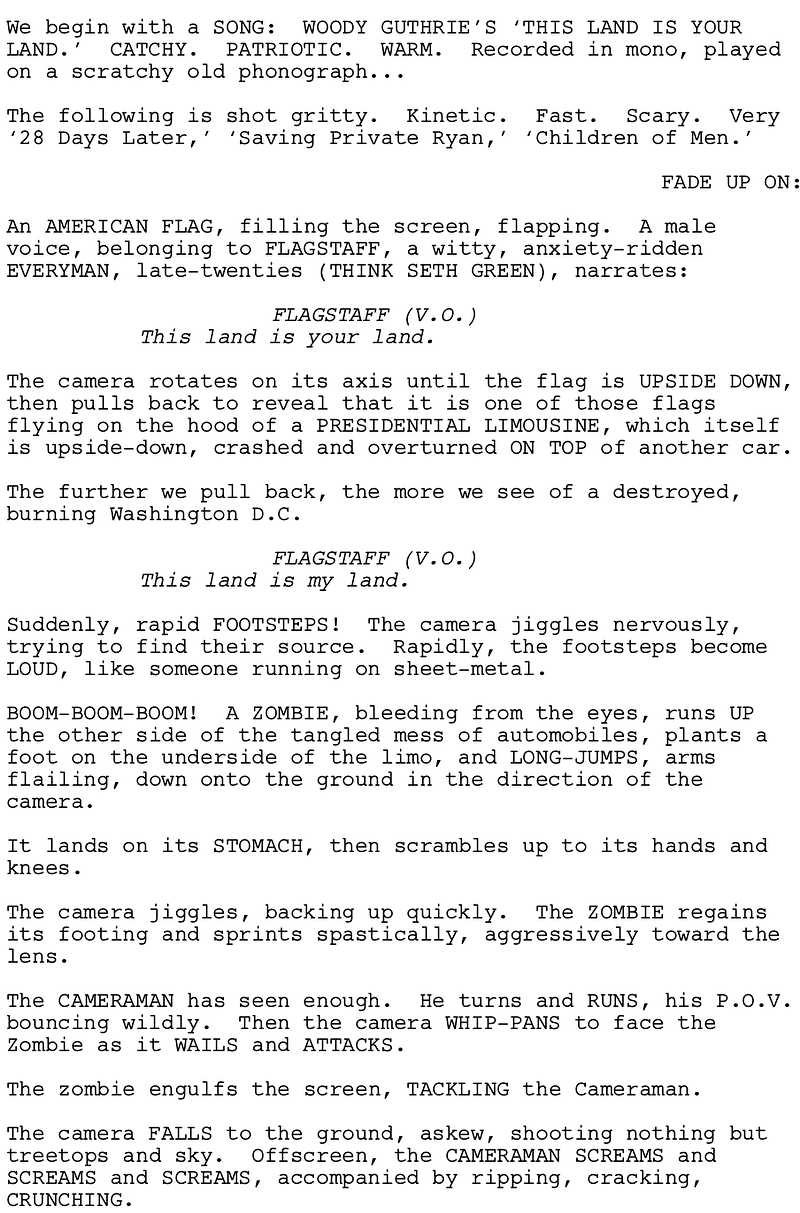
The scene ends with a zombie belch. So it not only establishes the story’s genre, the tone of the humor (dark comedy), and the central conceit — it’s a zombie movie — it also creates some laughs.
For thrillers, you go for something that creates suspense. A good example of that is the script Basic Instinct which describes — in detail — a sex scene that turns violent:
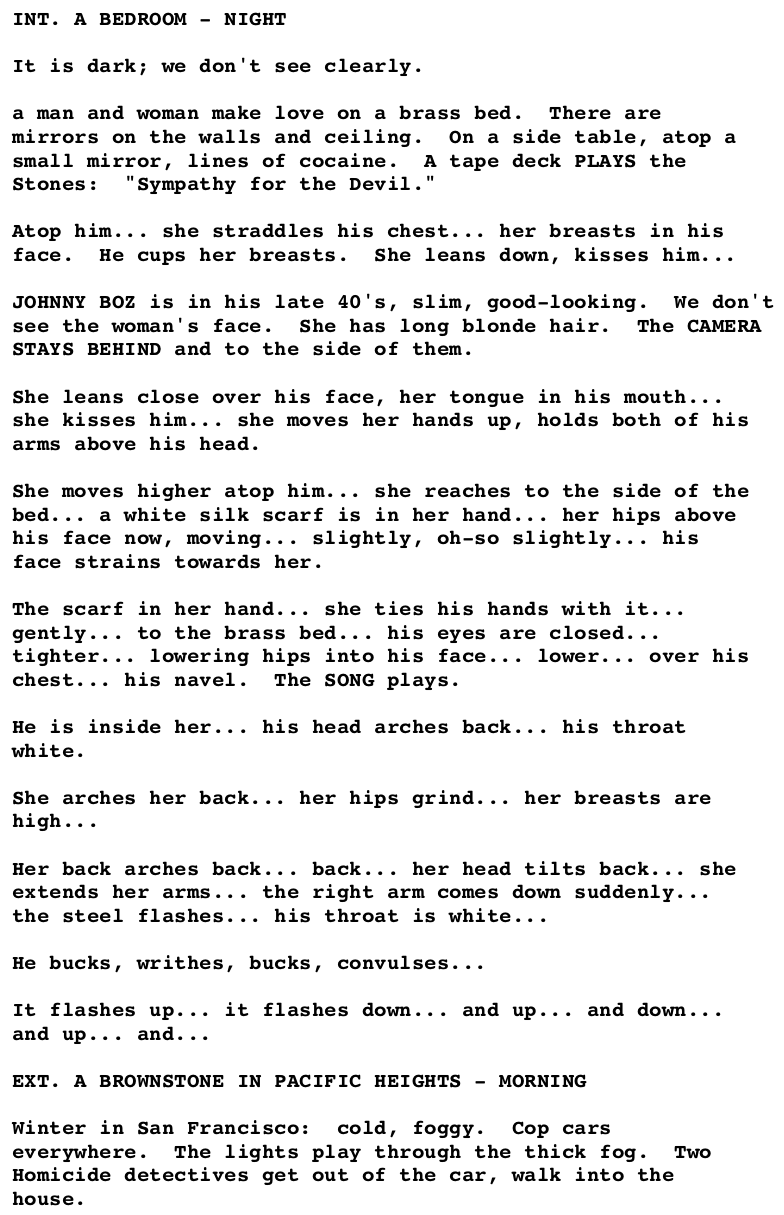
Here the screenwriter Joe Eszterhas titillates the reader, establishes the story’s genre, and gets the story off to a kick-ass start — all in 3/4 of a page.
So what are the keys to a great opening scene? Here are some of them:
- Get the story off to a strong start
- Establish genre and tone of the story
- Introduce basic story premise in a compelling way
- Set the Plotline into motion
- Play to your genre (i.e., if it’s a comedy, make the scene funny, if it’s a thriller, create suspense)
- Provide an indication of your key character’s core essence (typically your Protagonist)
- Make the scene a quick one (1–2 pages)
Bottom line: You want the opening scene to pull the reader into the story straight-away.
How about you? What do you think are the keys to a great opening scene?
And what are some of your favorite opening scenes?
For more Go Into The Story Reader Questions, go here.