Reader Question: Is it possible to have a screenplay without a specific Antagonist character?
Open Forum question from Eve Montana:
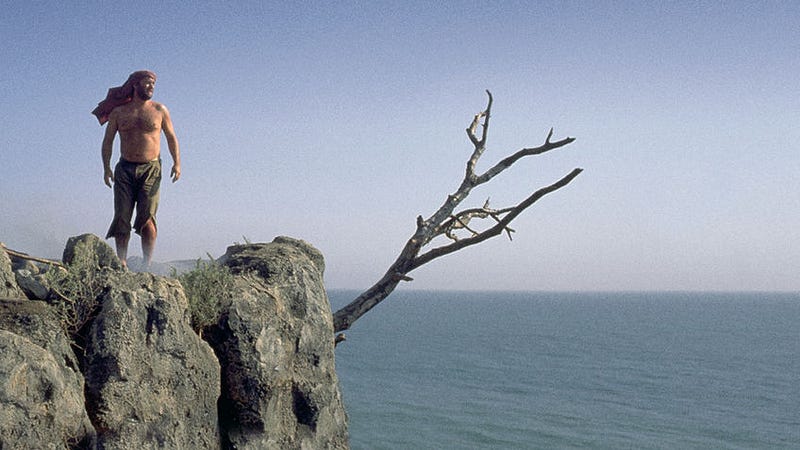
A screenplay does not need a real, live, human Nemesis, but it does require some sort of Protagonist opposition dynamic
Open Forum question from Eve Montana:
I’m having trouble locating my antagonist and character goal in my character-driven movie. In “Juno”, her goal is to find suitable parents for her unborn baby, but who is the antagonist?
And coincidentally a similar question via email from Jeff:
I have a question regarding the villain character in a screenplay. Many screenwriting books, articles, and blogs suggest that a screenplay needs to have a Villain. This villain needs to be a formidable opponent that stands directly in the way of our hero obtaining his goal. Well, some concepts I come up with don’t really have a “villain” per se. According to everything I read this could be wrong. But I feel like there are a lot of successful movies that don’t have classic villains — Who’s the villain in 40 Year Old Virgin? Knocked Up? Juno? A lot of movies don’t have this maniacal evil villain working against the hero. Sometimes the world/society/circumstance is the villain. Or our hero is his own villain. Or maybe I’m just missing it?
The short answer is no — your script does not need to have a traditional Nemesis / Antagonist / Villain character. However, all movies must have some sort of opposition dynamic in relation to the Protagonist — or else you have no conflict. If you have no conflict, you likely have no drama.
My working theory re screenplays is that if Plot equals Structure, then Character equals Function. Every character in a screenplay should have a function tied to the narrative. In most movies, there are five primary functions filled by these archetypes: Protagonist, Nemesis, Attractor, Mentor, and Trickster.
One way of looking at the Nemesis function is per Carl Jung’s concept of the shadow:
It is a frightening thought that man also has a shadow side to him, consisting not just of little weaknesses- and foibles, but of a positively demonic dynamism. The individual seldom knows anything of this; to him, as an individual, it is incredible that he should ever in any circumstances go beyond himself. But let these harmless creatures form a mass, and there emerges a raging monster; and each individual is only one tiny cell in the monster’s body, so that for better or worse he must accompany it on its bloody rampages and even assist it to the utmost. Having a dark suspicion of these grim possibilities, man turns a blind eye to the shadow-side of human nature. Blindly he strives against the salutary dogma of original sin, which is yet so prodigiously true. Yes, he even hesitates to admit the conflict of which he is so painfully aware.
The shadow is everything in us that is unconscious and undeveloped, those aspects of our psyche which we repress and deny. Most often these represent our ‘dark’ impulses, however as long as it exists only in our unconscious, we experience it indirectly — through dreams, underlying and unknown intentions behind our actions and thoughts, and so on.
Jung asserted this:
The psychological rule says that when an inner situation is not made conscious, it happens outside as fate. That is to say, when the individual remains undivided and does not become conscious of his inner opposite, the world must perforce act out the conflict.
Therefore in any movie story where the Protagonist is involved in some sort of significant transformation-journey, the Nemesis can be seen as the physicalization of the shadow, an expression of the Protagonist’s need to become conscious of, connect with, and oftentimes combat their dark, hidden impulses and aspects.
In other words, psychologically speaking, if you ask this question of the story you are writing — “Why does this story have to happen to this Protagonist right now?” — a Jungian response might be, “Because the Protagonist must now deal with their Shadow.”
The classic cinematic example of this is in the movie Star Wars: The Empire Strikes Back when Luke Skywalker ventures deep into the swamps of Degobah to encounter his Nemesis Darth Vader — only to sever Vader’s head off Vader’s body, his helmet explodes, revealing that the face within is Luke’s.
In other words, Luke has within him the dark side of the Force as well as light side — just as all humans have ‘good’ and ‘bad’ instincts. As Jung would argue, we can not move toward any approximation of wholeness or unity unless we engage all of the aspects of our psyche and that includes those parts of who we are that we fear and repress.
Now notice I used the term physicalization, not “personification.” That is because in a screenplay, an opposition dynamic to the Protagonist does not need to be provided by a sentient being.
An example of a movie that doesn’t have a personal Nemesis character is Cast Away (2000), where the Protagonist Chuck Nolan (Tom Hanks) is stranded for four years alone on a remote island. In this story, geography and weather generate the primary conflict in the life of the Protagonist by creating his isolation and standing in the way of his escape — it is those elements that provide the opposition dynamic.
Per the question re Juno: Who’s the Nemesis in that story? Here’s my character archetype breakdown of that movie:
Protagonist — Juno
Attractor — Paulie (True) / Mark Loring (False)
Mentor — Juno’s father / Juno’s step-mother
Trickster — Vanessa Loring
And the Nemesis? Let’s look at the two big questions that typically help to define the Protagonist character:
What does Juno want? To make sure her baby finds a good home.
What does Juno need? To be a teenager.
In my view of the movie, all that snarky slanguage that Juno uses and her cooler-than-cool attitude she adopts is a response to her shadow, arising from this key factor — she was rejected by her mother:
She [her mother] lives on a Havasu reservation in Arizona and three replacement kids. Oh, and she inexplicably mails me a cactus every Valentine’s Day. And I’m like, “Thanks a heap, Coyote Ugly. This cactus gram stings worse than your abandonment.” [P. 16]
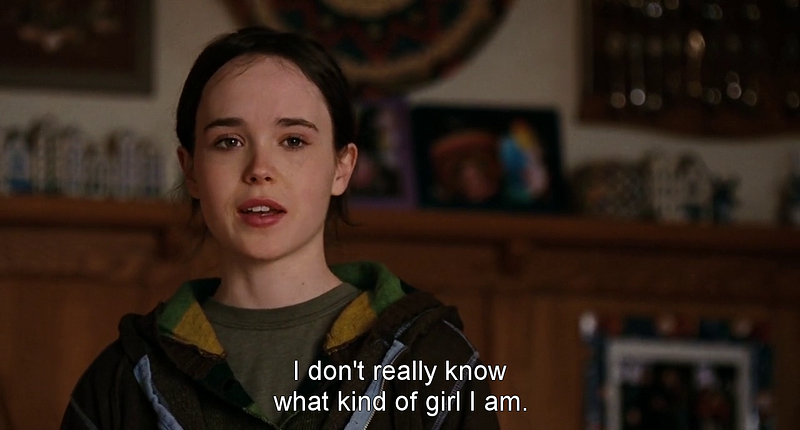
Juno has never recovered from that hurt. This one side of dialogue is the only overt sign of that pain, but if you look at Juno from a macro perspective, throughout the first two acts of the movie, it’s clear that she has tried her best to jump past and out of her youth into adulthood. Over and over, she attempts to distinguish herself from her peers — through her attire, habits, language and, her likes / dislikes (e.g., weird horror movies, early 80s punk bands). In my view, she has ‘grown up’ quickly to put as much distance as she can from the experience of her mother’s rejection, and therefore as a means to avoid dealing with that pain. And so I think what she needs is to give up her pseudo-adult ‘mask,’ and be what by rights she ought to be: a teenage girl.
This is borne out in the Denouement: We see her riding a bike (not driving a car), pulling out a guitar to sing a silly little duet with Paulie (innocence), then chastely kisses Paulie on the cheek. In contrast to the opening scene where we see her dropping her panties and initiating sex with Paulie, the whole tone of the ending scene is spring, innocence, and youth — she’s a happy teenager.
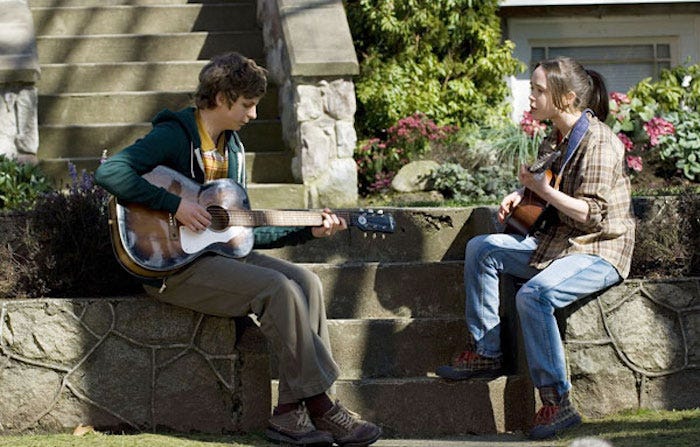
Thus, one interpretation in Juno is the Nemesis is the mask of her adult-self, eventually ripped away when Mark Loring — an adult who ends up acting like a child — betrays her, and the very real and very raw experience of childbirth.
[Another interpretation: The baby is the Nemesis!]
Similarly in 40-Year-Old Virgin, the Nemesis isn’t a person, it’s a state of being: Andy’s virginity. And in Knocked Up, the nemesis is Ben’s immaturity: It provides opposition in that Ben has to overcome his infantile instincts to prove to be a worthy father and Alison has to get over her fear of Ben’s immaturity to learn to trust and love him.
So again, a screenplay does not need a real, live, human Nemesis, but it does require some sort of Protagonist opposition dynamic, whether it’s physical — like being stranded on an island — psychological — like immaturity — or a state of being — like virginity.
That said, a word of caution: Most movies have strong Nemesis characters, ones that are human and do act overtly in opposition to a Protagonist. To this point, Jeff emailed me later to say this:
BTW — I posed this question to a friend who just wrote a book on screenwriting.
His response — There are those movies, I don’t suggest you write them.
Probably two reasons for that response: (1) Movies without actual human Nemesis characters are harder to write because the central conflict is almost by definition more difficult to locate and steer without a specific Nemesis; (2) Studios feel a lot more comfortable with movies where there is a strong central Nemesis.
For more of my thoughts on the Nemesis character:
How to build a powerful Nemesis?
Does a story absolutely need an antagonist?
The psychopathology of heroism
How about you? Do you think a screenplay needs a Nemesis or can it function without one?
For 100s more Reader Questions, go here.