Reader Question: Is it okay to include an image in a spec script?
Revisiting this subject based on the spec script for the movie A Quiet Place.
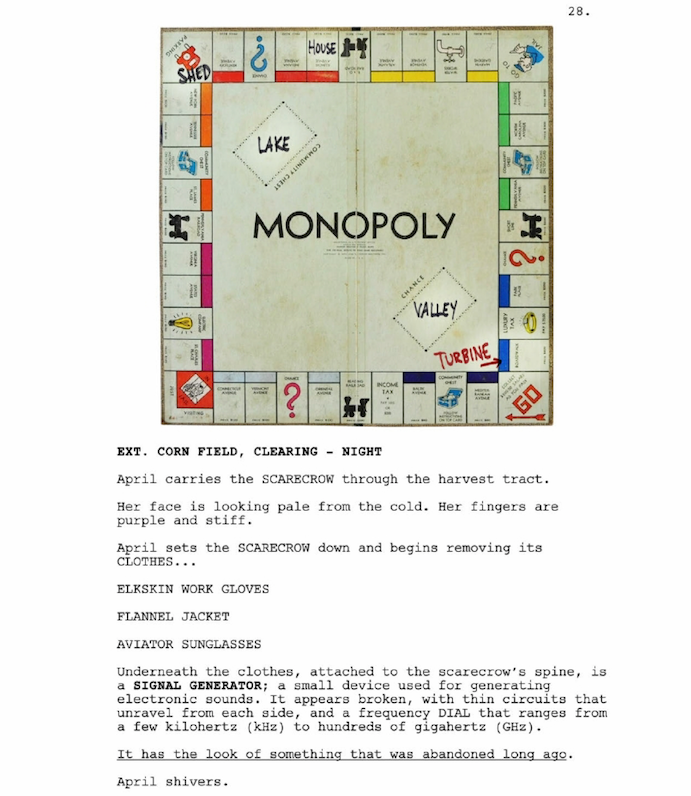
Revisiting this subject based on the spec script for the movie A Quiet Place.
This was originally posted on November 22, 2010:
Yesterday’s script for the 7 Days of Screenplays (Thriller) challenge was Se7en. In comments, Chris Drzewiecki said:
Did anyone else notice the use of the diagram on page 32? I believe this is copied straight from “The Divine Comedy”… Scott are there any specific rules when it comes to including something like this?
In one of my screenplays I describe a unique headstone that plays a significant role in my story and would love to include a diagram similar to this one for almost the exact same purpose. But I don’t think it would help me sell the work, mostly due to a rule infraction… Just an observation, this is an amazing piece of writing, thanks for including it in this weeks readings…
Screenplay style is a moving target. There are lots of people who will claim that you must write this way or that. And there are certainly some choices a writer can make that will be perceived as a sign of an amateur such as including a script’s WGA registration number on the title page, writing an opening credit sequence, and so on.
While it is important to know the conventional wisdom re screenplay style, I have a more important bottom line: A writer must do whatever they think is necessary to best tell their story.
Your reference to the image in the script for Se7en (actual script: P. 29) is a case in point. I couldn’t find the exact image on the web, but here is a similar one:
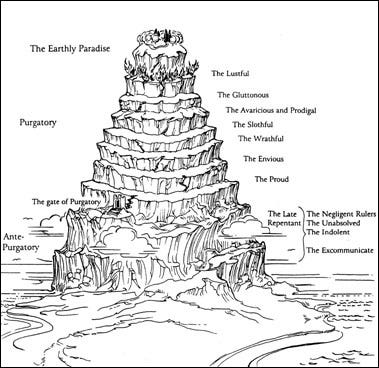
The conventional wisdom is that a writer should not include visual references like this in a script. Why? I suppose two things. First, there is a supposition that a writer should be able to convey everything in a story through words because they are… you know… a writer! Second, there’s the Shane Black Phenomenon. After he sold The Last Boy Scout for a boatload of money, a script that broke the fourth wall several times — Black, the writer, using scene description to ‘talk’ directly to the script reader — it seemed like every other spec script that cycled through the submission process for months featured writers breaking the fourth wall. Grew quite tiresome to script readers. So if a spec script were to sell that featured one or more images in its pages, there lurks an unstated fear that the floodgates might open to a zillion spec scripts filled with photos, drawings, icons, and so on.
But obviously Se7en screenwriter Andrew Kevin Walker got away with it. Now I don’t know if the purgatory image was in the original spec script that sold to New Line in 1991, but obviously it’s in the draft we read dated November 1, 1994 which had to be around the time the movie went into production (it was released in 1995). Why is the distinction important? If the studio has already bought your script, then the issue of whether you include an image is a moot point because once you have their money, you can pretty much do what you want per style. Before purchase when your screenplay is being circulated as a selling script, that’s when you run up against conventional wisdom as script coverage is critical.
To my bottom line point: Obviously Walker thought he needed to put that image in the script in order to tell the story the way he wanted.
So what’s my answer to Chris’ question? If you’re an outsider to Hollywood or a non-pro writing a spec script, I would avoid inserting an image. If you think that you must include it to tell your story, then go ahead. But only if you’re absolutely sure it’s necessary.
By the way, Walker’s Wikipedia page provides some interesting background on Se7en:
Shortly after completing his education, he moved to New York City and began a career in retail at Tower Records. During that time, he worked on several projects, but Walker was unable to find much success until 1991, when he completed the script for Seven. Walker decided to move to Los Angeles to sell his screenplay. There, he personally contacted screenwriter David Koepp, who showed the script to executives at New Line Cinema, who ended up purchasing the rights to it. The film, however, took nearly three years to begin production. While the project was ongoing, Walker found other work as a screenwriter, including a short stint with HBO’s television series Tales From the Crypt, as well as writing two other films, Brainscan (1994) and the novel adaptation Hideaway (1995).[1]
Seven began production between his two other films, headed by David Fincher as the director and starring Morgan Freeman, Brad Pitt and Kevin Spacey. At one point during production, the studio proposed several changes — which would later become a recurring theme throughout Walker’s career — deeming it too dark for its target audience; both Fincher and Freeman backed Walker’s original script, and it eventually went unchanged.[1] The film was met with critical acclaim and enormous box office success, earning $327,311,859 worldwide.[2][3] It would allow Walker to make a name for himself in the movie industry, as well as make stars of then-relatively unknown actors Brad Pitt and Kevin Spacey.
I’ve been in conversation with folks in the Hollywood acquisition and development world, and I’m hearing there has been a definite uptick in scripts which include visuals in their pages. A possible influence: The success of the movie A Quiet Place. Here is an excerpt from my interview with that script’s screenwriters Scott Beck and Bryan Woods:
Scott Myers: Another one of the Zero Draft Thirty Facebook group members, Dee Chilton, asked, “Would Scott and Bryan have had the confidence to have written that original script in that way, which I loved reading, given it breaks so many, cough, screenwriting rules?”
Of course, you had an agent and a manager at that time. Were you aware of these so‑called screenwriting rules and that you were going against convention in a lot of ways that you do in the script?
Scott Beck: Of course. I think, to answer that specifically, for this script we knew there was no other way to do it. I would say even if this was a few years ago, before we were repped, we probably would’ve written it the same way just by virtue of it’s a silent film. What we thought was most important is to convey the visual experience on the page as much as possible.
Bryan: You could say it was born actually out of a lack of confidence.
[laughter]
Bryan: We wanted to make sure that producers and studio heads would read the script. Normally, dialogue is the easiest thing to turn the pages because it takes up the least amount of space, it’s blocked down, it’s easy to turn the page and read dialogue. Producers and studios hate reading blocks, and blocks, and blocks of description.
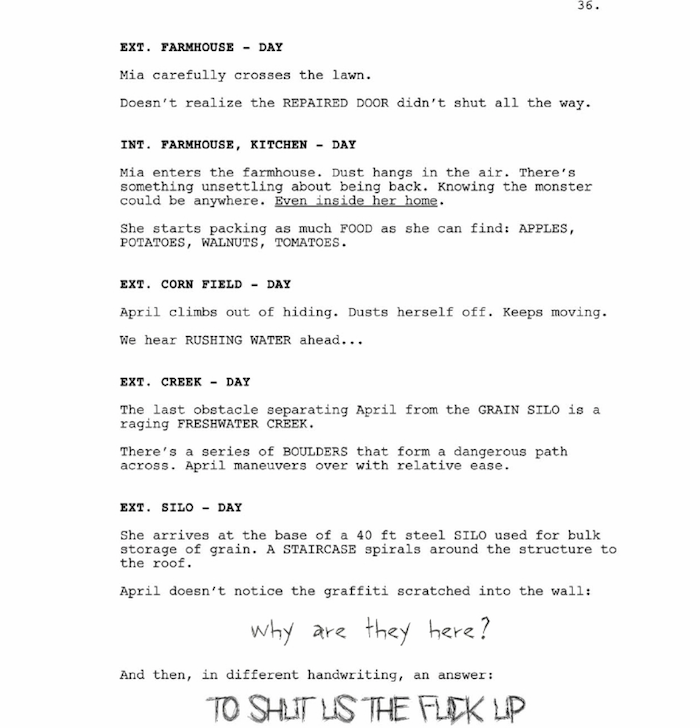
Scott Beck: We were looking at the Walter Hill and David Giler draft of Alien, and Dan Gilroy’s draft of Nightcrawler, and were just really in awe of how they were able to use words and spaces on the page to really just convey a mood, a tone, and a pace as well. That was always super important for us to crib from them.
Scott Myers: Yeah, that ‘haiku style of screenwriting, that’s what Walter Hill calls it.
Scott Beck: Exactly.
Scott Myers: As a response to people reading this script, I thought it was great that you do this because I can’t, in my mind, wrap my head around where this idea of screenwriting rules comes from. There’s no rule book, but people keep popping up. This is why these flame wars happen online on the most stupidest things.
I saw a Reddit thread and one of the commenters said, “I guess my point is, why can’t you be different? Why can’t you try doing your own thing? If a 68‑page spec horror by two relative unknowns, filled with Photoshopped pictures of buildings, buttons and Monopoly boards can get bought by Paramount, then surely anything is possible.” Do you think that’s a good lesson there for writers?
Scott Beck: Yeah, I think it certainly is. I believe the reason that we were able to forge ahead with that notion was because we had a backup plan. We knew if nobody cares about this, the two of us are so passionate about this idea that we’ll go off and make this.
Again, we wrote it for a certain degree of production where it could have been shot for 50 thousand dollars.
Of course, it wouldn’t be the exact same movie and maybe the set pieces would’ve been pulled back a little bit, but we were trying to design things on a page that we could totally foresee how those could be created on the cheap.
Bryan: I would also add to that that we were doing it for a reason. It’s funny because some of the stuff we’re doing on the page is incredibly gimmicky. That we would not be caught dead writing that way in certain other scripts.
It’s not a style that we have used in hardly anything else we’ve done, but it was true to the vision of this particular movie, which is a bizarre silent film that is, we felt, unlike anything people had seen in theaters. We just wanted to make sure that was captured on the page. It’s not necessarily something we’d do for anything.
I think you can break all the rules you want. If you have a darn good reason to do so, why not?
Scott Myers: That’s probably the safe takeaway for people. If it services the story, you can do it. If not, then it’s a gimmick. I’m a teacher and the script goes into my small category of scripts where the writers brazenly break these so‑called rules. Another one, and quite a contrast in tone, is (500) Days of Summer, where Scott Neustadter and Michael Weber said, “Screw it. Let’s go crazy and break every rule.”
In both cases what they did, what you guys did, it serviced the story. Again, as long as you’re doing that and what you write is clear to the reader, I think you can feel free to do anything you want.
Scott Beck: Exactly.
Can you include images in a script? Yes, you can. However, if this becomes a trend, it may go the way of the whole ‘breaking the fourth wall’ nausea development people began to feel when Hollywood was flooded with Shane Black wannabe scripts.
On the other hand, maybe this is the front edge of yet another stage of screenplay evolution.
We’ll just have to wait and see how this all shakes out.