Reader Question: Is any exposition scene a “crock of shit”?
“Exposition is critically important. However, poor handling of exposition can be lethal to creating drama and sustaining a story’s pace.”
“Exposition is critically important. However, poor handling of exposition can be lethal to creating drama and sustaining a story’s pace.”
A reader question via email from Lee Gabel:
I have a question about exposition in regards to the David Mamet note.
“ANY TIME ANY CHARACTER IS SAYING TO ANOTHER “AS YOU KNOW”, THAT IS, TELLING ANOTHER CHARACTER WHAT YOU, THE WRITER, NEED THE AUDIENCE TO KNOW, THE SCENE IS A CROCK OF SHIT.”
Does that mean use of exposition in any way is a “crock of shit”? I agree it goes against the “show, don’t tell” rule.
Lee is referring to the 2005 David Mamet letter that went around town — I posted on it here.
Four things. First, we have to grant a certain amount of hyperbole on Mamet’s part as he’s trying to drive home a point to a group of writers on a TV series. From the rest of his letter, it’s apparent that the “penguins” (Mamet’s assignation for TV network execs) complained about wanting more exposition and the thrust of Mamet’s entire letter is somehow work around those complaints — don’t let the bureaucrats squash good drama.
Second, I think it’s probably safe to say that it is impossible to tell a story without using exposition. In fact, exposition is critically important. However, poor handling of exposition can be lethal to creating drama and sustaining a story’s pace.
Third, exposition can also make for riveting drama. I need no further evidence than this scene in The Shawshank Redemption, the last moments between Andy and Red before Andy’s escape:
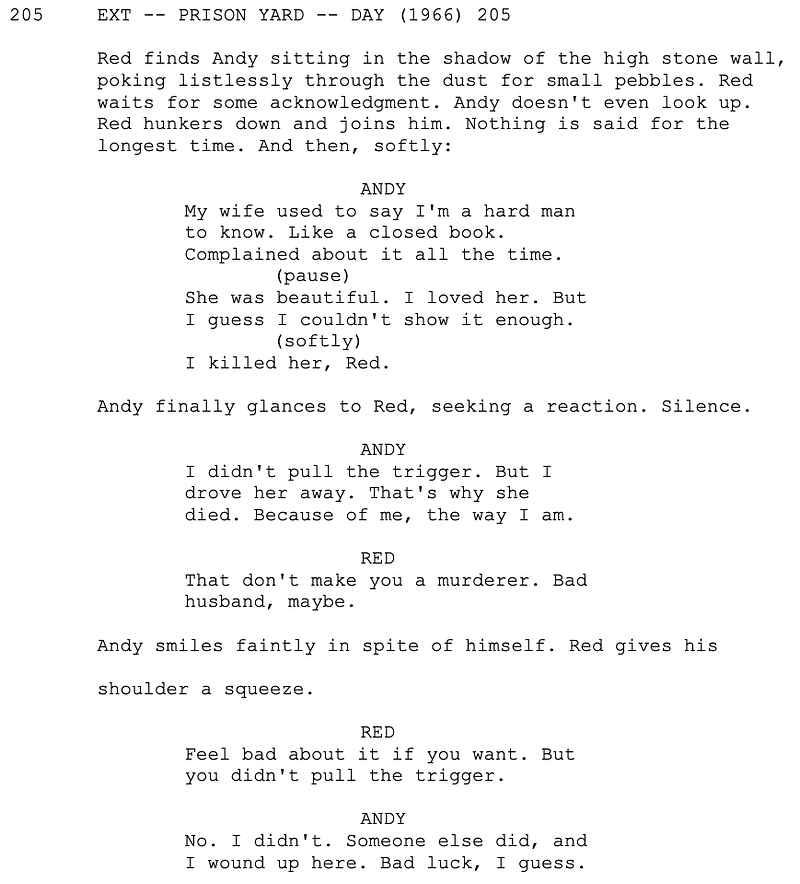
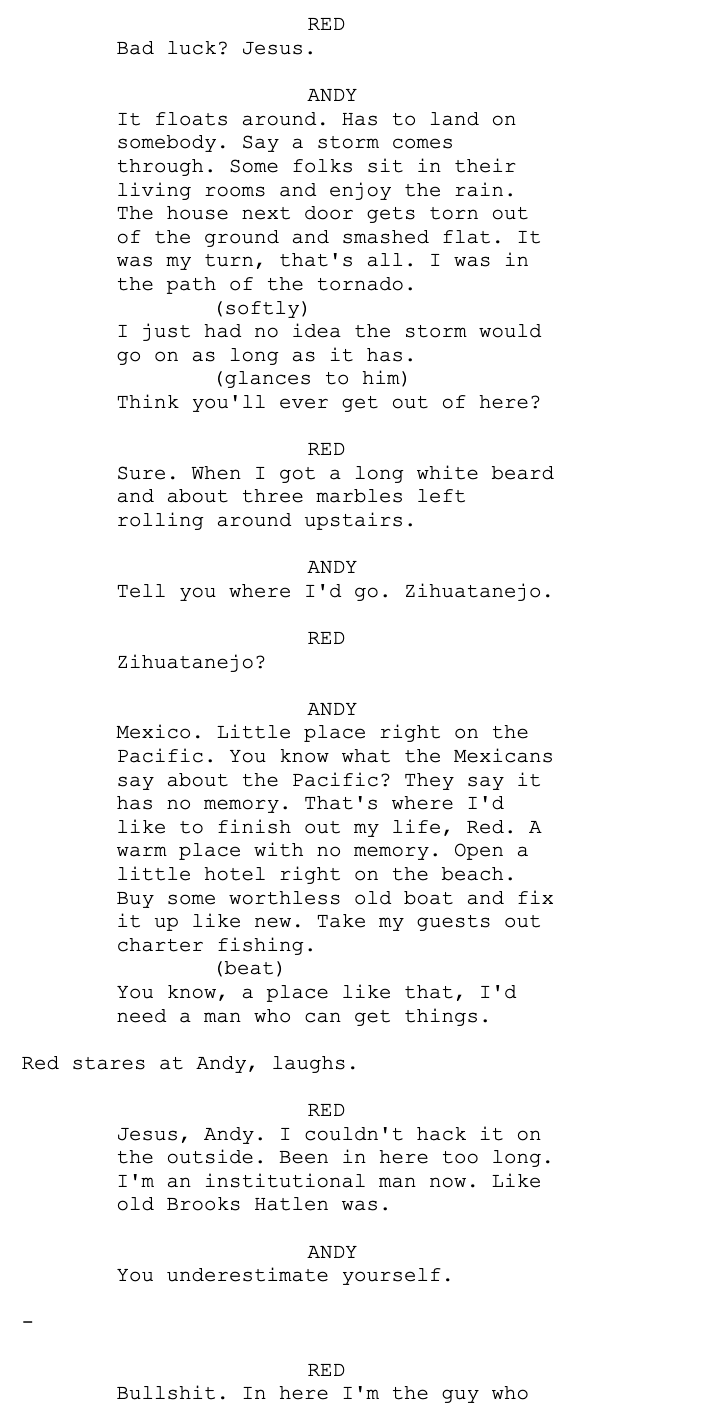
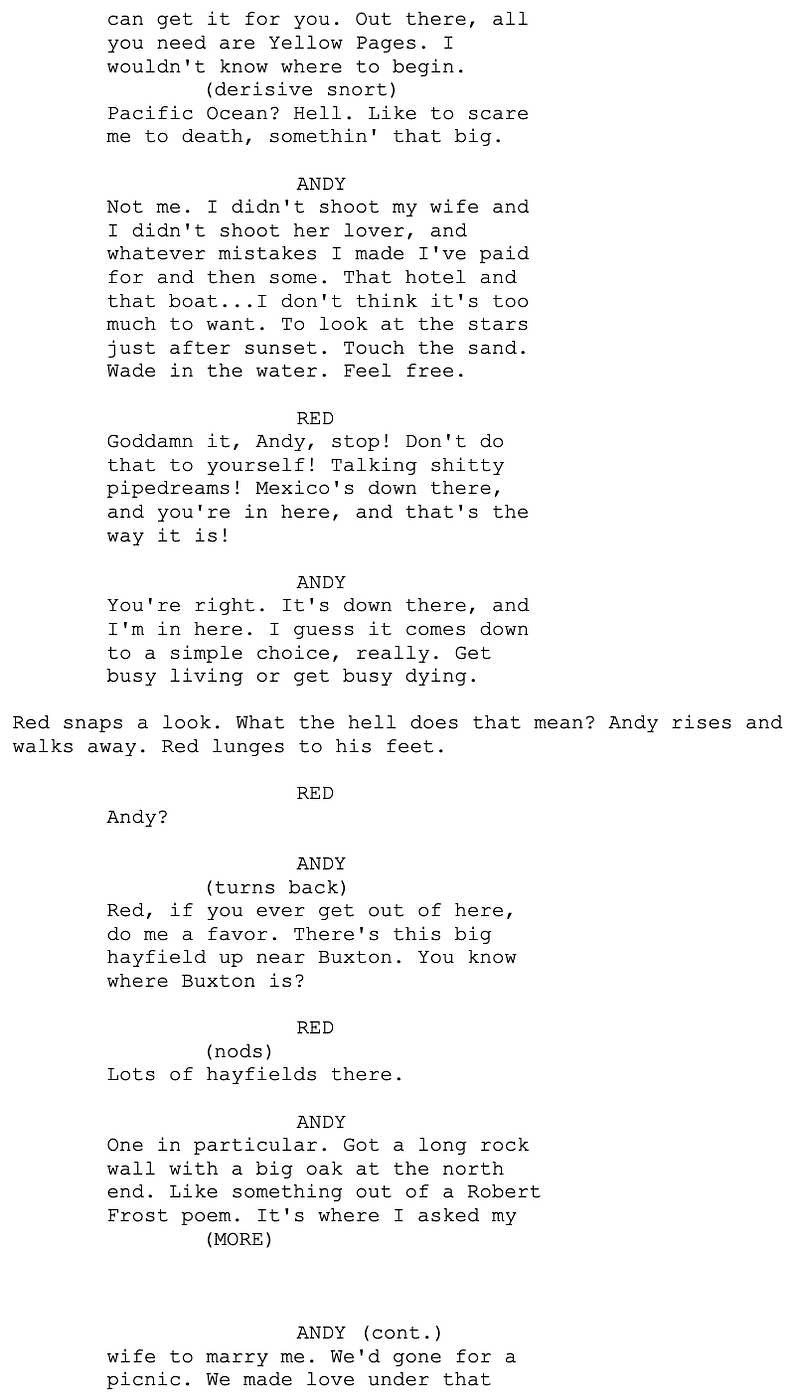
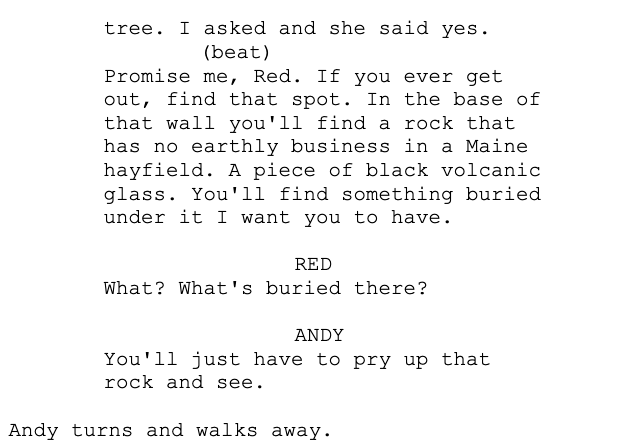

One of the cardinal rules of screenwriting I learned early on was get your exposition out of the way in Act One and avoid it as much as possible in Act Three. Yet screenwriter-director Frank Darabont literally stops the movie — right at the beginning of Act Three — for a 4+ minute scene, filled with exposition:
- Andy describes his wife
- He confesses to ‘killing’ her
- He tells Red where he’d go if he ever gets out of prison (“Zihuatanjo”)
- He talks about what the Mexicans say about the Pacific
- He tells Red how he’d buy a hotel on the beach there
- He tells Red how he get an old boat, fix it up, and do charter fishing
- He tells Red about a hayfield near Buxton
- He tells Red how he proposed to his wife after making love to her in that field
- He tells Red to go there — if he ever gets out of prison — and look for a piece of volcanic glass
- He tells Red there is something buried there he wants Red to have.
All of that is exposition. Facts, data, information. And yet it’s one of the most riveting scenes in the movie because (A) we don’t know what the hell Andy is talking about and (B) we think recent events might have sent him over the edge to insanity. So while most of the time, writing good exposition scenes is a struggle, the fact is it can be done — and done well. See how the scene plays in the movie:
Does that feel like a crock of shit? I think not! Hell, one of the most memorable scenes in movie history is ALL exposition!
Fourth, to be precise, Mamet isn’t talking about exposition per se. His focus is narrower:
“ANY TIME ANY CHARACTER IS SAYING TO ANOTHER ‘AS YOU KNOW’, THAT IS, TELLING ANOTHER CHARACTER WHAT YOU, THE WRITER, NEED THE AUDIENCE TO KNOW, THE SCENE IS A CROCK OF SHIT.”
“Telling another character what you, the writer, need the audience to know.” That isn’t so much about exposition, but rather what I call writer’s convenience. It’s when a writer has a character say or do something simply because it’s the easiest way for the writer to advance the plot. That’s not just sloppy, it demeans the character. It’s you — the writer — speaking through the character rather than the character acting of their own free will. It’s the character meeting your needs — as a writer — rather than the character meeting their needs.
And yes, more often than not, I would imagine that scene would end up being a crock of shit.
So does writing exposition necessarily result in a “crock of shit?” No. Exposition scenes may be hard to write / make dramatic, but as indicated with Shawshank and Jaws, exposition can also make for a great scene.
However, at all costs you must avoid writer’s convenience. If you’ve written a scene where you have a character doing or saying something strictly because of your need to get through the scene and move the plot forward, then rewrite that scene. As screenwriters, we can all strive do better than that.