Reader Question: How to write lean, yet not lose nuance and subtlety?
It’s all about this screenwriting mantra: Minimum words. Maximum impact.
It’s all about this screenwriting mantra: Minimum words. Maximum impact.
Via my Twitter feed (@GoIntoTheStory), a writer posed this question:
Great question. Because a screenplay is tied to a story told on screen with a built-in ticking clock, we have a limit on page count. When I began working in Hollywood as a screenwriter, the outer edge of a feature film screenplay was 120 pages. Figuring a page-a-minute, that translated to 2 hours. In today’s script development universe, it feels like 105 is the new 120, so there’s even less real estate in which to build our stories.
How to write lean, yet not lose nuance and subtlety in our storytelling? Here are some lessons I share with my undergraduate and graduate screenwriting students.
With each scene, line of scene description, or side of dialogue, screenwriters are faced with what I call The Three E’s:
- Is is Essential?
- Is it Efficient?
- Is it Entertaining?
We want to end up with writing that is entertaining, but first, we must justify why this scene, line, or side needs to exist, then make sure what we write is both as lean and effective as possible.
Which leads to a screenwriting mantra: Minimum words. Maximum impact.
Simply based on the fact that we have a limit to the page count means we must be mindful of how we use our words, particularly scene description.
Beyond that, there is an aesthetic consideration. Scripts filled with black ink are not only less pleasant to look at, they’re harder for a reader to get through. White space is more attractive to the eye, which can have a psychological effect on a reader, and can make a script a better read. I’ve known plenty of folks who work in the script development universe who have told me they hate reading scene description and often scan or eve skip big blocks of it to read the dialogue. Why? Because dialogue margins are narrower and, therefore, easier to read.
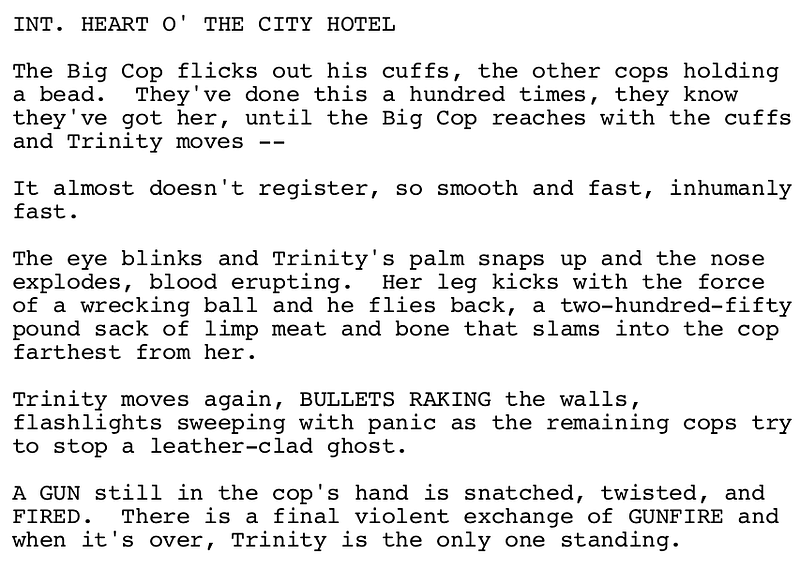
But there’s an even more important reason why we need to be choosy about the words we use: To make an impact on the reader. How do we do that? Strong verbs. Visual nouns and adjectives. Tight paragraphs. Good, lean imagematic writing. Here’s an example from the beginning of The Matrix:
17 lines and a ton of action. Average paragraph length: 3 lines. And note those descriptors: flicks, inhumanly fast, blinks, snaps, explodes, erupting, kicks, wrecking ball, flies, limp meat and bone, slams, raking, sweeping, leather-clad ghost, snatched, twisted, fired, gunfire. You could almost just read those key words and get a sense of the action.
Of course, the mantra pertains to dialogue as well. I’ve heard an anecdote about one of the first things Clint Eastwood does when he agrees to act in a movie is take a red marker and cross out half of his dialogue. Movies are primarily a visual medium. While important, creating moments where with a minimum of dialogue we let the emotion of the scene work its magic in subtext and silence is most often the preferred way to go.
I tell my students to think of screenwriting, particularly scene description, as more akin to poetry than prose. There’s a precision to poetry. Each word choice is important. When composing stage direction, use strong verbs … vivid descriptors. By all means, we need to be mindful of style. As William Goldman said: “Screenplays don’t have to read like an instruction manual for a refrigerator. You can write them as a pleasurable read.”
So yes, minimum words … ask “is this essential” … “is this efficient” … but by the time we rewrite the script and prepare to send it out into the world, we need to ensure we hit the maximum impact … and can answer the question “is this entertaining” with a resounding yes.
It’s not easy, but we can be efficient writers while crafting stories that have “subtlety and nuance.” Here is a great example: the ending set of scenes in the movie Arrival (2016), screenplay by Eric Heisserer, based on the story “Story of Your Life” written by Ted Chiang.
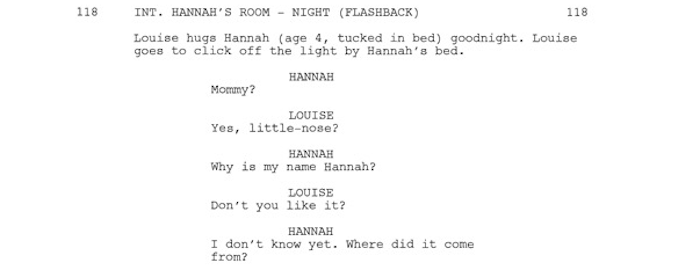
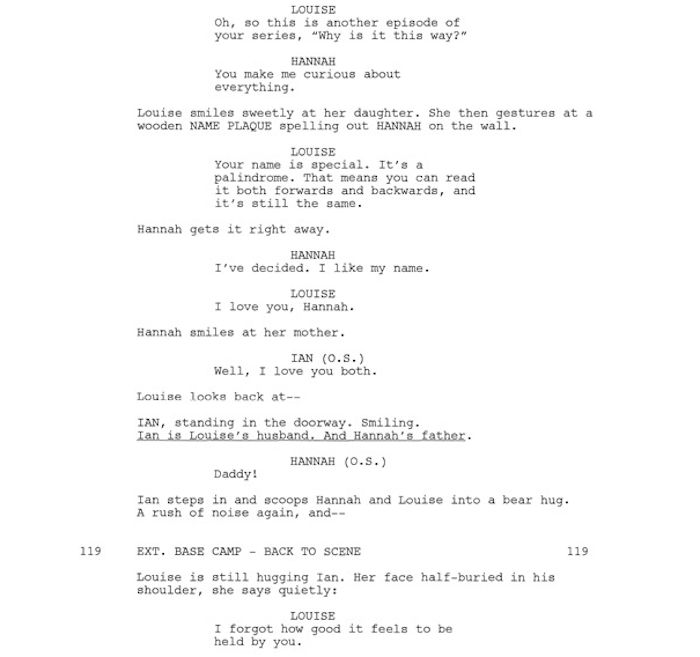

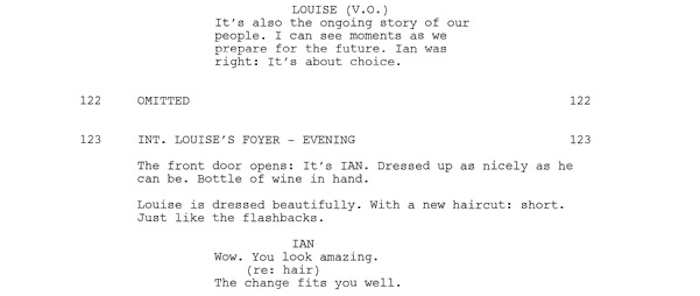
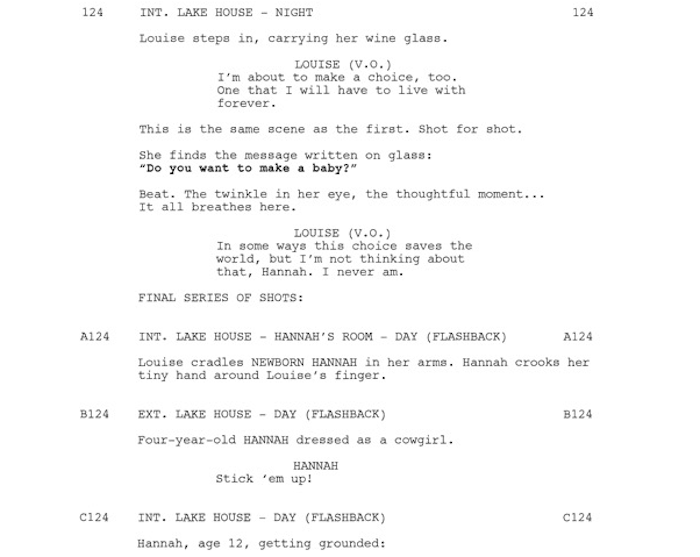
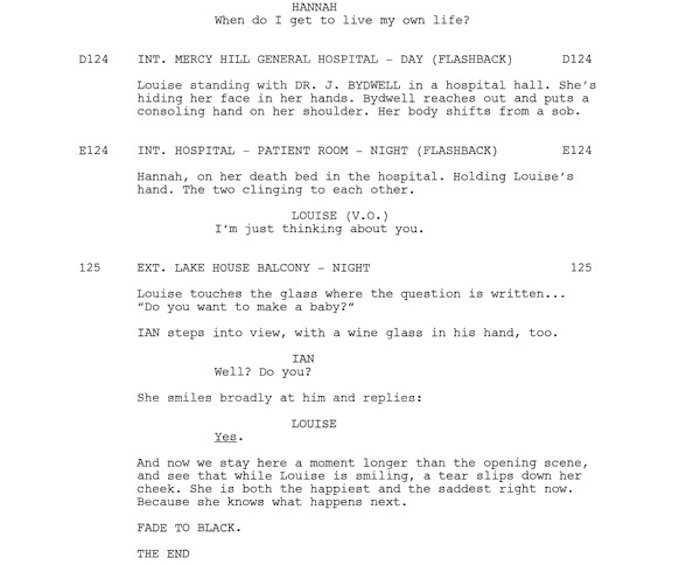
It is possible to write lean and craft stories which are subtle and nuanced. To be sure, it’s a challenge … but if you read enough great movie scripts and watch how those words are translated onto the screen …
If in your own writing you ask of each scene, line, or side … is it essential … is it efficient … is it entertaining …
If your touchstone is the mantra: Minimum words. Maximum impact …
And if you embrace the spirit of poetry with precise word choices … strong verbs … vivid descriptors … tight paragraphs …
You can do it.
For 100s more Reader Question articles, go here.