Reader Question: How to handle the passage of time in a script?
Time management can be a big concern in a screenplay.
Time management can be a big concern in a screenplay.
A question from Dan:
I’ve got a screenwriting question if you wouldn’t mind having a look. I’m an 18 year old kid writing my first script, a biopic, and trying to learn the trade while also piecing together my script I run into problems quite a bit…
One thing at the moment which I’d love to hear your knowledge on, is how to believably convey time passing without the use of title cards, and without a montage, but in a relatively small frame of time. The entertainer my script is about moves to LA at the age of 18, and has some success doing gigs there, he even lands a part on a pilot which doesn’t get picked up, but he decides within two years to return home to readjust his outlook. I’m still drawing an exact outline of where I want events to fit into place, but I’m pretty sure that his entire experience in LA (which really is only the tip of the iceberg for his career) will be almost introductory and within the first 5–10 pages.
I have some brief character stuff going on and I don’t want to cut this out because I feel it is an important part of his early career, although it may end up being so brief that it is almost useless. I’ll have to work on it.
So sorry, if you want to skip that, my question is how would I show the time passing for this character? Or in general, what are some non-hack ways of presenting a move forward in time so that it doesn’t feel like he’s performing in one instance and then we fade to black and suddenly he has a beard and is talking about leaving?
That’s a good question. As any GITS reader knows who’s had to deal with time shifts in a script, it’s a tricky business because you are requiring the reader to jump from this time period to that time period. That may not seem like a big deal, but if you’ve worked super hard to lure a reader into your story universe, any time jump can cause them to blink — Wait a sec, what’s happening — and if they blink long enough, they can fall out of the story.
The actual pragmatics of it are easy enough. Let’s say you start your script with this establishing scene:

Then you set up your character where they begin the story. After that sequence, you shift the action to L.A. some years later. All you would have to do is this:

And there you go — you’ve made your time-jump.
But it’s not enough to simply make the time-jump, you need to handle it for what it really is: a transition. And as I say, it’s tricky to do that in a “non hack way.”
One approach is to use a narrator. For example, that’s how writer-director Frank Darabont handled the many time-jumps he had to make in The Shawshank Redemption. Here is the first big one in the script:


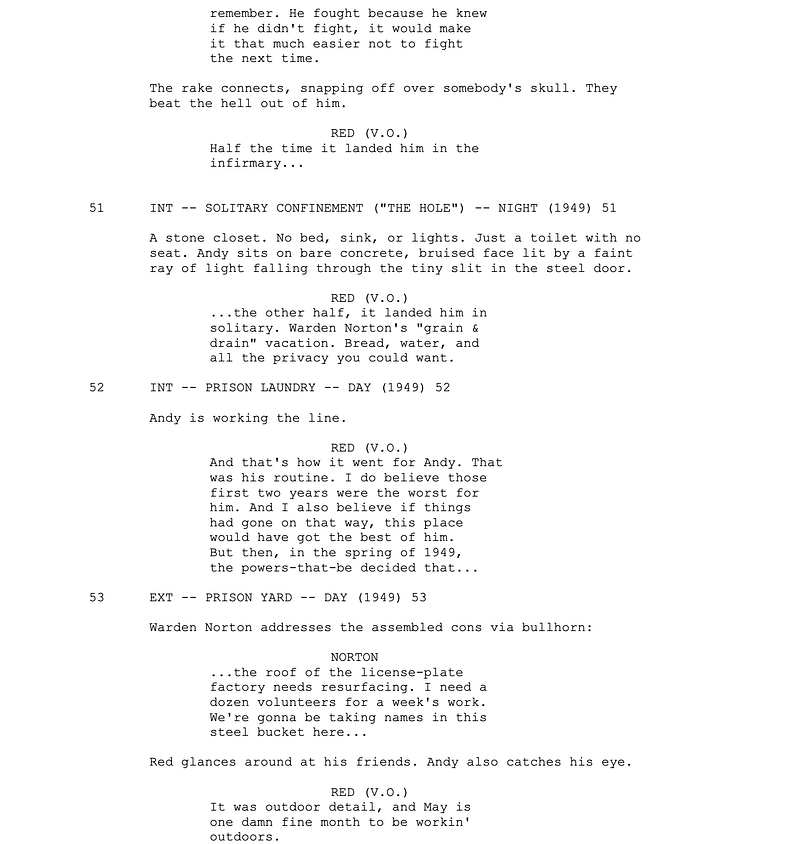
Two things. First, voice-over narration is frowned upon in Hollywood. I think it’s because there is a belief that using a narrator is somehow an example of sloppy writing. Certainly that can be the case, but as movies like Shawshank, Forrest Gump, and Sunset Blvd. prove, narrator V.O. can also be used to excellent effect.
Second, you’ll notice that Darabont uses a montage. That’s another time-jumping device that can be used poorly — probably the reason you included it in your question as an example of something you would prefer not using. But as this excerpt from Shawshank demonstrates, a montage can also be used quite effectively as an approach to transitions. If we look at this excerpt closely, I’d say there are at least three keys to a good montage:
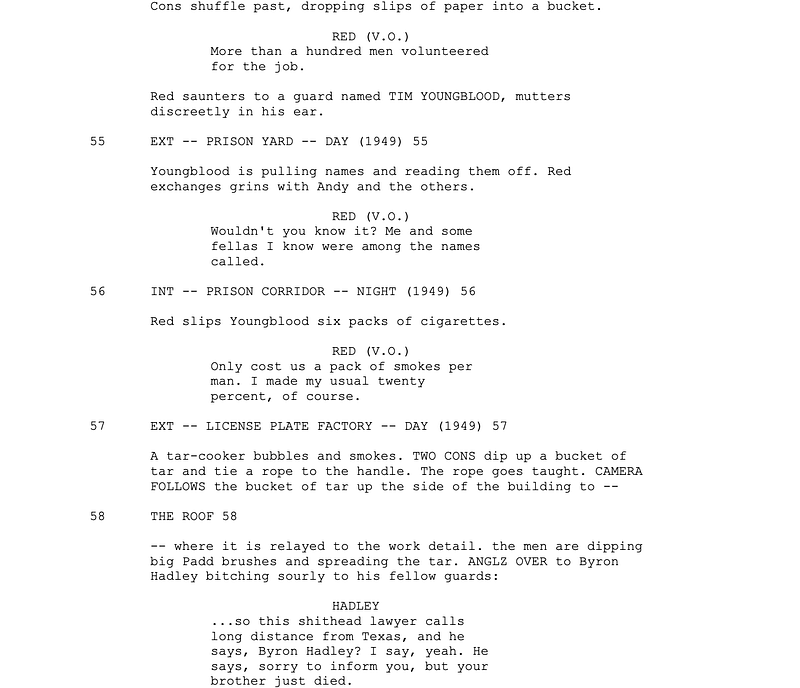
The montage offers a seamless transition into the next scene — the memorable “Suds on the Roof” business where Andy helps out Hadley with his financial dilemma, which turns out to be a huge turning point in Andy — and Red’s — life in Shawshank.
Another way to handle time-jumps is to position the story in such a way that a key character is looking back on their life. Forrest Gump does this as well as movies like Little Big Man. This allows you the possibility of telling a story in a linear fashion (like Gump and Big Man), or you can jump around and tell the story in a non-linear fashion. But by approaching the story like this, you’ll be using flashbacks and that is another narrative device that is looked upon with disfavor per Hwood’s conventional wisdom.
But if you’re just looking for ways to smooth over transitions, here are a couple of tricks.
- Visual-to-visual transition: Use a visual image to link the preceding and following sequence. For example, consider this transition from the Elliot & Rossio script for Pirates of the Caribbean: The Curse of the Black Pearl, from the opening sequence where Elizabeth, as a young girl, first meets a young Will Turner:
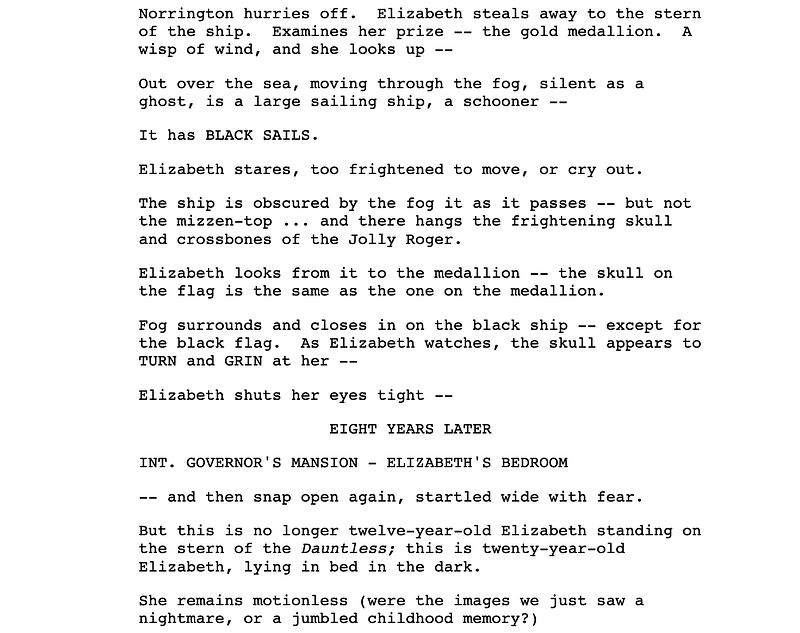
The visual link is Elizabeth’s eyes.
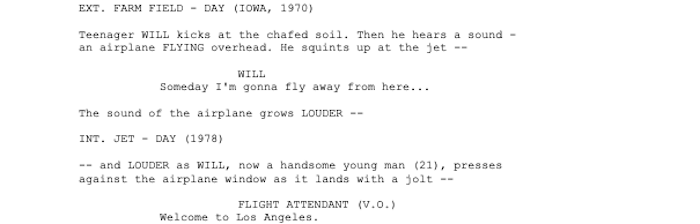
- Audio-to-audio transition: In the same way, you can use a sound to provide a link between a preceding and following sequence. The classic example, which I’m sure you’ve seen 10,000 times in TV shows and movies is an airplane:
While those can help smooth transitions, they really are filigree. The keys are as noted above. And I would say the single most important thing is to pull the reader into the ending of the preceding sequence, making them curious about what’s going to happen next, then push them into the beginning of the following sequence, depositing them smack in the middle of the action so that they don’t have time to dawdle or think — just keep them moving.
For 100s more Reader Questions, go here.