Reader Question: How to create genuinely unique character voices?
As opposed to the characters all sounding alike… or like the writer.

As opposed to the characters all sounding alike… or like the writer.
A question from Atlanta:
Hello Scott! As ever, thank you so much for your wonderful blog, it is my respite and delight several times each day. My question: Do you have any tips and insights into creating genuinely unique character voices (vs them all sounding kinda alike, and kinda like me). Thank you!!
I’m not sure there’s any clear path to learning how to write good dialogue (and I would include your specific concern — distinctive character voices — as one aspect of what good dialogue is). Some students I have write great dialogue, whereas others struggle. The same with scripts I read — some writers strong with dialogue, others not so much. That leads me to believe that there are writers who are either born with or develop through their life-experience a good ‘ear’ for dialogue. Fortunately there are things we can do and be aware of to help us write better dialogue.
The single biggest key: Dig into each character. You really ought to know them on an intimate level. I remember reading an interview with one of my favorite contemporary playwrights August Wilson where he was asked how he wrote such great dialogue. His response? “I just write down what the characters say.” I doubt a writer can get to that point where a character ‘talks’ to them unless the writer has immersed themselves in that character’s personal experience.
But per the distinctive qualities of each character’s voice, rather than randomly assigning this verbal tic to this character, and that vocal style to that character, I think a better approach is to dig into the character so that you get a grasp of their own unique individuality, then let that inform you how they talk. And this may be yet another area where thinking in terms of primary character archetypes — Protagonist, Nemesis, Attractor, Mentor, Trickster — may help.
By zeroing in on each character’s core essence, revealing what their fundamental narrative function is, that should help you to ‘hear’ how they sound:
- For example, a milquetoast Protagonist may start out talking one way, then their dialogue might evolve as they tap into their inner strength and power, assuming a hero’s role.
- You have a million different types of Nemesis characters at your disposal, but the fact that they are opposing the Protagonist will likely have an impact on how they present themselves through their dialogue.
- An Attractor character is tied to the Protagonist’s emotional development, so again while you can develop and shade the Attractor in any number of ways, there may very well be an emotional dynamic to the way they talk.
- Same, too, with a Mentor typically connected to the Protagonist’s intellectual growth; they can take a myriad shapes as personalities, but you would do well to think how their role as a wisdom character might impact their dialogue.
- Finally, a Trickster tests the Protagonist, sometimes an ally, sometimes an enemy. Wouldn’t that shapeshifting dynamic emerge in their dialogue?
So two big things: Get to know your characters so well that they ‘talk’ to you, and shape their way with words per their archetype function in the story. How about some general tips re writing good dialogue?
- Listen. When you’re out and about in social settings, make it a point to listen to how people around you are talking. Sometimes I’ll close my eyes, hear conversation, then ‘type’ up those words as sides of dialogue in my mind. Another exercise: Get a DVD of a movie, push play, then turn your chair around, and listen to the movie. Pay attention to the pace, mood, style of each character.
- Read. When you finish a scene or a script, read it aloud (this will help you with both dialogue and scene description). How does each side of dialogue sound to your ear? Are the lines easy to read or are they laborious? If the latter, then you will want to do some editing. Another thing you can do: read all of one character’s dialogue, each side back to back to back. That’s a really helpful way to see if there are some unique vocal patterns or verbal tics.
- Edit. In general, most dialogue suffers from saying too much with too many words. You almost always benefit from trimming sides.
- Subtext. Perhaps the single most important thing you can do. What’s more interesting: A character who says, “I hate you” and that’s precisely what they mean, or a character who says, “I love you,” but they mean precisely the opposite? Sometimes we want a character to say exactly what they mean, but most of the time, it’s more compelling to use subtext in dialogue. It keeps a reader on their toes as they have to peel away layers of potential meaning, almost as if trying to solve a mystery.
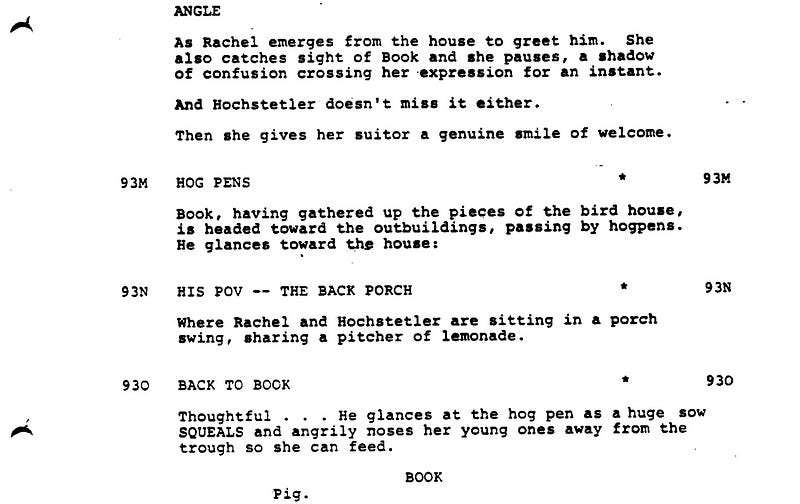
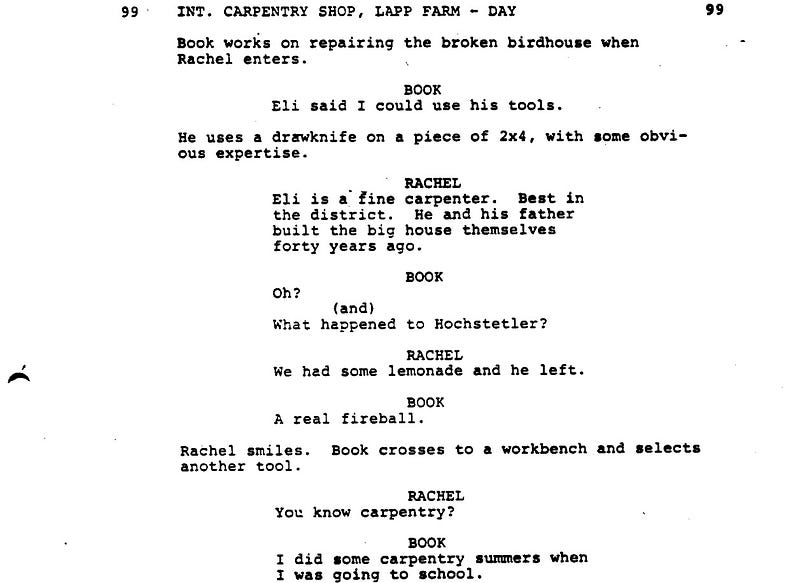
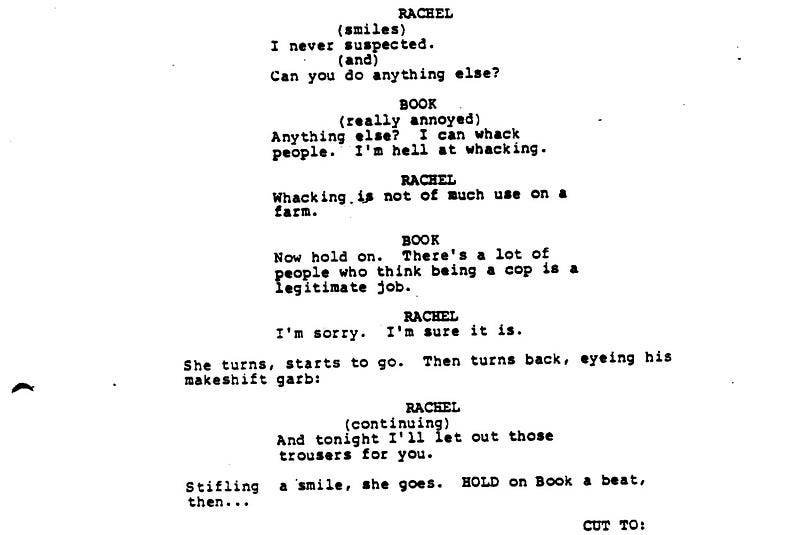
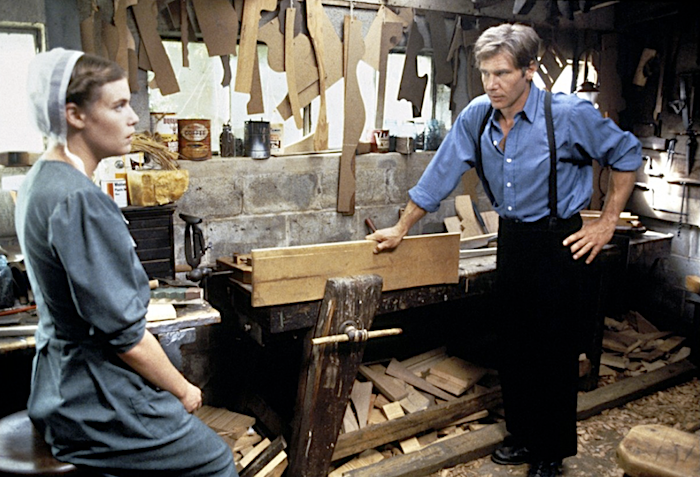
With these in mind, let’s explore this scene from 1985 movie Witness:
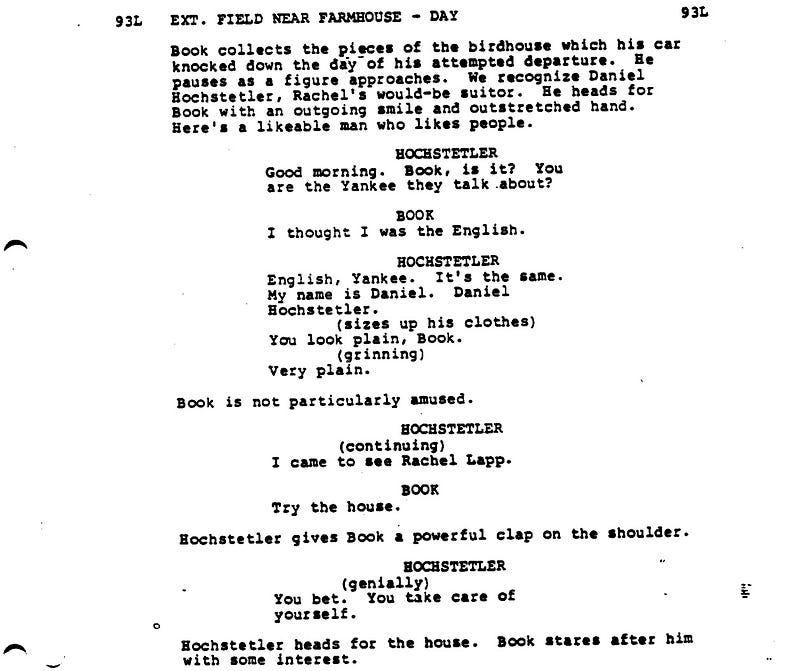
“You look plain, Book. Very plain.” Is that an actual compliment per Amish standards of dress? Or a way for Hochstetler to put down Book?
“A real fireball.” Just a joke by Book? Or a wry comment on the guy — and potential rival suitor?
“I can whack people. I’m hell at whacking.” This is a callback from a sharp exchange between Rachel and Book after she witnessed him roughing up a potential witness to the crime. Is he deriding Rachel or just having a bit of fun at his own expense?
“What else can you do… Tonight I’ll let out those trousers for you.” Could be innocuous comments. Or are they hinting at sexual curiosity by Rachel about Book? In the movie, that subtext is definitely there because when Book drains the tall glass of lemonade in one big gulp, this act of virility clearly grabs Rachel’s attention.
But let me reiterate my main point: Dig into your characters. The more you know them, the better the chance they will come ‘alive’ and, like August Wilson said, “Tell you what to say.”
For more Go Into The Story Reader Question posts, go here.
Starting March 12th, I will be teaching a one-week online class focusing on writing dialogue. For more information, go here.