Reader Question: Do Nemesis characters necessarily HAVE to suffer in the end?
Are there stories which can work without the Antagonist getting their comeuppance?
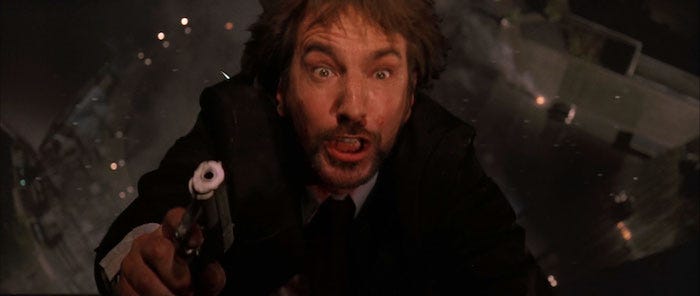
Are there stories which can work without the Antagonist getting their comeuppance?
Reader question via email from Darren McLeod:
Hey Scott,
I’m currently having a bit of a problem with my ending. As it currently stands, the protagonist solves his problem and everything works out for him in the end. However, nothing bad comes of the bad guys who were plotting against him.
My rationale for this is twofold: 1) the protagonist is not the type of guy who would believe in revenge or be clever enough to achieve it, 2) the bad guys are cops who were doing what they were commanded to do by a superior (that the protagonist is unaware of, and therefore couldn’t really get revenge on).
Even with that rationale, though, it seems weird to me that the bad guys get off so easy without actually learning a lesson. Can this happen in a movie, or do the bad guys need to suffer for the audience to be satisfied?
So Darren, if I’m reading you correctly, your story’s Nemesis characters — those who oppose the efforts of the Protagonist and serve as a threat to the P — are actually not ‘bad guys,’ just doing their jobs; indeed it appears they think the Protagonist is a bad guy, yes?
In theory, that can work. Perhaps you go the other route and have the Nemesis characters end up siding with the Protagonist. Do you remember the guys who came to arrest George Bailey in It’s A Wonderful Life? Eventually they tear up the warrant and join in singing with the rest of Bedford Falls revelers as George’s good news piles up:
In fact, the movie’s primary Nemesis Mr. Potter doesn’t suffer anything at the end, rather the story’s conclusion focuses solely on all the good stuff that happens to George. Therefore based on It’s A Wonderful Life alone, we can answer the question — “Is it mandatory for a Nemesis character to suffer at the end?” — with a resounding “No!”
But — and this is a big but — the more a Nemesis character tilts toward being a genuinely ‘bad’ individual, the more the need for some sort of consequence. I suppose it’s almost like a mathematical formula:
a x b = c
a = Nemesis
b = how bad they are
c = how much of a consequence they need to suffer
The worse they are in the ‘bad’ department, the greater the consequence. The rationale behind that is pretty simple: the more bad-ass a Nemesis is, the more negative emotion gets generated toward the Nemesis on the part of a script reader. And at the end of the script, the reader has to have a place to focus that negative emotion and, in a sense, resolve that psychological tension.
Let’s take The Silence of the Lambs. The Nemesis is Jamie Gumb (aka Buffalo Bill). He is a serial killer. He has kidnapped poor Catherine Martin. He is skinning his victims to sew together a female body suit. And in the Final Struggle, he pulls a gun on the Protagonist Clarice Starling with the intent of killing her.
In other words, he’s really bad guy.
So how satisfactory would it have been for a script reader or moviegoer to have a Final Struggle where Clarice simply arrests Buffalo Bill?
No, movie logic dictates Clarice must blow him away:
Another classic example is the 1987 hit movie Fatal Attraction. Per Wikipedia:
Alex Forrest [Glenn Close — Nemesis] was originally scripted to commit suicide at the end of the movie by slashing her throat. Her plan was to make it look as if Dan [Michael Douglas — Protagonist] had murdered her, for which he would be arrested. Although Beth [Anne Archer] saves the day by finding a revealing tape that Alex had sent Dan and taking it to police, test audiences did not respond well.
This resulted in a three-week reshoot for the action-filled sequence in the bathroom and Alex’s death by gunshot. Her shooting by Beth juxtaposes the two characters, with Alex becoming the victim and Beth taking violent action to protect her family.
In the 2002 Special Edition DVD, Close comments that she had concerns re-shooting the movie’s ending because she believed, and was backed by psychiatrists, that the character would “self-destruct and commit suicide.” She gave in on her concerns, however, and recorded the new sequence after having fought against the change for two weeks. The movie was initially released in Japan with the original ending. The original ending first appeared on a special edition VHS and LaserDisc release by Paramount in 1992, and was included on the film’s DVD release a decade later.
On the one hand, Dan definitely has some culpability in the situation because he willingly had an affair with Alex. But Alex goes totally stalker to the point where she’s threatening Dan and Beth’s children, even boiling the family’s pet rabbit in their own kitchen.
Bad, very bad.
Which is more than likely why test audiences “did not respond well” to the original ending — when Alex commits suicide. No, they wanted to see some sort of vengeance meted out toward her character — they wanted her to suffer. Perfect choice for Beth to do it because Dan is, as noted, partially culpable for the situation and Beth is an innocent protecting her family.
Indeed a March 11, 1992 appearance on the CBS show “This Morning”, Michael Douglas said this:
“The picture was wonderful, but there was a problem with the ending. It didn’t build up. No one quite anticipated how much you [the moviegoer] would hate this woman after she went after your family. So the original ending where she takes her own life, you [the moviegoer] were left unfulfilled.”
Here is the original ending:
After Close and Archer discuss their misgivings about the new ending, Douglas — who started off as a movie producer (One Flew Over the Cuckoo’s Nest) — nails the point again:
“It did affect her role [Alex], she’s right, her character. But… sometimes your character has to work for what’s best for the film.”
In other words, what works best for the moviegoer — in this case, an ending that provided a sequence of events that allowed them to release their “hate” for Alex’s character.
While your story, Darren, may work where the Nemesis avoids suffering, to the degree that you work on stories in the future where you do have a really nefarious Nemesis, then you will almost assuredly need to provide an ending where that character experiences some significant consequences in order to satisfy the need the script reader / moviegoer will have to resolve their negative energy toward the Nemesis.
Here is an interview with Glenn Close and Michael Douglas discussing Fatal Attraction years later including a discussion about the ending:
For more articles in the Go Into The Story Reader Question series, go here.