Reader Question: Do I HAVE to use INT/EXT — LOCATION — DAY/NIGHT in scene headings?
Wherein we consider selling scripts, shooting scripts, conventional wisdom, and writing whatever the hell we want.

Wherein we consider selling scripts, shooting scripts, conventional wisdom, and writing whatever the hell we want.
This question arose from an interview I did in 2016 with screenwriter Andrew Friehof: “Do I have to use INT./EXT. — LOCATION — DAY/NIGHT in scene headings?
To answer this question, let’s distinguish between a selling script and a shooting script. The latter, also known as a production draft, needs INT. and EXT. and LOCATION and DAY and NIGHT. Why? Because the team of people involved in producing the movie require that information to do their jobs.
They need it for location scouting.
They need it for budgeting.
They need it for scheduling.
They need it for the production designer.
They need it for the art department.
They just need it, okay?
But a shooting script is a different creature than a selling script. When you write a spec script or a script on assignment, your most fundamental goal is this: Entertain the reader.
That reader can be a studio executive, producer, director, actor, or even a lowly intern or assistant. Whoever it is, you want to grab their attention and keep it from FADE IN to FADE OUT.
While your plot, characters, dialogue, scenes, themes, and so on are all important, there’s another aspect you need to pay attention to and that is this: READABILITY.
You want your spec / selling script to be a good read.
What has evolved with screenplays over the last half-century, as the spec script market has grown into its own and scripts have become more than just blueprints to make a movie, is a transformation of style and form away from directing lingo and ‘scripty’ language to a more literary approach to telling a story.
Again, we are talking about selling scripts.
With that as my preamble, the answer to your question is this: No, you do not need to use the nomenclature of scene headings.
Consider the script “Great Falls” written by Andy Friedhof, the subject of my interview with him which led to the question. From my interview, here is what Andy said about his stylistic approach:
What I really want to do with my scripts is take people through the experience of watching the movie. You might have noticed that I often start scenes with close ups on objects or specific details in the scene. That’s how films are shot, basically. When a film is edited together they generally don’t start scenes with wide shots of the interior of a room. So it doesn’t really make much sense to start every scene with some variation on INT. ROOM — DAY. For me, it’s really important to capture the energy, movement and spirit of film.
There are quite a few screenwriters who do that already. Those are the screenwriters I admire and those are the screenwriters I’m always excited to read. I want people to look forward to reading the scripts I write.
Here is P. 1 of “Great Falls”:
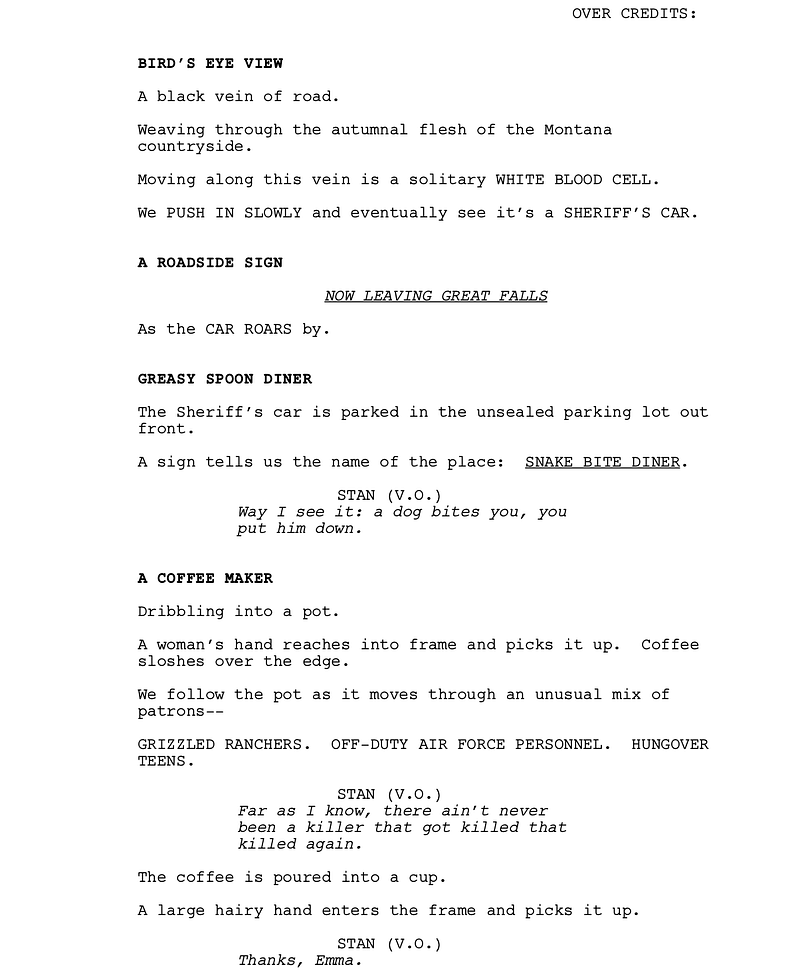
Nary a scene heading in sight. Nor any other page of Andy’s script. I can hear the Script Literalists out there gnashing their teeth. But here’s the thing…
Andy’s script won him a 2015 Nicholl Fellowship in Screenwriting Award.
What’s more, Andy’s pages are imminently clear as to their intent. Indeed, I would argue they create more of a visual tapestry in the mind of the reader than the more formulaic and staid INT. DINER — DAY.
Therefore, who are we going to listen to: Some format and style ‘guru’ insisting we stick to some supposed ‘rule’ which derives from a time when screenplays were the bastard child of shot lists, stage plays, and production drafts or a talented award winning writer who is embracing the trend to evolve screenplays into a more literary READABLE form?
Look, you can write however and whatever you want. You are free to do that. Whatever you do, do it in service of your story. As long as what you write presents what you see in your head as efficiently and effectively as possible — and let’s throw in another E word: Entertaining — then tell your story the way you SEE it.
When you sell it and start working with a director, then you can worry about slug lines.
But when you write a spec script, do what best conveys your story.
For more articles in the Go Into The Story Reader Question series, go here.