Reader Question: Are there movies where the Protagonist is the Nemesis?
Is it possible for the Protagonist to also be the story’s Nemesis? A deep dive into Fight Club, The Shawshank Redemption, and Carl Jung.
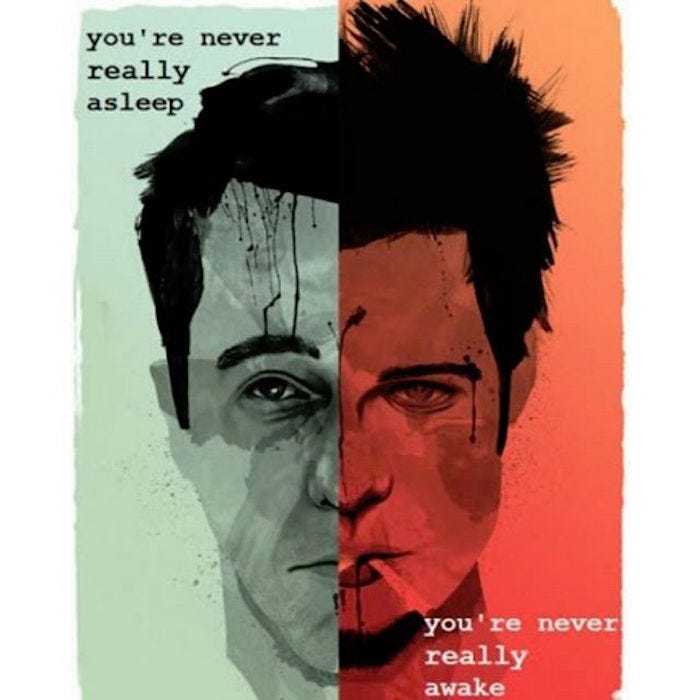
Is it possible for the Protagonist to also be the story’s Nemesis? A deep dive into Fight Club, The Shawshank Redemption, and Carl Jung.
Question via email from Shawn Larkin:
In “Fight Club,” I’m pretty sure Tyler Durden is the Nemesis to the Nameless Narrator / Protagonist (Edward Norton). Having these two guys be essentially a “split personality” of one guy makes for a clever device to have the Protagonist also be the Nemesis.
However, are there films where the Protagonist is the Nemesis? Any films where the Protagonist is his / her “own worst enemy?” I’m thinking these are films about the “interior” life of someone or someone who must overcome their own personality and therefore, there is not External Device or Person used as the Nemesis.
In movies where the Protagonist goes through a transformation process — and that extends to most mainstream Hollywood films — generally you’ll find a specific Nemesis who acts in opposition to the Protagonist and their goal. For example, in The Shawshank Redmeption, one of the Protagonists Andy has the goal of getting out of prison. Arguably, therefore, his Nemesis is Warden Norton who assassinates Tommy, thereby ending any hopes that Andy can use Tommy’s statement to have his (Andy’s) conviction overturned.
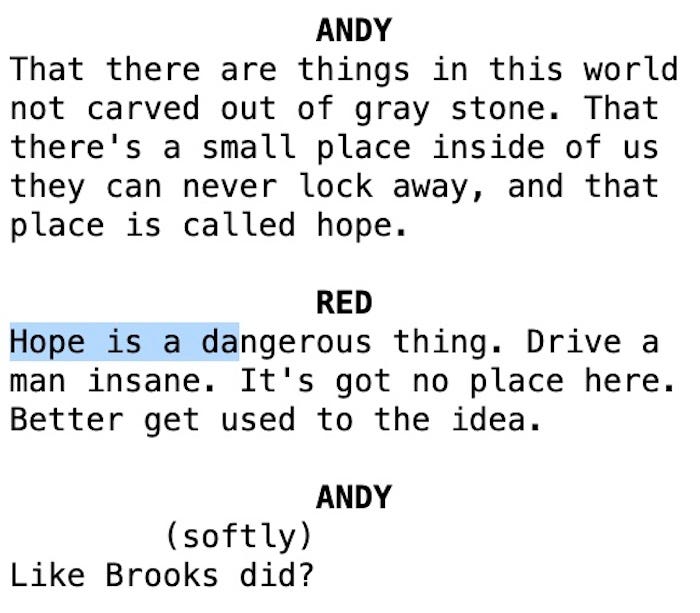
But if you look at the story’s other Protagonist Red , who or rather what is his Nemesis? The key, I think, is the scene after the prisoners have heard about Brooks committing suicide:


In my view, Red’s Nemesis is the effects institutionalization have had on him. It has worn him down to the point where he has almost given up hope:
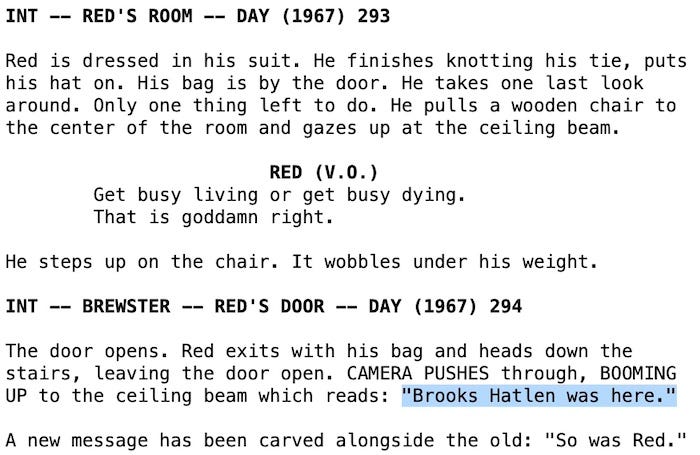
Red comes face-to-face with his Nemesis, literally confronting the very same choice Brooks had:

So in the battle for Red’s soul — hope wins out over the Nemesis of institutionalization:
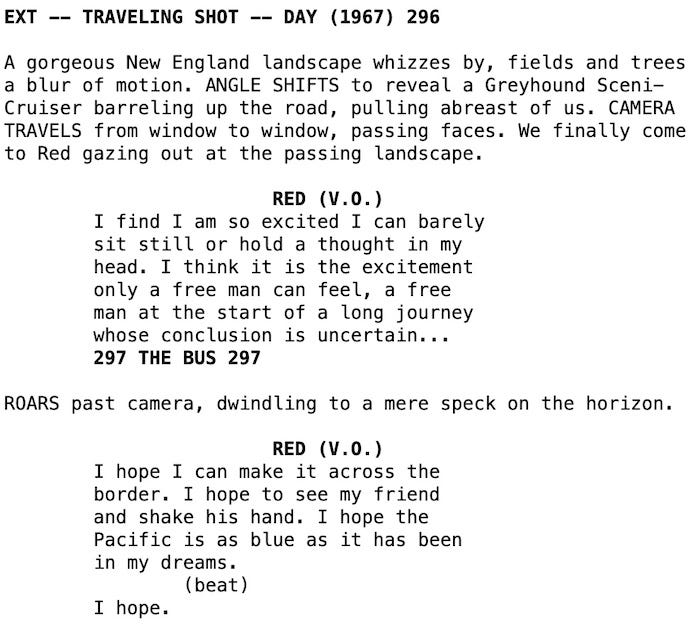
In the tradition of “being your own worst enemy,” Red had to confront the Nemesis within, which I would argue he experienced as institutionalization. But is that the same thing as a Protagonist being a Nemesis?
While I suppose it is possible to have a story where the Protagonist is the Nemesis, I would humbly suggest that for 99.9% of screenplays, that would — even should — not be the case.
Why?
First, movie studios like Nemesis characters. “A worthy foe” they often call it. It’s the easiest way to set up and sustain conflict — Protagonist vs. Nemesis — and even if a studio exec doesn’t understand story all that well, they do know that conflict is critical in creating drama.
Second, oftentimes the Nemesis character is at least as interesting a character as the Protagonist which — again thinking per movie studios — is great because that’s a role they can cast with a name actor who can provide lots of heat on screen and lots of fireworks with the Protagonist.
But the third reason is more about the psychology of stories. Per Carl Jung and the idea of the shadow:
It is a frightening thought that man also has a shadow side to him, consisting not just of little weaknesses- and foibles, but of a positively demonic dynamism. The individual seldom knows anything of this; to him, as an individual, it is incredible that he should ever in any circumstances go beyond himself. But let these harmless creatures form a mass, and there emerges a raging monster; and each individual is only one tiny cell in the monster’s body, so that for better or worse he must accompany it on its bloody rampages and even assist it to the utmost. Having a dark suspicion of these grim possibilities, man turns a blind eye to the shadow-side of human nature. Blindly he strives against the salutary dogma of original sin, which is yet so prodigiously true. Yes, he even hesitates to admit the conflict of which he is so painfully aware.
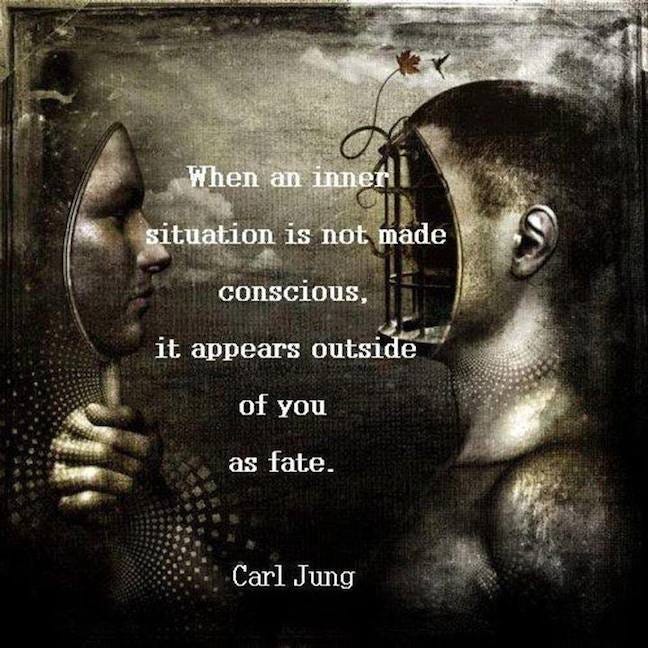
If you subscribe to the idea that each of us has a shadow, an aspect of our psyche where we keep repressed feelings, thoughts, impulses, then you have right there the dynamic of Protagonist as their own Nemesis. The Apostle Paul expressed that dynamic this way:
I don’t really understand myself, for I want to do what is right, but I don’t do it. Instead, I do what I hate.
And that’s all great except for one thing as it pertains to movies — the conflict is all internal! That’s why movies typically physicalize a Protagonist’s shadow in the form of the Nemesis. For example, look at how the Judge describes Andy in the opening sequence of The Shawshank Redemption:

Doesn’t that sound like an apt description of Warden Norton? And here the day before Andy escapes, he makes this confession to Red:


He acknowledges that at the time of his marriage’s break-up, when his wife took a lover, Andy — likely due to his coldness — “I guess I couldn’t show it enough” — drove her away. So in order to achieve any sense of ‘unity’ (per Jung), Andy had to confront that “icy and remorseless” aspect of his psyche, his shadow self — and psychologically that narrative function is provided by Warden Norton.
Likewise Red had to confront his shadow — and while much of that process is internal, the story lets us in on that business in three ways: (1) Through the effect Andy has on Red. (2) Through Red’s V.O. in which he shares what’s going on ‘inside.’ (3) Through Brooks, who represents Red’s ‘dark’ Mentor, providing a literal path to self-destruction so that Red knows precisely where that option leads. In his suicide, Brooks wears the mask of the ‘nemesis,’ tempting Red to the same fate. But because of Andy’s Mentor advice — “Get busy living, or get busy dying” — Red chooses hope over the effects of institutionalization.
Fight Club is a perfect example of a projection of the Protagonist’s shadow because that’s precisely what Tyler Durden is to the Protagonist, a fact we learn to be true at the very end of the movie. So the question I pose here for discussion is what psychological aspects of the Protagonist’s psyche Durden represents. Obviously the P felt restricted, even imprisoned in his own well-organized life (in Act One) and part of his shadow is about the need to explode normality, be free, and release pent-up anger. What else?
Sorry for the lengthy and serpentine answer, but my main points are two: (1) Think about the Nemesis in your stories as projections / physicalizations of your Protagonist’s shadow. (2) If you’re trying to write a spec script to sell as a mainstream, commercial movie, almost assuredly you’re better off with a real individual Nemesis rather than some sort of internal Protagonist process.
For more articles in the Go Into The Story Reader Question series, go here.