QA: Chris Jones
The driving force behind The Impact, a feature film which was written by 50 screenwriters and 36 directors.
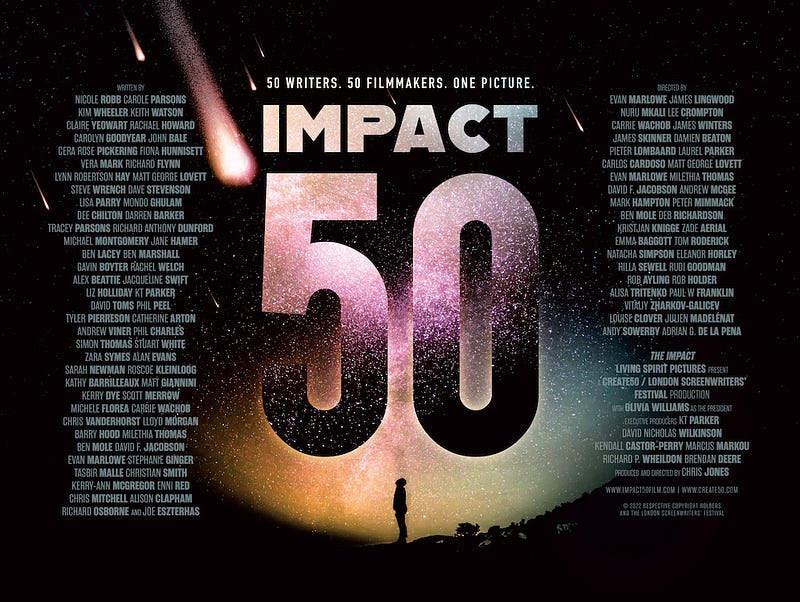
The driving force behind The Impact, a feature film which was written by 50 screenwriters and 36 directors.
An asteroid, sixteen miles across, will impact the Atlantic Ocean in exactly ninety seven minutes. Nothing will survive. It will destroy all life… all life on Earth.
This is how a new audacious movie The Impact begins, the words of the President of the United States addressing a television audience. And thus begins a sprawling saga that not only spans the planet in terms of its various storylines, but also the creators who made the film.
The result: A two-plus hour feature film which will see its world premiere on May 31 at the Genesis Cinema in London.
Background
The Impact is a crowd-created feature film with multiple stories connected by one thing — a meteor strike.
The film opens with the President of America (Olivia Williams) giving a televised speech to the world (written by Joe Eszterhas (Basic Instinct) where she sets out the premise of the movie… Nothing will survive.
The movie poses the question: what would you do if you knew that you only had two hours to live? This question was answered by thousands of screenwriters who wrote short scripts that were filmed and edited together to create The Impact.
The person who spearheaded this project is Chris Jones.

I have known Chris for several years now through his role as the Creative Director at the London Screenwriters’ Festival. I reached out to Chris to learn more about this project. Here is my Q&A with Chris.
Scott: Chris, congratulations on this amazing achievement. I’d like to start off with some numbers.
- 2,800: That’s how many short film scripts were submitted from around the world
- 1,500: That’s how many new entrant crew members involved in making the movie
- 136: That’s how many minutes long The Impact movie is
- 67: That’s how many credited writers there are for the movie
- 36: That’s how many credited directors there are
- 8: That’s how many years it took from conception to theatrical debut
I look at these numbers and I think, “There’s only one person I know who would have the vision, energy, and drive to spearhead such a behemoth project,” and that is you, Chris Jones. You personify a saying we have here in the States in the sports world: “Go big. Or go home.” With The Impact, you certainly went big.
So first question: Why? Why make this movie?
Chris: You say go big or go home but the funny thing about The Impact is that it’s multiple stories about perhaps the biggest event that would ever face humanity but told through the most intimate stories. It’s like M. Night Shyamalan’s ‘Signs’. Let’s have an alien invasion, and lets set it in the basement of a farmhouse!
As for the why question, that really comes out of the London Screenwriters Festival. Very early on I made a distinction that I didn’t just want to be an organization that offered workshops and classes and talks, I wanted us to take a stand for peoples success. To be part of that process. So logically that led to the idea, how can we get as many screenwriters produced? Not just one but ideally hundreds? And how can we make that process simple and easy to be a part of?
I realized that getting that first credit on a produced film was important for new entrant screenwriters. The other important thing was that screenwriters had the experience of creative development and then the process of having another human being interpret their words, to have actors act it, production designers design it, editors chop it around, and to go through that experience. It’s a quickening experience that we must embrace and survive as writers.
In 2010 we ran a short film competition that was based around some riots that we had in London that year. The concept was very simple. Write a one page script, then we offered the best scripts to filmmakers around the world, who then made their own versions and submitted them. It was so successful that we immediately launched a second project, but this time we would take all the shorts and make a feature film.
The concept was, write a two page script that features a kiss and is set on Valentines. We called it 50 Kisses, a feature film with 50 writers, 50 filmmakers with 50 short films. That film was completed and premiered in 2014 and was released in cinemas. For us and everyone involved it was a hugely successful experience.
Not having learned our lesson about the perils of herding cats, we decided to do it again.
We came up with a number of concepts, with Impact 50 being one of them, the drama being set around the idea of what would you do if you knew a meteor was going to strike the earth in the next two hours and everyone was going to die?
Funnily enough a second project we developed in tandem, but never actually produced, was Pandemic50 which explored the idea of a swine flu like virus. That would have been extraordinarily prophetic.
As it happens we went with impact 50 and launched the project, gaining an extraordinarily positive reaction from the screenwriting community. Hard baked into the process was the notion that in order to participate, you also had to read an leave feedback on three other scripts when submitting one. Every writer had the opportunity to re-draught and resubmit their script multiple times in order to make it the best that it could possibly be. This was our way of mimicking the process of development, and people delighted in it. Once we selected the best scripts and released them on the Internet for filmmakers, we went through a similar process with the films with feedback and re-editing.

Scott: There’s another number I didn’t mention and that’s 1: As in one apocalypse, the global COVID pandemic. When did that strike in terms of the film’s production and how did that impact your filmmaking process?
Chris: The pandemic struck during beginning phases of post production. We had to then shutdown everything and figure out how to keep the festival and company alive throughout the pandemic, and only at the latter half of 2021 was I able to return to The Impact, complete the edit, and also begin the process of getting it out into the world. I can’t lie, there were times when I genuinely wanted to give up because the process was so brutal. Happily I persevered and eventually we discovered the film inside all of the films. It was a revelatory process more than one of crafting.
Scott: As the creative director of the London Screenwriters’ Festival and a well-known figure in the screenwriting world, it’s not surprising that people would respond to the call to contribute to the making of this movie. But were you surprised at how enthusiastic the response was? I mean, 2,800 hundred submitted short film scripts!
Chris: Yes of course everybody wants to be a winner, but I wanted to give everybody involved the opportunity to give and receive feedback so that they understand what it is like to work in a collaborative team. Some people really engaged with this process and learnt huge amounts by reading other people’s scripts and submitting many scripts of their own. It was genuinely exciting to watch so many people evolve and become swept away with enthusiasm for the project.
Scott: How did you and your crew go about figuring out which scripts made the cut? What happened after the scripts were selected?
Chris: Taking 2,800 scripts and finding the best 50, or rather the 50 that would make a compelling movie, was a daunting task.
Many writers fell into common traps such as writing very similarly themed ideas. Fundamentally if an idea was very common we could only select one script that explored that idea. We also had dilemmas around tone, like how would a comedy sit in the context of a drama? Every script was read by three different people and we used a traffic light process that allowed us to very quickly take that list from 2,800 down to 1,400.That’s when it got difficult. Over a very long weekend a team descended upon our offices at Ealing Studios and we re-read those 1,400 scripts multiple times. We argued. We fought. We cried. We laughed. Until we ended up with 56 scripts which were the final scripts that we released on the internet for filmmakers.
It’s important to state clearly again that sometimes great scripts were lost because another script was very similar. And we had to take a big step back and say, we’re making a complete movie, not just selecting the best scripts. We needed to create contrast, dynamics, diversity and that’s where much of the tears inside our reading team came from.

Scott: How did you manage the making of all those short films? Was there a uniform list of specifications in terms of production and deliverables?
Chris: Yes we were very clear about what we needed. Ultimately most filmmakers didn’t deliver everything needed and we did a lot of work in post to kind of fill in the gaps.
Scott: I cannot even imagine the process of editing the movie. How did you decide which mini-stories went where to create a narrative throughline?
Chris: Post production on the feature film was perhaps the most challenging phase, partly for technical reasons, as we were mixing films with different frame rates, different aspect ratios, different editing platforms and different levels of skill within the teams. The biggest challenge was making a narrative out of all the short films.
I had provided a timeline for the movie that began with the President making the announcement, with the Impact taking place 97 minutes later, and with the blast wave completing its journey around the planet over the following 45 minutes. I encouraged writers to select a moment within that time frame for their story. Unfortunately, most people relied on the classic 3 act structure which began with the announcement from the President, then explored the activity or action of their central concept, and concluded with the actual asteroid impact.
This clearly made for a compelling short film, but it also made post-production on the feature more challenging because we couldn’t intercut films easily. We would need to intercut 30 or so films, before we could revisit he first, literally an hour later. People literally lost the plot and it devolved into a series of seemingly random scenes.
Eventually I hit on the idea of making in mini acts by intercutting three or four short films in a 20 minute or so sequence. Those films to be connected too, sometimes in similar plots, sometimes in theme, sometimes in genre. And it works extraordinarily well.
I was always worried about the light-hearted and comedy films because I was concerned that they would sit uncomfortably next to hard-hitting drama. What we discovered is that after two or three mini acts of hard-hitting drama, the audience was ready for a good 20 minutes of light-hearted or fun storytelling. Ultimately it worked brilliantly and I have to give credit to Linda Aronson here, who’s talk at the London Screenwriters Festival gave me the inspiration to think about editing the Impact in a kind of repeating flashback structure.
I think it’s fair to say that we didn’t craft and design the narrative, more we discovered the story structure and story arc in the process of editing. Perhaps more akin to documentary. The whole process was extraordinary fluid and at times terrifying, but rather magically, it all came together very quickly once we had settled on this mini act approach.
Scott: The film begins with a scene in which the President of the United States, played by Olivia Williams, delivers a speech to the world. That scene was written by the king of 80s and 90s spec scripts Joe Eszterhas. How did you pitch the project to get them involved?
Chris: Both Joe and Olivia had spoken at the London Screenwriters Festival and as such, I like to think that they had been infected with the enthusiasm of our events! I simply pitched it to them and both immediately said ‘yes, of course’.
I think this also speaks to one of the great strengths of the Create50 concept, which is this. All of us can write a two page script if we want to be screenwriters. All of us can make a two minute short film if we want to be filmmakers. The barrier to entry was extremely low. This is hard baked into the concept in order to allow everyone at every level to get involved, to learn, to create relationships, and to discover better ways of being brilliant at what we all love doing. Namely storytelling.
Scott: Did you do any test screenings? If so, what was that like and how did they impact The Impact?
Chris: I showed the film to a select group of professional friends. Lots of pacing suggestions were made but overall everyone felt a little shell shocked at the final experience.
Scott: Where did the funding for this project come from?
Chris: There was no funding for Impact50 aside from entry fees for the scripts (which was set around £3), and we also ran a small crowdfund for the Presidents Speech section. It genuinely is crowd sourced, the idea being that thousands of people do a little bit of work in order that the collective can benefit from the final film. In reality of course, there are a handful of people who have dedicated years of their life to the project. People like KT Parker and Milethia Thomas both read almost all the scripts, made films and have seen it through to the very end.
Scott: With all these different short stories, did you discover a central theme that emerged in the story-crafting process? If so, what is it?
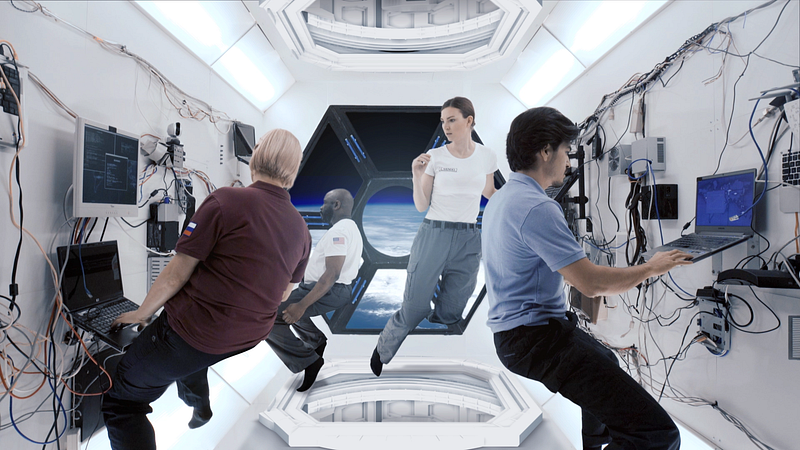
Chris: There was a lot of commonality in the ideas that we discovered at script stage. If I had any criticism of the majority of scripts submitted, grossly generalizing of course, it would be by that we tend to overcomplicate and become ‘too clever’ for our own good. For instance, my mother had dementia and when my father died, I had to go through the process of telling her that he had died over and over again. I used this as a way to communicate the kind of ideas I was hoping we would get submitted. Imagine that story playing out on a sofa but with The Impact. What would be said? How would it be said? What unspoken truths could be said? This would give the writer a really serious challenge, actors something extraordinary to get their teeth into, and ultimately a script that could be shot in an afternoon for next to nothing. We don’t need a lighthouse, submarine, operating theater, space station, nuclear bunker — you get the idea.
In my view the most successful finished films in The Impact are the ones that rely on a strong and emotional hook and simple execution. In fact my favourite script remained unproduced and it was just about a little girl on one of the rides outside shops, like a horse or play fire engine, and her mum just feeding the ride with coins while contemplating.
We always knew we could never compete with Hollywood, this was never going to be a Michael Bay film, so we leaned in the opposite direction and encouraged people to embrace reduced, intimate, authentic, truthful, gut-wrenching stories that everyone of us would connect with.
Scott: The movie is going to premiere at a big gala event in London on May 31. You’re about a week or so out from that celebration. If I could ask you to close your eyes for just a second, take a really deep breath, and just allow yourself to feel your feelings about this movie and your experience during the years-long journey to seeing it get made. How would you describe your current feeling on the cusp of the movie’s debut?
Chris: The act of creating a film ma is something that cannot be fully described and only experienced. From the earliest days of my own filmmaking, I have always recognized that the premiere is a rite of passage. It is a moment in time where you can say look at what we achieved together, and it is completed. I always encourage filmmakers to go as large as possible at their own premiere and to invite all their friends and family to join in the celebration, much like births, deaths and weddings. As such I’m hoping that the high point of the Impact50 is yet to come, ti’s going to be on the evening of May 31st at the world premiere, and everyone is welcome to join is. It will be emotional!
Scott: Final question: Is it too soon to ask if you can imagine a sequel to The Impact?
Chris: Not to put too fine a point on it, but everybody dies!
That said the Create50 brand has been enormously successful, having made two feature films and published a number of books, including 4 books in the Twisted50 brand of Horror. I think if we can find and a broadcaster or publisher who is prepared to make an investment then it could be even more successful. But as I began in this interview, most of the time it does feel like herding cats.
If you want to attend the world premiere you can get tickets at www.Impact5film.com. If you want to attend a later online only screening, June 25th, just sign up to the email list on Impact50film.com and I will send you a message about it after May 31st.
Here is the trailer for The Impact:
Here is one of the short films which is incorporated into The Impact:
I screened The Impact. It is surprisingly coherent given the disparate nature of the writers, directors, and storylines. It’s also entertaining and emotionally compelling. Kudos to Chris and everyone involved in the project. And congratulations to each and every one of you who has achieved your very first IMDb filmmaking credit!
Twitter: @livingspiritpix.
For 100s more exclusive Go Into The Story interviews, go here.