Q&A: Alisha Brophy and Scott Miles
The screenwriting duo talks about their longstanding writers group along with tips on how to sustain a successful one.

The screenwriting duo talks about their longstanding writers group along with tips on how to sustain a successful one.
I’ve known Alisha Brophy and Scott Miles since 2014 when I interviewed them after they had been named recipients of that year’s Nicholl Fellowships in Screenwriting.
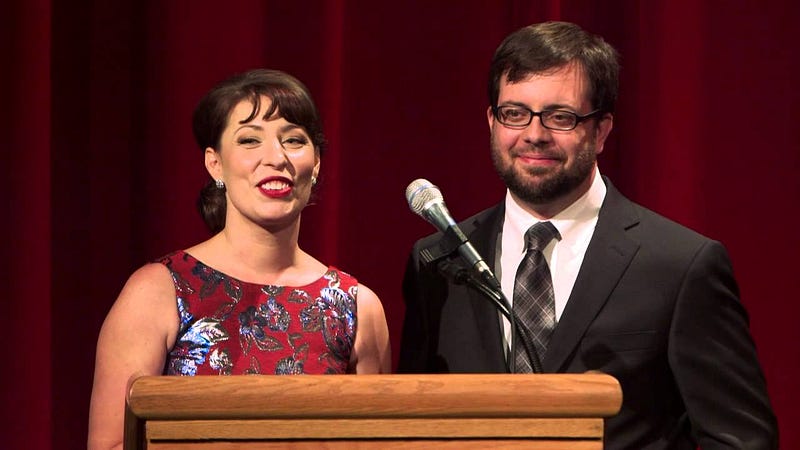
I reconnected with them at this year’s Austin Film Festival and discovered that their writers group, which we had talked about in our interview, was still an ongoing thing. That led me to ask them: How about a Q&A about how to sustain a successful writers group. Alisha and Scott kindly agreed to the interview. Here it is.
First, some background. How long have you been writing together?
We met in the screenwriting MFA grad program at the University of Texas at Austin, and were fans of each others’ work. After school, we decided to try co-writing, and our first script together landed us a manager. That was twelve years ago, and we’ve been a writing team ever since.
You won the Nicholl Fellowship in Screenwriting in 2014 for your comedy script “The United States of Fuckin’ Awesome.” How did winning that competition influence your writing careers?
Winning the Nicholl changed everything and truly gave us our career. Well, what it actually gave was legitimacy as writers and a small window of opportunity where people would take meetings with us. It was up to us to turn that success into paying gigs, which we did after landing our first OWA (open writing assignment) about six months after winning the Nicholl. But without the profile boost of the Nicholl, it probably would have taken much longer to get that first job.
You’re a member of a writers group. How did that come about?
The group itself predates us. It started with a Craigslist ad over a decade ago. It was just a group of aspiring screenwriters all starting out together. A spot opened up a few years later, and Alisha sent in a sample of her work to “audition.” A year or so later, once we were cemented as a co-writing team, Scott was grandfathered into the group. We’ve had writers come and go in the past, but we’ve now had the same roster for the last several years. We like to joke that the only way to get in now is to marry one of the single writers (which actually did happen in 2015).
How many members are in the group?
We have six writers, but four entities — two writing teams and two solo writers. This has been the perfect number because since we meet each week, each entity is guaranteed one night of workshopping a month. Too few members and you can’t compare the notes against each other in a meaningful way and see trends (i.e. most people seemed to be bumping on this plot twist). Too many members and there’s not time to dig deep enough into the material, so the notes end up being fairly surface level.
Is it true that several members of the group have won the Nicholl?
Yes! It’s insane when you think about the odds. There’s 5,000–8000 scripts submitted every year, and we’ve now had multiple winners! And the one member who hasn’t won? He’s consistently a semi-finalist. The rest of us are constantly apologizing to him because he gives such stellar notes, he keeps getting our projects to the top, and we haven’t yet been able to do the same for him. But, it’ll happen. Of course there’s luck involved with any type of contest that relies on subjective judging. But, the amount of wins we’ve racked up feels like proof that our system works.
What is the structure of your writers group in terms of schedule, reading and critiquing pages, due dates, and the rest?
We want to give each other enough time that notes aren’t off-the-cuff. Everyone should have time to absorb the material and think about possible fixes. So, we send our pages out on Fridays, and hold our meetings on Tuesdays. If two people have shorter material, like outlines or beat sheets, we pair them up for the week, and give notes on both projects. If someone has a full pilot or feature, they get the whole evening. Our session lasts about 2.5 hours. The first couple of minutes are catching up. Then we do two rounds of notes. During the critiques, the writer is not allowed to speak. This way they are in a mental space of just listening. The first round is macro “blue sky” notes. Critiques on character arcs, tone, pacing, sequences, etc. The second round is page notes on dialogue and action lines etc. (But not typos. Just circle mistakes and email them over. No one needs to waste precious writer’s group time on typos.) Once the two rounds are done, we open the floor to discussion, and the writer can ask questions, and talk through ideas. At this point it feels more like a TV writer’s room or a brain trust. And this is where the magic happens. Because when you get notes, via email, from different friends, you are missing out on this other set of notes that comes from writers hearing each other’s critiques. This discussion is where the best ideas are born.
What are the keys for creating and sustaining a writers group?
We’ve watched many writers’ groups pop up and then die. And it makes sense. You are asking people to commit their precious free time to reading your worst material, and then helping you make it better. Weekly. That’s a huge ask. We try to make it a nurturing environment. We always start and end our critiques with compliments. And we also make a point of being in each other’s lives outside of the writer’s group. No one wants to just show up, weekly, to a place where they are only told what’s wrong with what they put on the page. But, the biggest factor in getting people to consistently show up and do the work is by giving thoughtful notes. No one wants to be the guy who takes a bunch of great notes, and then phones it in for others. So, the more you give to the process, the more others give back. And you eventually have a tight crew of committed writers, where everyone gives their best, and no one wants to be the weak link.
Finally, what advice do you have for people seeking to start up a writers group (e.g., where to find other writers, how to determine compatibility, setting up a structure)?
Don’t be discouraged when people drop out or seem flaky. This business is a war of attrition. Not everyone is going to stick it out. And your writer’s group is an early predictor of who is willing to consistently do the work. Eventually, you will end up with that smaller core of writers who are going to keep showing up. And those are the writers you will build a community with for the rest of your career.
Some great advice from Alisha and Scott. Years ago, I aggregated a list of writers groups. You can check that out here. See if there’s one in your area. Meet up with other writers. See if you find a connection with a couple of them and begin your own writing tribe.
For 100s more Go Into The Story interviews with screenwriters, go here.