Psychological Writing in a Screenplay
“Screenwriters do have some latitude to dip into the psychological currents of our story and splash onto our pages the occasional insight…
“Screenwriters do have some latitude with scene description to dip into the psychological currents of our story and splash onto our pages the occasional insight into the inner emotional and intellectual experience of our characters.”
Note: This is an excerpt from my Core IV: Style course, a one-week online class which is part of the Core curriculum I teach every autumn. The classes cover essential subjects directly related to screenwriting theory: Plot, Concept, Character, Style, Dialogue, Scene, Theme, and Time, a comprehensive approach to character driven screenwriting.
Psychological Writing in a Screenplay
One way of looking at a story is as a psychological journey — all the Protagonist’s adventures, everything they experience and learn feeds into their metamorphosis. That aspect of the story is naturally infused with dynamics emerging from within the character’s psyche.
As writers, we need to get in touch with that psychological dimension in part to understand what our story’s characters are experiencing, but it is also important for another reason: We can bring our understanding of the story’s psychological aspects into the scene description we write.
Now I must state the obvious: A screenplay is not a novel. In that narrative form, a writer can go inside a character, describing the depths of their psyche. By contrast, a screenplay is largely an externalized reality, characters making themselves known almost exclusively through action and dialogue.
Yet screenwriters do have some latitude to dip into the psychological currents of our story and splash onto our pages the occasional insight into the inner emotional and intellectual experience of our characters. When we do this, we engage in psychological writing. Or to be precise, it is our Narrative Voice, that storytelling sensibility unique to who we are as writers tied to the specific nature of our story’s genre, that makes these psychological observations.
In fact, we saw examples of psychological writing in three out of the four script excerpts in previous lectures: The Matrix, Black Swan, and Buried.
- The Matrix: They’ve done this a hundred times, they know they’ve got her. This is neither dialogue nor action, but rather pulling back the External World to reveal something going on inside the cops’ psyche as they draw near to Trinity to arrest her. The scene description captures their attitude.
- Black Swan: Convincing herself it was just her imagination… She wants to scream, but nothing comes out. Again neither dialogue nor action, but a portrayal of Lily’s psychological state.
- Buried: Something is very wrong, and he doesn’t need to see to know that. Same thing.
You may have heard you can only write what an actor can say (Dialogue) or do (Action). This is patently wrong as evidenced by the examples above and thousands more I have encountered in movie scripts. A screenwriter can — at key moments — use psychological writing to enrich the story experience for a reader.
Which leads us to three touchstones for effective psychological writing:
- Perspective
- Proximity
- Perception
Perspective: This is your Narrative Voice’s vantage point into a character’s inner world.
Proximity: This is how far / close your Narrative Voice is to the character’s inner world.
Perception: This is your Narrative Voice’s interpretation of what the character is feeling.
Thus, when we consider psychological writing, we can think of Narrative Voice as what else — a psychologist. Most of the time, we observe and report what’s transpiring with our characters, but from time to time, when we see moments where some important psychological dynamic is at work and should be communicated to the reader, we use our perspective, proximity, and perception to comment on what’s happening in the story.
Psychological Writing in American Beauty
One script where the Narrative Voice makes good use of psychological writing is American Beauty (1998), written by Alan Ball.
Plot summary [IMDB]: Lester Burnham, a depressed suburban father in a mid-life crisis, decides to turn his hectic life around after developing an infatuation for his daughter’s attractive friend.
Here are some examples in the script.
In this scene, Lester is at work and finds out from the young, new hire Brad that Lester’s job is on the line:
BRAD
Jesus. Calm down. Nobody's getting fired
yet. That's why we're having everyone
write out a job description, mapping out
in detail how they contribute. That way,
management can assess who's valuable and--
LESTER
Who's expendable.
BRAD
It's just business.
LESTER
(angry)
I've been writing for this magazine for
fourteen years, Brad. You've been here
how long, a whole month?
BRAD
(frank)
I'm one of the good guys, Les. I'm trying
to level with you. This is your one
chance to save your job.
Lester stares at him, powerless.
There with that single word — “powerless” — Ball uses his Narrative Voice to capture what it is that Lester’s character is feeling inside. It’s a small example of psychological writing, but an important one as it provides a baseline where Lester starts his journey which is, indeed, one of empowerment. The use of the word powerless not only depicts for the reader what is going on inside Lester, it also drives home a key thematic point.
Next is a moment between Lester and his daughter Jane directly after a nasty familial scene at the dinner table:
Jane stands at the sink, rinsing off her plate. Lester
enters.
LESTER
Honey, I'm sorry. I...
Jane turns and stares at him, waiting for him to finish.
LESTER (CONT'D)
I'm sorry I haven't been more available,
I just... I'm...
He's looking to her for a little help here, but she's too
uncomfortable with this sudden intimacy to give him any.
LESTER (CONT'D)
(finally)
You know, you don't always have to wait
for me to come to you...
JANE
Oh, great. So now it's my fault?
LESTER
I didn't say that. It's nobody's fault.
Janie, what happened? You and I used to
be pals.
Here Ball uses Narrative Voice to peer inside the emotional states of both characters: Lester is “looking to her for a little help” while she is “uncomfortable with this sudden intimacy.” Again this is an important moment as it shows Lester reaching out to his daughter and her ultimately rejecting his bonding attempts. The psychological writing used in this scene crystallizes for the reader precisely where each character is in terms of the father-daughter relationship.
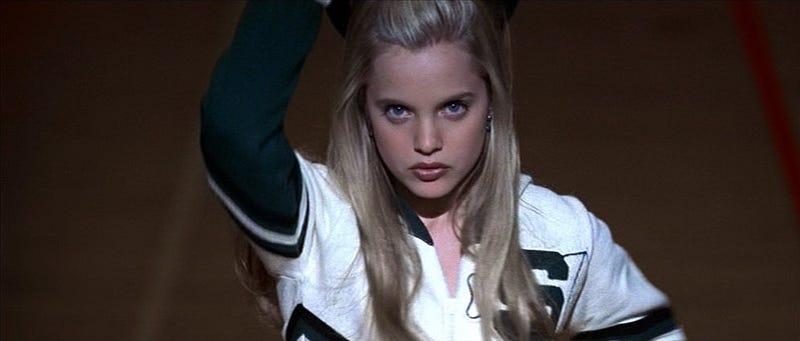
This next example is a major plot point in the story where Lester sits alongside his wife in the stands of a high school auditorium watching Jane and her fellow cheerleaders perform a routine:
Lester, watching from the stands, picks out his daughter.
His POV: Jane performs well, concentrating. Dancing awkwardly
next to her is Angela. Suddenly Angela looks right at us and
smiles... a lazy, insolent smile.
Lester leans forward in his seat.
His POV: We're focused on Angela now. Everything starts to
SLOW DOWN... the MUSIC acquires an eerie ECHO...
We ZOOM slowly toward Lester as he watches, transfixed.
His POV: Angela's awkwardness gives way to a fluid grace, and
"ON BROADWAY" FADES into dreamy, hypnotic MUSIC. The light on
Angela grows stronger, and the other girls DISAPPEAR
entirely.
Lester is suddenly alone in the stands, spellbound.
His POV: Angela looks directly at us now, dancing only for
Lester. Her movements take on a blatantly erotic edge as she
starts to unzip her uniform, teasing us with an expression
that's both innocent and knowing, then... she pulls her
uniform OPEN and a profusion of RED ROSE PETALS spill
forth... and we SMASH CUT TO:INT. HIGH SCHOOL GYMNASIUM - CONTINUOUS
Angela, fully clothed, is once again surrounded by the other
girls. The HIGH SCHOOL BAND plays its last note, the Dancing
Spartanettes strike their final pose, and the audience
APPLAUDS.
Carolyn claps along with the rest of the audience. Lester
just sits there, unable to take his eyes off Angela.
Everything after the description “Lester leans forward in his seat” is a specific sort of psychological writing, namely one that visualizes what’s going on inside a character’s mind. This goes to the idea of proximity: Instead of the perspective Ball has used with his Narrative Voice thus far in the script, an external view from which the scene description provides their perception of a character’s psychological state, here Ball burrows inside the character’s mind and depicts it for a reader to read and a moviegoer to see.
If the previous scene is the beginning of Lester’s fantasy with Angela, this next scene is the pivotal end-point:
Lester starts unbuttoning Angela's blouse. She seems
disconnected from what's happening. Lester pulls her blouse
open, exposing her breasts.
Lester looks down at her, grinning, unable to believe he's
actually about to do what he's dreamed of so many times, and
then...
ANGELA
This is my first time.
Lester LAUGHS.
LESTER
You're kidding.
ANGELA
(a whisper)
I'm sorry.
A beat. Lester looks down at her, his grin fading.
His POV: Angela lies beneath us, embarrassed and vulnerable.
This is not the mythically carnal creature of Lester's
fantasies; this is a nervous child. ANGELA (CONT'D)
I still want to do it... I just thought I
should tell you... in case you wondered
why I wasn't... better.
Lester's face falls. There's no way he's going to go through
with this now.
Here the Narrative Voice uses psychological writing to emphasize the Beginning, Middle and Ending movement of the scene:
Beginning: Lester looks down at her, grinning, unable to believe he’s actually about to do what he’s dreamed of so many times. He is set up to consummate his fantasy.
Middle: His POV: Angela lies beneath us, embarrassed and vulnerable. This is not the mythically carnal creature of Lester’s fantasies; this is a nervous child. The Narrative Voice again closes the proximity to go inside Lester’s mind as he has a moment of clarity, distinguishing between his fantasy vision of Angela and the reality of who she is: simply a “nervous child.”
End: There’s no way he’s going to go through with this now. With the line “Lester’s face falls” establishing that the Narrative Voice has moved to an ‘outside’ perspective again, it provides a culminating observation: Lester has decided not to have sex with Angela.
Ball’s use of psychological writing is a stylistic choice grounded in the story’s Narrative Voice. We may also glean an important additional takeaway: Only use psychological writing when it is an important moment in a story. In other words, do not waste it on mundane incidents, rather pick your spots to maximize both the emotional and entertainment impact of a scene.
Summary
While most of the time, a screenwriter will use action and dialogue to move the story ahead, when important moments arise, we may use psychological writing in scene description to convey what is happening with characters in their inner world of experience.
Beginning in August, I begin my 2020 cycle of one-week online Core classes.
CORE I: PLOT — A one-week class which begins with the principle Plot = Structure and explores the inner workings of the Screenplay Universe: Plotline and Themeline. Start date: September 7.
CORE II: CONCEPT — A one-week class which begins with the principle Concept = Hook and examines multiple strategies to generate, develop and assess story ideas. Start date: September 21.
CORE III: CHARACTER — A one-week class which begins with the principle Character = Function and delves into archetypes: Protagonist, Nemesis, Attractor, Mentor, and Trickster. Start date: October 5.
CORE IV: STYLE — A one-week class which begins with the principle Style = Voice and surfaces keys to developing a distinctive writer’s personality on the page. Start date: October 19.
CORE V: DIALOGUE — A one-week class which begins with the principle Dialogue = Purpose and probes a variety of ways to write effective, entertaining dialogue. Start date: November 2.
CORE VI: SCENE — A one-week class which begins with the principle Scene = Point and provides six essential questions to ask when crafting and writing any scene. Start date: November 16.
CORE VII: THEME — A one-week class which begins with the principle Theme = Meaning and gives writers a concrete take on theme which can elevate the depth of any story. Start date: November 30.
CORE VIII: TIME — A one-week class which begins with the principle Time = Present and studies Present, Present-Past, Present-Future and time management in writing. Start date: December 14.
These eight Core classes represent decades of my work on the front lines of the entertainment business as a writer and producer, and engaging the craft as a teacher as well.
If reading ‘how to’ screenwriting books has left you confused, the Core curriculum offers a comprehensive, coherent, and cohesive approach to screenwriting theory.
This is not about secret systems or magic formulas, rather the Core content presents a story-crafting process that starts with characters, ends with characters, and discovers the story in-between. That process of engaging you with your story universe through your characters and getting you in touch with these living, breathing individuals informs every step of your creative process, leading you to story structure, themes, conflict, subplots, and all the rest. As I say, Character Based Screenwriting.
I provide feedback and am actively involved in our online chats. That includes a 90 minute teleconference for each Core class.
This cycle, I am offering a special sale price. Normally, the Core classes are $95 each. In 2020, each is on sale for $79!
A popular option is the Core Package which gives you exclusive access to the content in all eight Craft classes which you can go through on your own time and at your own pace, plus automatic enrollment in each 1-week online course — all for nearly 50% off the normal price of each individual class. If you sign up now, you can have immediate access to all of the Core content.
“I’m a huge fan of Scott’s classes, and I signed up for his Core Package, which I cannot speak highly enough about. If anyone wants to take a serious look at improving their writing, there is more than enough material to keep you busy for a few… dare I say, lifetimes? He’s the best. No bones about it.”
~ Heather Farlinger
To learn about any of the Core classes, click here.
I look forward to the opportunity to work with you!