Prosody: The Secret to Memorable Writing
Another in the excellent screenwriting video series Raising the Stakes.
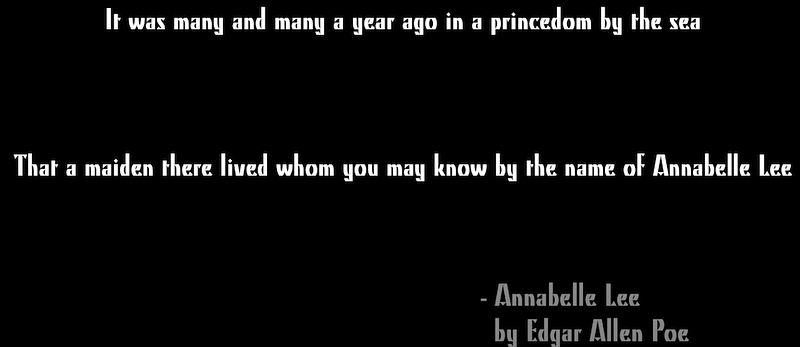
Another in the excellent screenwriting video series Raising the Stakes.
Jonathan W. Stokes is a screenwriter with a unique credit to his name: Five of his original screenplays have been named to the annual Black List. That alone should get your attention, but there’s also this: Over the last few years, he has produced a valuable video series called Raising the Stakes.
Recently, Jonathon debuted the second video in Season 4 of his screenwriting series. Episode 4: Prosody: The Secret to Memorable Writing. Here’s how he frames the subject:
Prosody is the art of controlling the rhythmic flow of words for poetic and dramatic impact. In this video, I flex my wimpy Final Cut Pro muscles to their limit, in a desperate attempt to explain why the most lyrical writers care deeply about prosody…and how it can elevate our work.
Here is the video.
Having a musical background, I especially resonated with this video. And by the way, Jonathan is a musician as well. Here he is playing upright bass.
In fact, before Jonathan broke into Hollywood as a screenwriter, he made a living as a piano teacher.
As to Jonathan’s analysis in the video, I think he’s spot on. Memorable dialogue often has a rhythm to it … a flow … a cadence. The video mentions Aaron Sorkin. Check this out.
In this latest Raising the Stakes video, Jonathan provides a simple, yet valuable piece of advice for writers: Read your dialogue out loud. See if key lines have a rhythm. If not, can you rewrite the line so it does have a musical cadence.
One final observation. While Jonathan’s video focuses on dialogue, we can bring the same musical sensibility to writing scene description. Like Tony Gilroy in Michael Clayton:
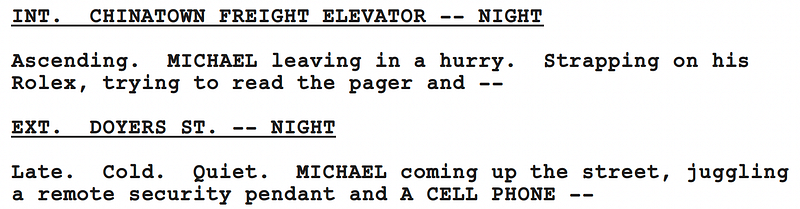
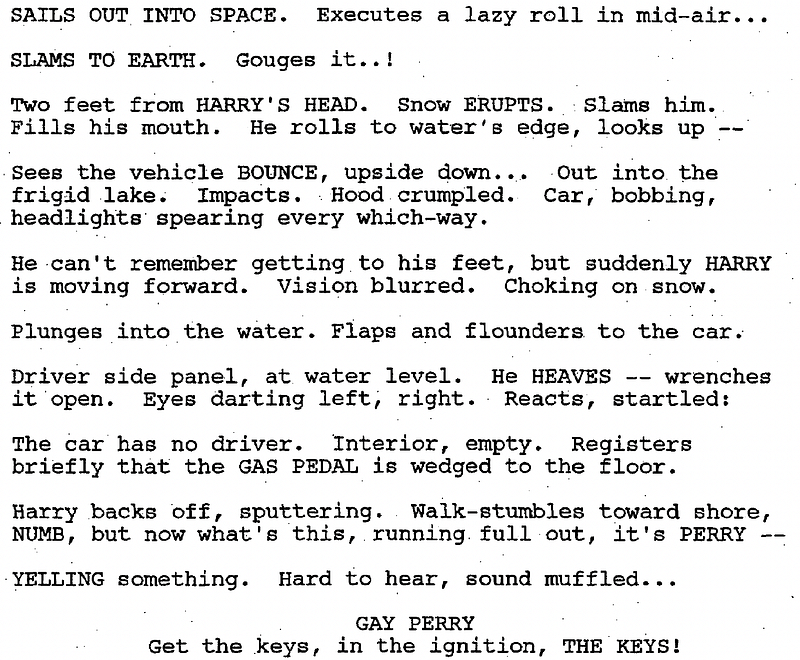
Or this description of an airborne car as written by Shane Black in Kiss Kiss Bang Bang:
Whenever I teach a scene-writing class, one of the very first things I tell my students: In a screenplay, you do NOT need to write complete sentences.
A clause. A gerund. A single word. In conjunction with complete or partial sentences, these can create a musical flow to stage direction.
So, another great video from Jonathan Stokes!
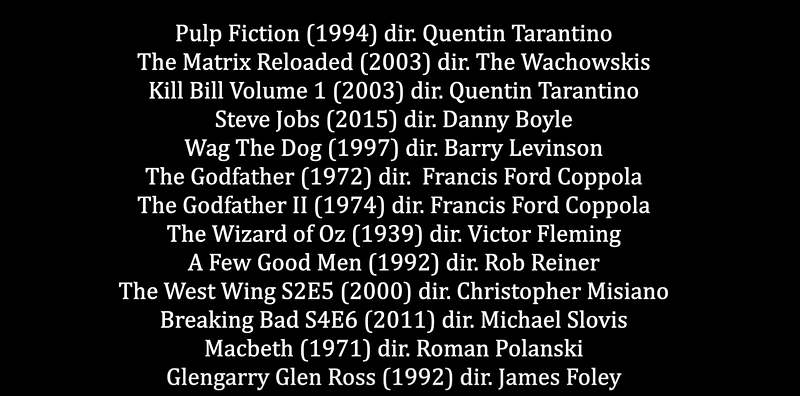
Here are the movie clips featured in Jonathan’s video.
Here are links to previous Go Into The Story articles featuring Jonathan’s excellent videos on storytelling.
Season 1
Episode 1: The Objective Correlative
Episode 2: Breaking Suture
Episode 3: Nuking the Fridge
Episode 4: 10 Ways to Invest Your Audience in Your Hero
Episode 5: Heightening
Season 2
Episode 1: Theme Shown
Episode 2: Raising the Stakes on the Call to Adventure
Episode 3: 7 Ways To Do Bad Exposition
Episode 4: 9 Rules For Good Exposition
Episode 5: Magic Flight
Season 3
Episode 1: The Act One Break
Episode 2: Atonement with the Father
Episode 3: Seven Set Pieces
Episode 4: The Midpoint
Episode 5: Anaphora and Epistrophe
Season 4
Episode 1: What is subtext?
Episode 2: The Christ Symbol
Episode 3: Why “We’re Not So Very Different, You And I”
Episode 4: MacGuffins Aren’t MacGuffins
For more background on Jonathan W. Stokes, you can go here.
I wrote an in-depth analysis of Aaron Sorkin’s approach to “musical” dialogue which you can read here.