People Don’t Actually Like Remakes, but Studios Keep Making Them
Why, you ask? This Vice article suggests the prime mover is audience nostalgia. There’s another big reason…
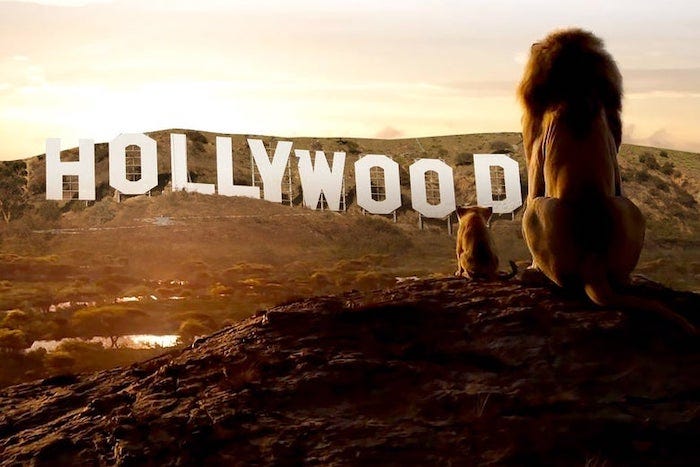
Why, you ask? This Vice article suggests the prime mover is audience nostalgia. There’s another big reason…
An excerpt from a recent article from Vice:
Disney’s live-action Aladdin came out just over a month ago. The Dumbo remake hit theaters just two months before that. Now, the newest affront to our childhood movie memories will arrive in a week: the CGI Lion King remake. Yes, movie marquees are filled with familiar titles from our childhoods from Child’s Play to Men in Black, with remakes of The Grudge, Charlie’s Angels, Little Women, and Dune all scheduled for the coming year.
But despite all the investment movie studios are funneling into rebooting these legacy films, they might not be as well-received as studios might hope, according to a new analysis by betting website Casumo. The study, which was done in collaboration with SEO firm Verve Search, is called Remake My Day, and it standardized IMDB and Metacritic stores to compare ratings and profits of recent movie remakes.
Check out the Remake My Day site. Here are some numbers:
- Per movie critics: “Overall, 87% of original movies are preferred by critics to their remakes.”
- Per audiences: “Audiences rate 91% of originals more highly than the remake.”
- Per profitability: “79% of original movies were more profitable than their remakes, based on their domestic gross vs their original budget.”
So what’s driving Hollywood’s obsession with remakes, reboots, prequels, and sequels? In a Washington Post article citing the same Remake My Day study, writer Steve Zeitchik suggests this:
The data may be the result of a kind of confirmation bias. The nature of nostalgia is such that viewers can’t help thinking an original film was better, but that doesn’t mean they won’t pay to see the new one. Call it a grumble gap: audiences complain, then take out their wallets.
Again from the Vice article:
It’s been clear for a while that nostalgia drives views. Just look at the success of Stranger Things, which has proven that sentimentality for the not-too-distant past isn’t just fun to watch, but it’s also an easy way to sell things (welcome back, New Coke). That feeling of familiarity might also account for all those rewatches of The Office and Friends, which respectively made up 7 and 4 percent of Netflix’s total streaming in 2018.
I wrote about the influence of nostalgia in Hollywood back in March 2016 in an article titled: Hollywood’s New Four-Quadrant Movie Model.
You need to know: The old Four-Quadrant Model has changed.
This per Wikipedia:
In the movie industry, a four-quadrant movie is one which appeals to all four major demographic “quadrants” of the moviegoing audience: both male and female, and both over- and under-25s. Films are generally aimed at at least two such quadrants, and most tent-pole films are four-quadrant movies.
Male. Female. Adult. Children. Been around for quite a while. However it seems to me that’s the old four-quadrant approach, one that’s being replaced at the major Hollywood studio level by a new model comprised of these elements:
Spectacle. International. Franchise. Nostalgia.
My take on Nostalgia:
The top two movies in domestic box office in 2015 were Star Wars: Episode VII — The Force Awakens and Jurassic World. Both movies are awash in nostalgia.
In SW:TFA, we thrilled to see our old friends — R2D2, C-3PO, Chewbacca, Han Solo, Princess Leia, and [spoiler alert] You Know Who at the very end.
In JW, there was a kind of meta-nostalgia at work since the characters were revisiting the old haunts, the audience got to experience what they experienced, but also revisit what we had felt when we saw the original Jurassic Park. This is driven home no more clearly than by comparing these two scenes:
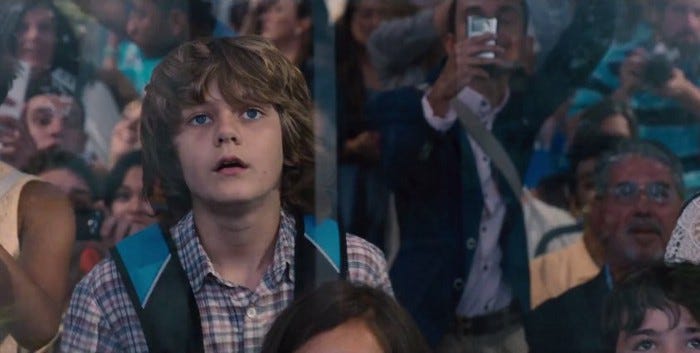
In Jurassic Park, the famous ‘Spielberg stare’ features the characters gawking in amazement at their initial glimpse of the dinosaurs. In Jurassic World, we see the same stare only it’s people astonished at seeing the park for the first time. In a way the characters are like us as we revisit our first trip to the movie Jurassic Park. And that tips off one nostalgic bit of business after another… after another… after another in JW.
Thus we have articles like this:
‘Creed,’ ‘Star Wars: The Force Awakens’ and the Rise of the Nostalgia Sequel.
‘Star Wars’ Premieres in Hollywood to Wild Cheers of Nostalgia, Delight.
Reboots Have Come To Television: Welcome To Nostalgic Revivalist TV.
I should note that if the nostalgia craze is driven by audiences wishing to relive moments from their past, it also can work with the old four-quadrant model: Adults who get to see movies like Star Wars and Creed, recalling films from their youth, along with children and teenagers.
One final point: Since nostalgia movies are based on preexisting material, this also plays into Hollywood’s obsession with pre-branded content, another piece of conventional wisdom about maximizing profit and avoiding risks.
While nostalgia may be a prime driver behind the movie studios’ preoccupation with remakes and the like, this last point is a second major reason: Fear. Even if they may not be guaranteed to ‘maximize profit’ on a remake, at a fundamental level because they are remaking successful films, this puts the development team in CYA territory: Cover Your Ass. As I noted in this 2012 article Hollywood: The Fear Factor:
Every time they green light a movie, they put their ass on the line. Much easier to say NO and not risk a B.O. bomb than to say YES and have everyone involved in the dud run for the hinterlands, leaving only you, red ink, and your corporate overlords glaring down at you.
The problem is saying NO is not a sustainable business policy. Sometimes a studio has to say YES. To make a movie. To generate revenues. So there is also the fear of not succeeding.
If the safest best is to say NO, the next safest bet is to remake a successful film. This in an environment in which studio execs increasingly refer to original stories as “untested content.”
Takeaway: For a screenwriter, especially one trying to break into the business, whatever story you choose to write on spec, make sure it is a strong concept. And if it falls into the ‘similar but different’ category, all the better as far as studio execs are concerned, both because of the nostalgia and fear factors.