Page One: “True Grit” (2010)
Screenplay by Joel Coen, Ethan Coen, novel by Charles Portis
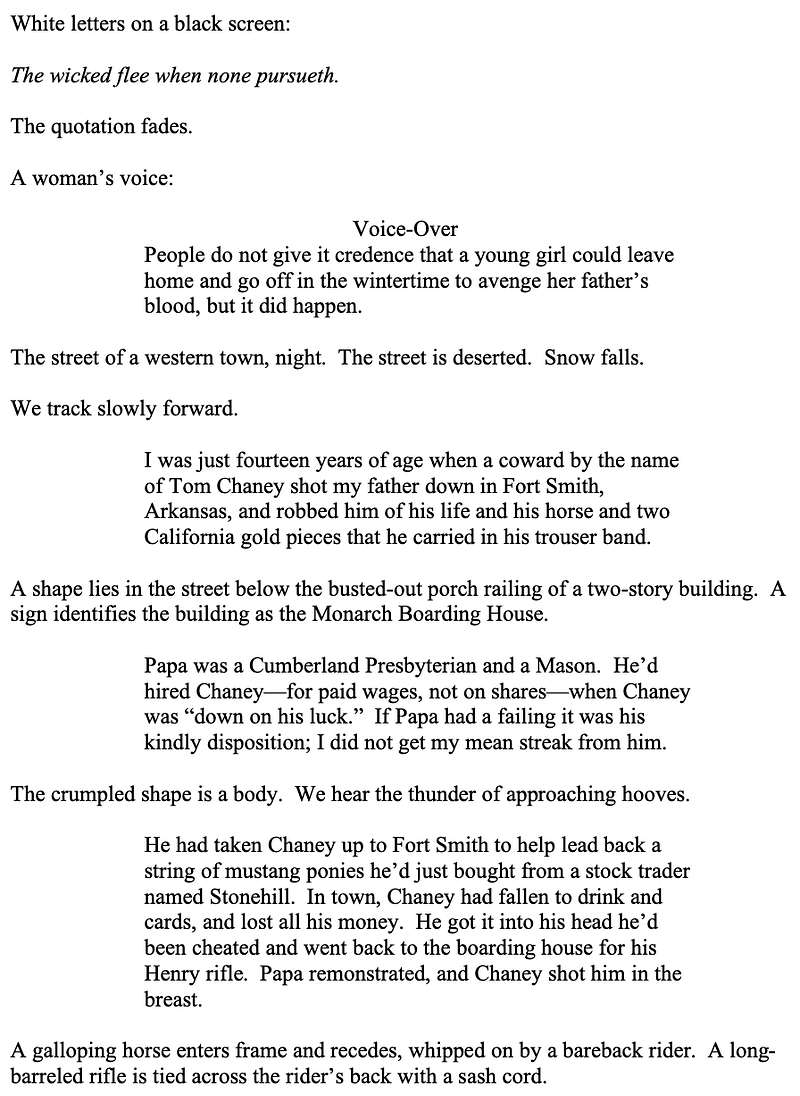
Screenplay by Joel Coen, Ethan Coen, novel by Charles Portis
Here is movie version of the scene:
Careful observers of screenplay format and style will notice a few things about Page One of True Grit:
- The font is not Courier 12, but looks to be Times New Roman.
- There is no FADE IN.
- The dialogue does not include the (V.O.) character extension. Instead, the Coens indicate voiceover in the Character Name position.
- The dialogue margins are extra-wide.
- “We track slowly forward … we hear the thunder of approaching hooves.”
- And what’s this? … No scene heading. No shots. No sluglines of any sort.
We have discussed before how writer-directors are cut some slack when it comes to screenplay format and style. After all, they are the ones directing the movie, so first and foremost, it has to make sense to them. But even then, what is written must be clear to above and below-the-line people in order to raise funds … secure actor attachments … budget and schedule the production … guide the production team … and so forth.
So I ask you: Is there any confusion in what the Coens wrote on Pages One of the script? No. It’s entirely clear what’s going on. For all we know, this could be the way of the future in terms of screenplays, or at least some elements, at least insofar as spec / selling scripts are concerned.
Does this mean you can approach screenplay format and style like the Coens do? There’s no rule against it. If your story mandates you do anything different than what the conventions are, then go for it.
But if you want your script to create the path of least resistance with script readers and story analysts, so they don’t ding you for the font you use … the margins of your dialogue … or whatever … it’s always safest to abide by the norms of current format and style.
You may download the screenplay here.
FOR EDUCATIONAL PURPOSES ONLY!
Page One is a daily Go Into The Story series featuring the first page of notable movie scripts from the classic era to contemporary times. Comparing them is an excellent way to study a variety of writing styles and see how professional writers start a story.
For more Page One posts, go here.