Page One: ‘The Verdict’ (1982)
Screenplay by David Mamet, novel by Barry Reed
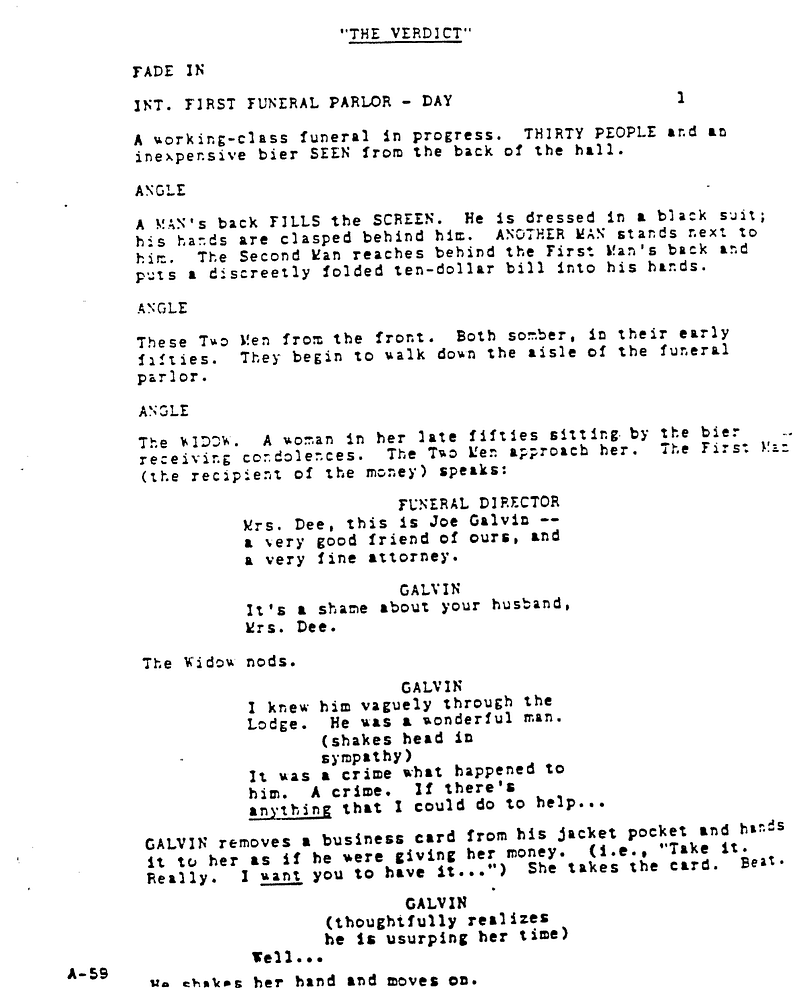
Screenplay by David Mamet, novel by Barry Reed
One of the values of the Page One series is it puts a spotlight on how screenplay style and format has changed over the years. Three examples in this first page of The Verdict:
- ANGLE: Once the spec script market emerged in the mid-80s and 90s, directors made it clear they did not want screenwriters directing the action on the page. Up to this point, when screenplays were essentially production drafts, scripts were often filled with directing jargon and camera shots. Not anymore. What has happened over the last four decades is a shift toward a more literary style of screenwriting, cutting out technical lingo like ANGLE. Besides, it’s not needed.
A MAN’S BACK. Dressed in a black suit.
You don’t even need “FILLS the SCREEN.” The first three words suggest a close-up or medium shot.
The TWO MEN, both somber. In their early 50s.
Again, no need for ANGLE.
The WIDOW, a woman in her late 50s.
The point is just describe what we’re seeing. The camera shots are implied in the scene description.
- (shakes head in sympathy) / (thoughtfully realizes he is usurping her time)
Nowadays, there is no rule against using parentheticals, however, they do appear to be falling out of fashion. They are a vestige from the days when playwrights inundated Hollywood when the “talkies” came into existence (late 1920s) and there was a sudden need for writers who had an ear for dialogue. Plays were often filled with parentheticals, thus, they became a part of what was then called a screen play (two words), a screen version of a play.
The problem with parentheticals is two-fold: (1) They are an inefficient use of line-space. Four words, three words, two words, sometimes one word… why waste a line space especially in light of the fact that (2) actors typically just cross out parentheticals as they don’t like to be told by the screenwriter how to act. Besides, you can simply include the text of the parenthetical in the preceding or following paragraph of scene description, often not adding a line to that paragraph, thus, saving a line-space… which if you tend to write long and are always fighting page count can be helpful.
- Beat.
This was all the rage for a while in the 80s: Screenwriters using “beat” to signify a momentary silence. Mamet used them a lot and because he is such a talented writer, others imitated him.
Again, there’s no rule against using the term in a contemporary script, however, if you use beat as a single term of scene description, that is three line-spaces:
line-space
Beat.
line-space
Talk about inefficient! Moreover, it’s a value neutral term. If a writer really wants to indicate a pause, why not use something which conveys atmosphere and emotion like:
A thick silence.
A frozen moment.
A painful standstill.
That said, there is one thing Mamet does in scene description which goes directly against the so-called screenwriting rule: You can’t write unfilmables.
(i.e., “Take it. Really. I want you to have it…”)
According to some script literalists, you can’t write that because it’s neither action nor dialogue. Yet, it’s a great bit of description speaking to the character’s inner stage of being. It’s evocative and conveys emotion.
We have the freedom to occasionally dip into a character’s inner world. We have to be judicious, but that is one tool available to us, no matter what script literalists may say.
Which brings me to my final point: Read scripts. The Verdict is definitely worth a read as it’s brilliant. But when it comes to style and format, you are better off reading contemporary movie scripts. In aggregate, those reflect current screenplay sensibilities.
Here is a short video on the making of The Verdict featuring one of cinema’s greatest directors Sidney Lumet.
Page One is a daily Go Into The Story series featuring the first page of notable movie scripts from the classic era to contemporary times. Comparing them is an excellent way to study a variety of writing styles and see how professional writers start a story.
For more Page One posts, go here.
You may follow the daily conversation on Twitter as I cross-post there: @GoIntoTheStory.