Page One: “The Prestige” (2006)
Screenplay by Jonathan Nolan and Christopher Nolan, novel by Christopher Priest
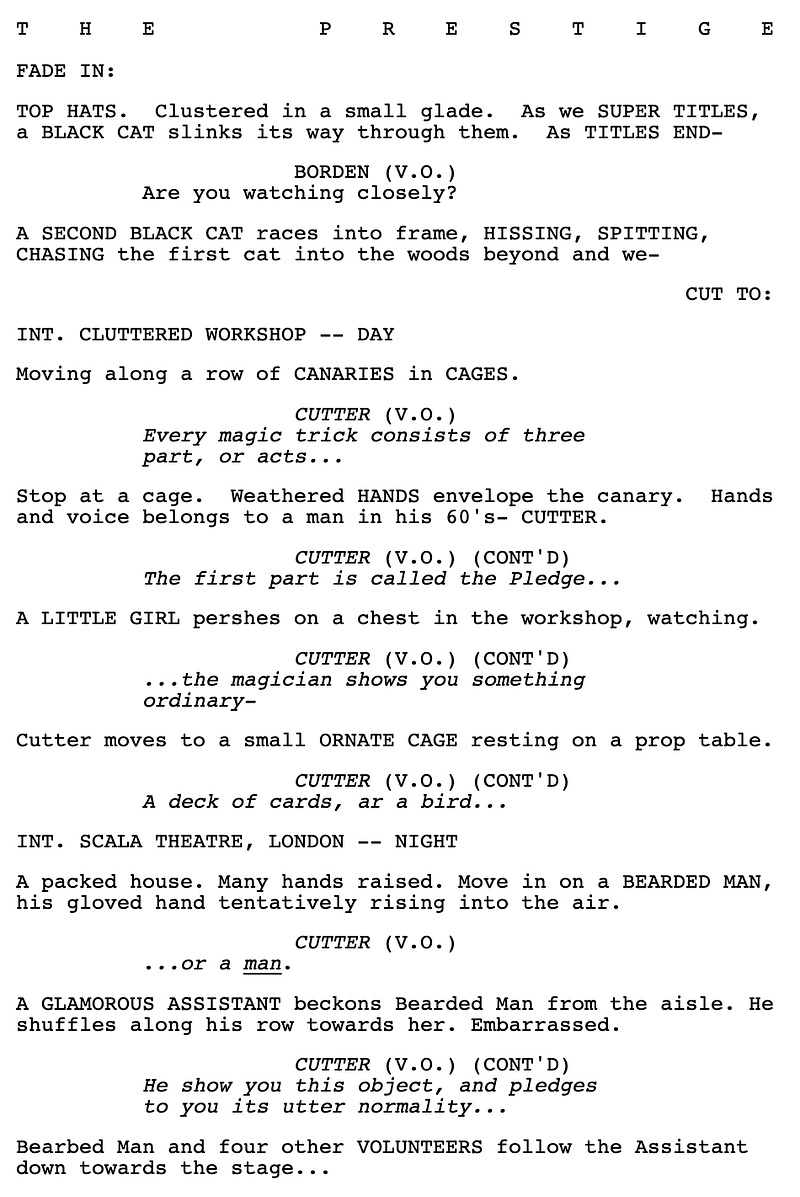
Screenplay by Jonathan Nolan and Christopher Nolan, novel by Christopher Priest
The movie version of the opening:
I have to say I’m really glad I started running the Page One series last August. For a lot of reasons, but here’s one: The utter confusion, even outrage scripts arouse in writers. In the case of The Prestige, a review of the Twitter feed finds two points of contention and concern: (1) Misspellings. (2) Capitalization.
With regard to the first:
Here they are:
- “Hands and voice belongs”: should be “belong”
- A LITTLE GIRL pershes on a chest: should be “perches”
- Bearbed Man: should be “Beardeded”
Three errors on the script’s very first page. Is our takeaway that we shouldn’t care about spelling and grammar?
If your name is Christoper or Jonathan Nolan, and you’ve written a green lit movie, nope.
For the rest of us plebes, we very much have to take care of every single word and sentence. Otherwise, the impression a sloppy scripts conveys to a script reader, development executive, manager or agent: The writer doesn’t really care about their story… or their craft.
With regard to capitalization:
Historically, screenwriters used caps in scene description to highlight three things: (1) Characters. (2) Sound effects. (3) Significant objects. Back in the day when a script was solely a production draft, capitalized words alerted actors to action and imminent dialogue, and the crew to SFX and important visual elements.
However, once the spec script market emerged in the 80s and 90s, and shooting scripts became selling scripts, the trend moved away from:
- Capitalizing a character’s name every time. Only do it when the character is introduced.
- Capitalizing sound effects. Only do it when the sound is BIG or IMPORTANT.
- Capitalizing specific objects. Only do it when the object is truly SIGNIFICANT.
That said, there are no rules. If you want to capitalize key sounds or important objects, you can do that. Just know this: Reading scripts with a LOT of capitalized words in scene description can become distracting, even annoying. This is not just my opinion, I’ve had multiple conversations with people in the development side of the business who have told me this.
This is yet another reason why you should be reading contemporary movie scripts, that is screenplays from the last 5–10 years. Track how different writers have different styles including how and when to use capitalization.
Find the style that works best for YOU.
Read the script here.
FOR EDUCATIONAL PURPOSES ONLY!
Page One is a daily Go Into The Story series featuring the first page of notable movie scripts from the classic era to contemporary times. Comparing them is an excellent way to study a variety of writing styles and see how professional writers start a story.
For more Page One posts, go here.
You may follow the daily conversation on Twitter as I cross-post there: @GoIntoTheStory.