Page One: ‘The Last Boy Scout’ (1991)
Screenplay by Shane Black, story by Shane Black & Greg Hicks
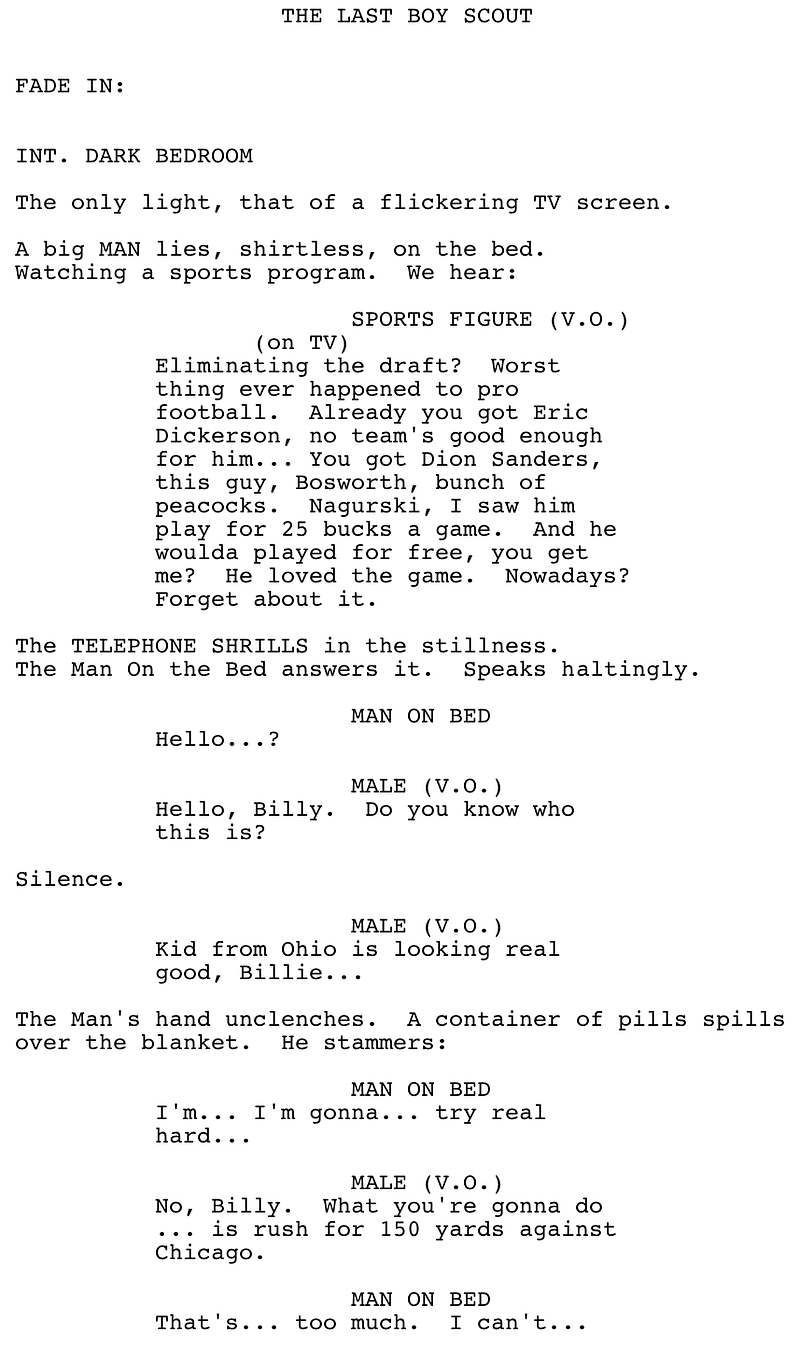
Screenplay by Shane Black, story by Shane Black & Greg Hicks
I can still remember reading The Last Boy Scout as it made the rounds in Hollywood directly after it sold in 1990 for $1.75M. There are a lot of reasons why Shane Black scripts like this one had an impact in the industry’s acquisition and development community, one of them this: Black is a hell of a visual writer. Active verbs. Evocative descriptors. Striking action. For all the well-deserved kudos Black receives for his characters’ dialogue, I think his action writing is every bit as compelling.
Here is an excerpt from the opening sequence in The Last Boy Scout. Setup: Star running back Billy Cole receives a phone call at halftime of a football game, telling him he has to start scoring touchdowns, there’s a lot riding on this game. If he doesn’t, bad things will happen. Pressure on and popping some pills, Cole heads out to begin the second half, a crazed look in his eye…
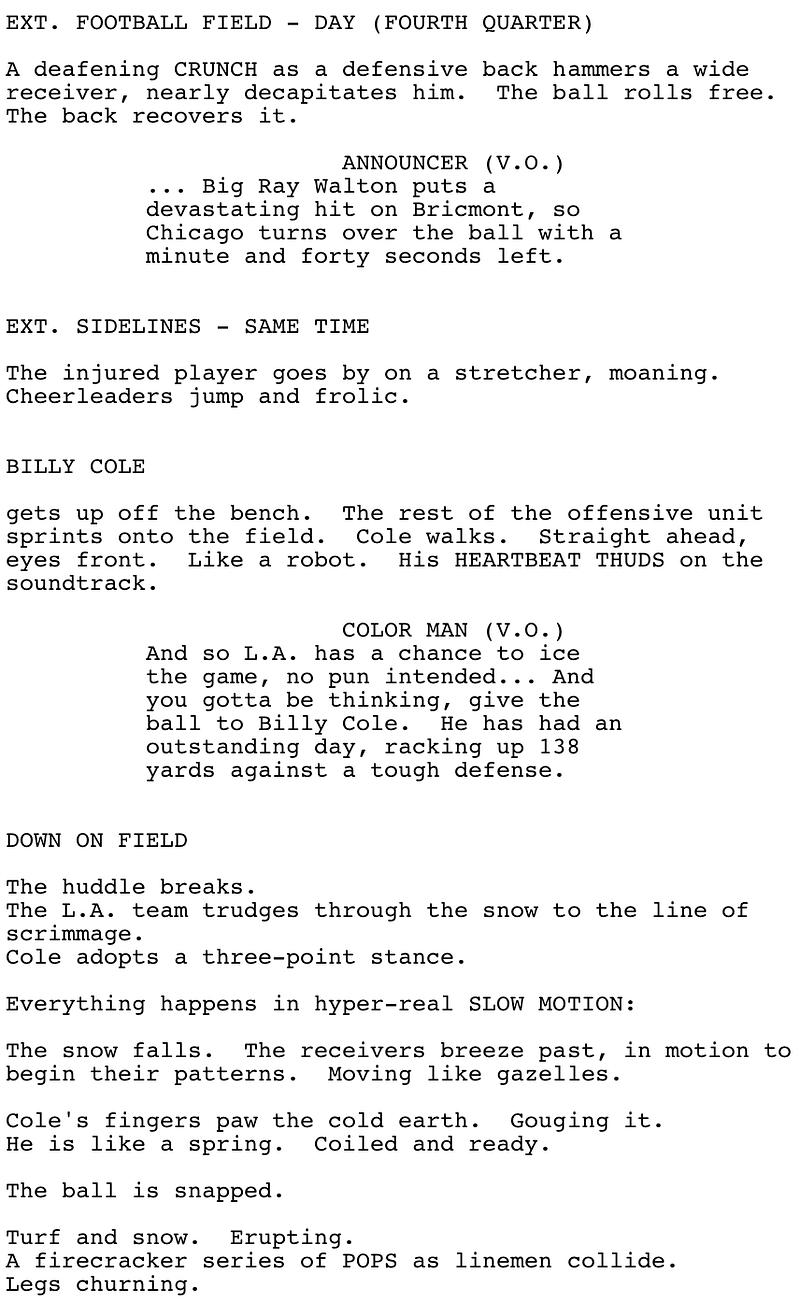
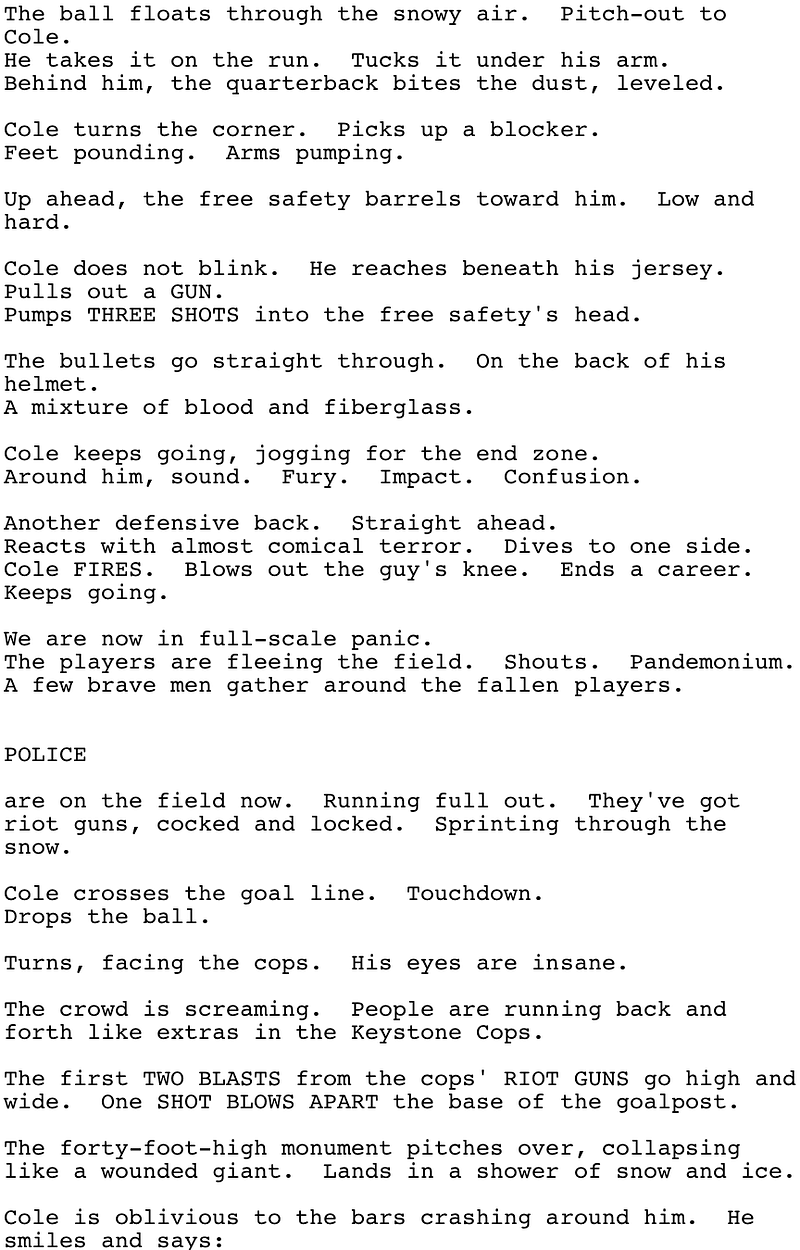

Here is the movie version of the scene:
Consider the verbs in the script pages cited above:
Paw… gouging… snapped… erupting… collide… churning… bites… leveled… pounding… pumping… barrels… fleeing.
How about the descriptors:
He is like a spring, coiled and ready… Turf and snow… The ball floats through the snowy air… Behind him, the quarterback bites the dust, leveled… On the back of his helmet, a mixture of blood and fiberglass… Shouts… Pandemonium… riot guns, cocked and locked… The forty-foot-high monument pitches over, collapsing like a wounded giant, lands in a shower of snow and ice.
This is an example of what I call Imagematic Writing, more poetry than prose, speaking to the fact that movies — and by extension screenplays — are primarily a visual medium.
Takeaway: When we write scene description, we need to think visually, use images — strong verbs, vivid descriptors — to create a rich, evocative story in the minds-eye of the reader.
Page One is a daily Go Into The Story series featuring the first page of notable movie scripts from the classic era to contemporary times. Comparing them is an excellent way to study a variety of writing styles and see how professional writers start a story.
For more Page One posts, go here.
You may follow the daily conversation on Twitter as I cross-post there: @GoIntoTheStory.