Page One: “Promising Young Woman” (2020)
Screenplay by Emerald Fennell
Screenplay by Emerald Fennell
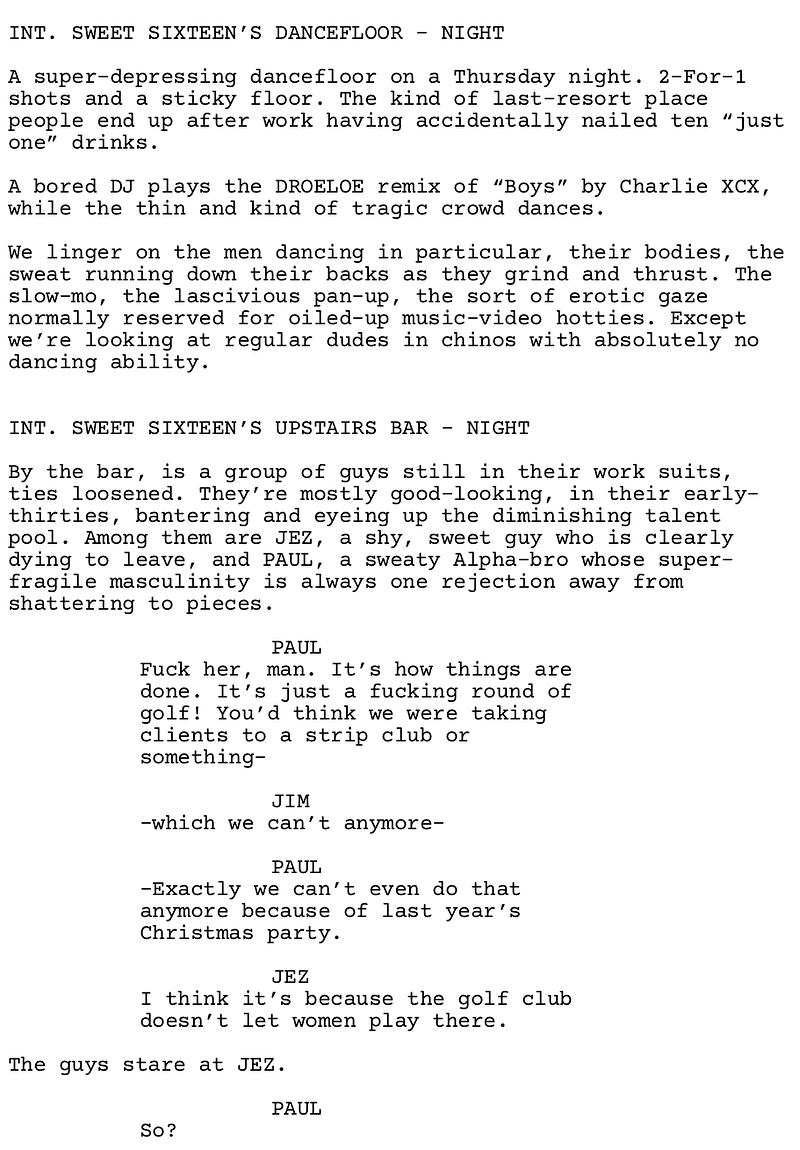
Yesterday, I tweeted the first page of Promising Young Woman as the latest in my daily Page One series. It created some interesting feedback on Twitter which I thought created an opportunity to once again address some issues related to screenplay style and format.
It shows what the first page of this year’s Best Original Screenplay Oscar-winning award looks like. The fact the script also won WGA, BAFTA, and Golden Globe screenwriting awards suggests it is something we, as writers, should study to see what we can learn.
For much more background on this subject, I have a fifteen-part series called So-Called Screenwriting “Rules,” but to get straight to the point: There are no screenwriting rules. If there were, there would be a rule book. There is no such thing dictating style and formal. Certainly, there are conventions, even expectations, but no rules.
When reading the thread of tweets, the basic underlying concern about the first page of Promising Young Woman is about writing what are commonly referred to as “unfilmables”: scene description which actors cannot say or do, or the audience cannot hear or see.
Yes, storytelling for movies and television is fundamentally about writing for an externalized reality: Action. Dialogue. However, there is no rule which says when we write scene description, we cannot create atmosphere…. we cannot comment on what’s happening in the moment… we cannot convey something of the inner thoughts or emotions of a character.
We have to be judicious and pick our spots for maximum impact. A screenplay is not a novel in which the writer can spend copious time in the story’s internal world. But if a writer reads movie scripts buy actual professional writers, they will soon learn that screenwriters have been enhancing the story by using “unfilmables” quite literally for decades.
That is the bottom line: We have the right to use every tool possible to write our story the way it can best be told. As William Goldman, who wrote such memorable screenplays as Butch Cassidy and the Sundance Kid, Marathon Man, The Princess Bride, and Misery, wrote:
“Screenplays don’t have to read like an instruction manual for a refrigerator. You can write them as a pleasurable read.”
Emerald Fennell took this advice to heart in writing Promising Young Woman and that is in evidence beginning with Page One.

With the very first few lines, Fennell creates a sense of atmosphere. The specificity of her description — super-depressing dancefloor… 2-For-1 shots and a sticky floor… last-resort place — conveys a universal experience: Each of us has doubtless been in some in sad late-night joint. Her words conjure up our own memories and associations with events in our past which helps to create a sense of mood for the opening scene.

More atmosphere: bored DJ… thin and kind of tragic crowd dances. But the thing which probably stands out most is the supposed screenwriting “rule”: You can’t include a specific song title in a screenplay.
If the fact that an Oscar-winning screenwriter does it in her Oscar-winning screenplay doesn’t convince you it’s okay, then consider this: The song is perfect. Consider the song lyrics:
I was busy thinking ‘bout boys
Boys, boys
I was busy dreaming ‘bout boys
Boys, boys (XCX)
Head is spinning thinking ‘bout boys
I need that bad boy to do me right on a Friday
And I need that good one to wake me up on a Sunday
That one from work can come over on Monday night
I want ’em all
I want ’em all
And when they finally leave me I’m all alone, but
I’m looking down and my girls are blowing my phone up
Them twenty questions, they asking me where I’m at
Didn’t hit ’em back
It not only sets into motion the Protagonist’s (Cassie) journey and it is deeply ironic. Yes, Cassie is dreaming about boys… not for sex, but revenge.
My take on this song inclusion debate: If you have a perfect song for your story, so much so that it improves s the story, go ahead and use it.

If you remember the movie, this is exactly what we see on screen: slow-mo images of guys hips grinding away, most of them “dudes in chinos,” all of them “no dancing ability.” It is great visual writing and conjures up a specific set of images which further pulls the reader into the scene.
Some might say, “But this is a screenwriter who is also going to direct, so she has the freedom to write like this as it reflects how she wants to shoot the scene.” True, there is an unstated license for writer-directors to include camera shots and directing jargon in their scripts, when there has been a trend over the last three-to-four decades away from that type of writing in spec scripts (directors don’t want to be told how to do their job by the writers). Then again, how do you explain this?
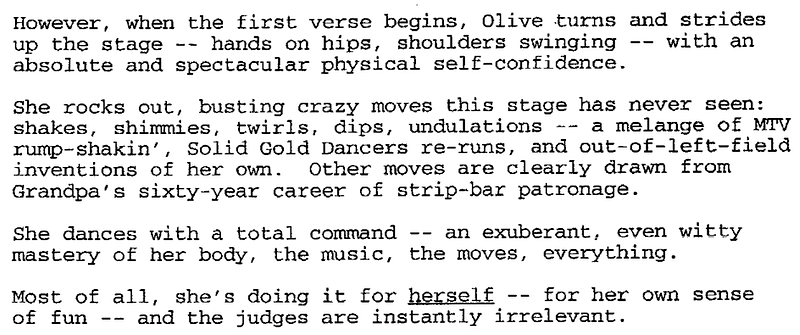
This is the way screenwriter Michael Arndt describes the Olive performance scene in Little Miss Sunshine. He didn’t direct the movie (Jonathan Dayton and Valerie Faris did). The beauty of what Arndt wrote is that while not choreographing Olive’s routine, he communicates tone, atmosphere, action… and fun. Moreover, he also conveys the single most important aspect of the moment: Olive’s emotional state of being. Most of all, she’s doing it for herself.
It should be noted that in 2007, Arndt also won a Best Original Screenplay Award for Little Miss Sunshine.
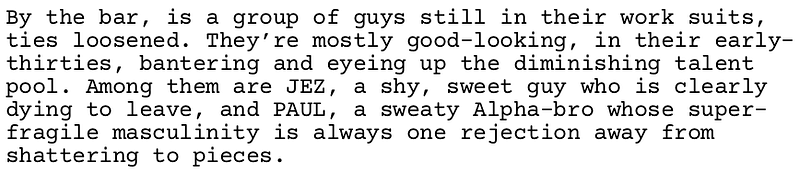
Here, too, Fennell hits on the mood of the moment. Plus, when introducing a pair of characters — JEZ and PAUL — she engages in commentary about their respective personalities. Sure, the descriptions are “unfilmable,” but in the real world of screenwriting, nowadays it is virtually an expectation for us to include a one-two line thumbnail description of a character when introducing them. As Aline Brosh McKenna once advised a group of writers at a Black List feature writers lab on the very subject of what to do when introducing a new character, “Answer this question: They’re the kind of person who…”
Look, there’s a lot of advice floating around the online screenwriting universe. If anyone tells you there are “rules,” I would advise you end that conversation, open a successful movie script, and read that instead.
Remember: A screenplay is not a refrigerator manual. It should be a “pleasurable read.”
I am editing my post because I just saw this tweet in the PYW thread:
That may be true. Whenever a writer goes against convention, they run the risk of script readers dinging the script or even dismissing it as “amateurish.” However, there are plenty of smart people in Hollywood who are looking for great stories, writers with a distinctive voice, and who by and large don’t give a shit about format and style. What they are looking for is to be emotionally engaged by the story and that means compelling characters, story concept, plot, and narrative voice.
What I choose to believe — and I have enough anecdotal evidence to sustain this belief from countless writers I know who have broken into the business with unconventional stories and/or storytelling approaches — if you write a great script, someone in a position to make something happen will find it.
Honestly, I don’t know how anyone writing a spec script can summon the time, effort, and — frankly — courage to take on that project if their hope is to set it up in Hollywood.
Obviously, you are free to choose whatever you believe. I just don’t anyone who works in the Hollywood acquisition and development community who is not looking for The Next Great Script. And in that community, story trumps everything else.
By the way: Promising Young Woman is a 139-page screenplay. Its structure completely blows out of the water any sort of “this has to happen on this page and that needs to happen on that page” paradigm. Yet, when reading it, the story plays just like a movie, and is engaging and entertaining throughout.
For a deep dive and analysis of the screenplay for Promising Young Woman, including my take on the controversial ending, go here for a six-part Go Into The Story series.
Download the screenplay here.
Page One is a daily Go Into The Story series featuring the first page of notable movie scripts from the classic era to contemporary times. Comparing them is an excellent way to study a variety of writing styles and see how professional writers start a story.
For more Page One posts, go here.
You may follow the daily conversation on Twitter as I cross-post there: @GoIntoTheStory.