Page One: “Point Blank” (1967)
Screenplay by Alexander Jacobs and David Newhouse & Rafe Newhouse, novel by Donald E. Westlake
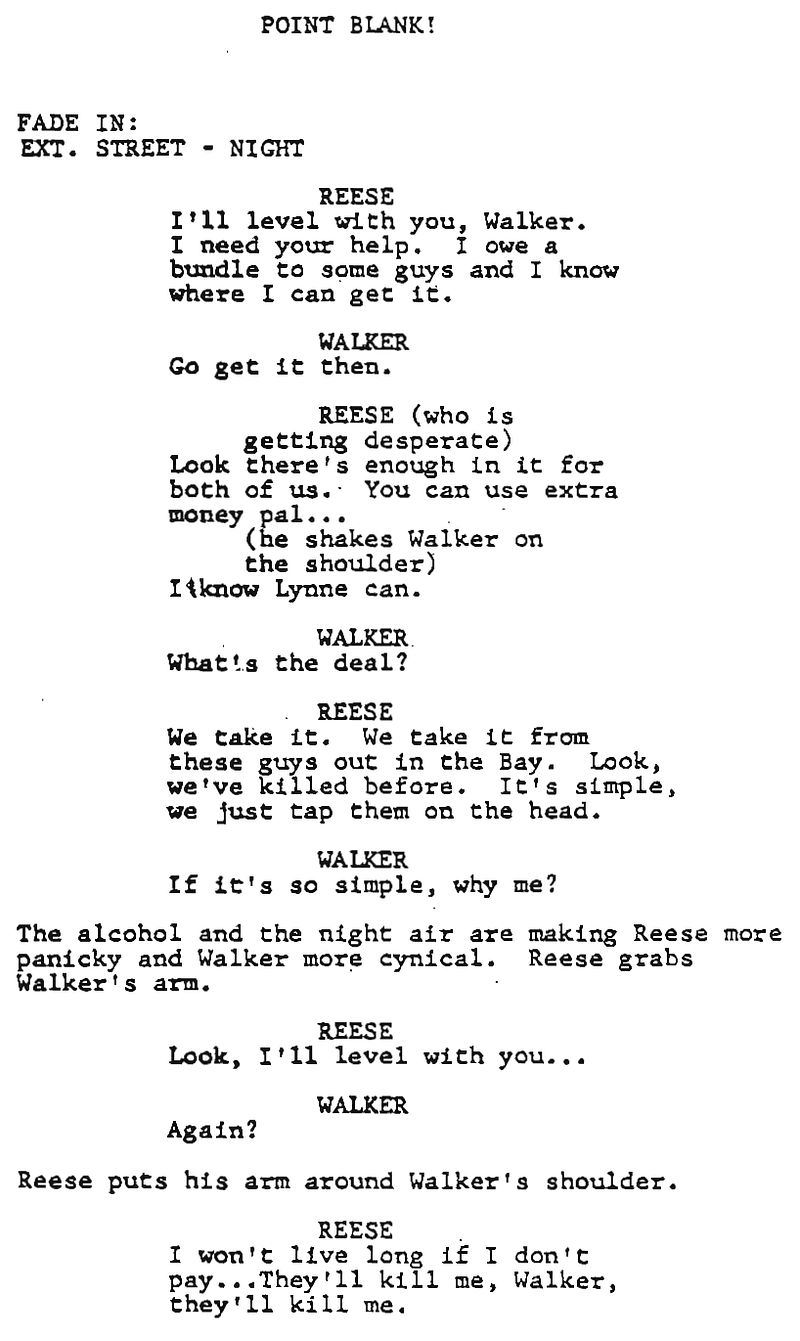
Screenplay by Alexander Jacobs and David Newhouse & Rafe Newhouse, novel by Donald E. Westlake
The movie’s official trailer:
The Alexander Jacobs’ version of the script has quite a history, especially since it was such an influence on Walter Hill. From the Go Into The Story archives:
“Alex Jacob’s script of Point Blank (1967) was a revelation. He was a friend (wonderful guy, looked like a pirate, funny and crazy). This revelation came about despite a character flaw of mine. I have always had difficulty being complimentary to people whose work I admire, when face-to-face with them. This is not the norm in Hollywood where effusiveness is generally a given. Anyway, a mutual friend told Alex how much I admired Point Blank and John Boorman. Alex then very graciously gave me a copy of the script. This was about the time he was doing The Seven-Ups (1973).
“Anyway, by now I’d been making a living as a screenwriter for maybe two or three years and had gotten to the point where I was dissatisfied with the standard form scripts were written in — they just all seemed to be a kind of subliterary blueprint for shooting a picture and generally had no personal voice. Mine were tighter and terser than the average, but I was still working with the industry template and not too happy about it. Alex’s script just knocked me out (not easy to do); it was both playable and literary. Written in a whole different way than standard format (laconic, elliptical, suggestive rather than explicit, bold in the implied editorial style), I thought Alex’s script was a perfect compliment to the material, hard, tough, and smart — my absolute ideals then. So much of the writing that was generally praised inside the business seemed to me soft and vastly overrated — vastly oversentimental. Then and now, I haven’t changed my opinions about that. But I have changed them about the presentational style.
“Anyway I resolved to try to go in that direction (that Alex had shown), and I worked out my own approach in the next few years. I tried to write in an extremely spare, almost haiku style, both stage directions and dialogue. Some of it was a bit pretentious — but at other times I thought it worked pretty well. I now realize a lot of this was being a young guy who wanted to throw rocks at windows.
Point Blank led Walter Hill to develop his “haiku-style” of screenwriting which has influenced many screenwriters including Andrew Stanton when he wrote the script for Wall-e.
Download the Point Blank script here.
FOR EDUCATIONAL PURPOSES ONLY!
Page One is a daily Go Into The Story series featuring the first page of notable movie scripts from the classic era to contemporary times. Comparing them is an excellent way to study a variety of writing styles and see how professional writers start a story.
For more Page One posts, go here.
You may follow the daily conversation on Twitter as I cross-post there: @GoIntoTheStory.