Page One: “Misery” (1990)
Screenplay by William Goldman, novel by Stephen King
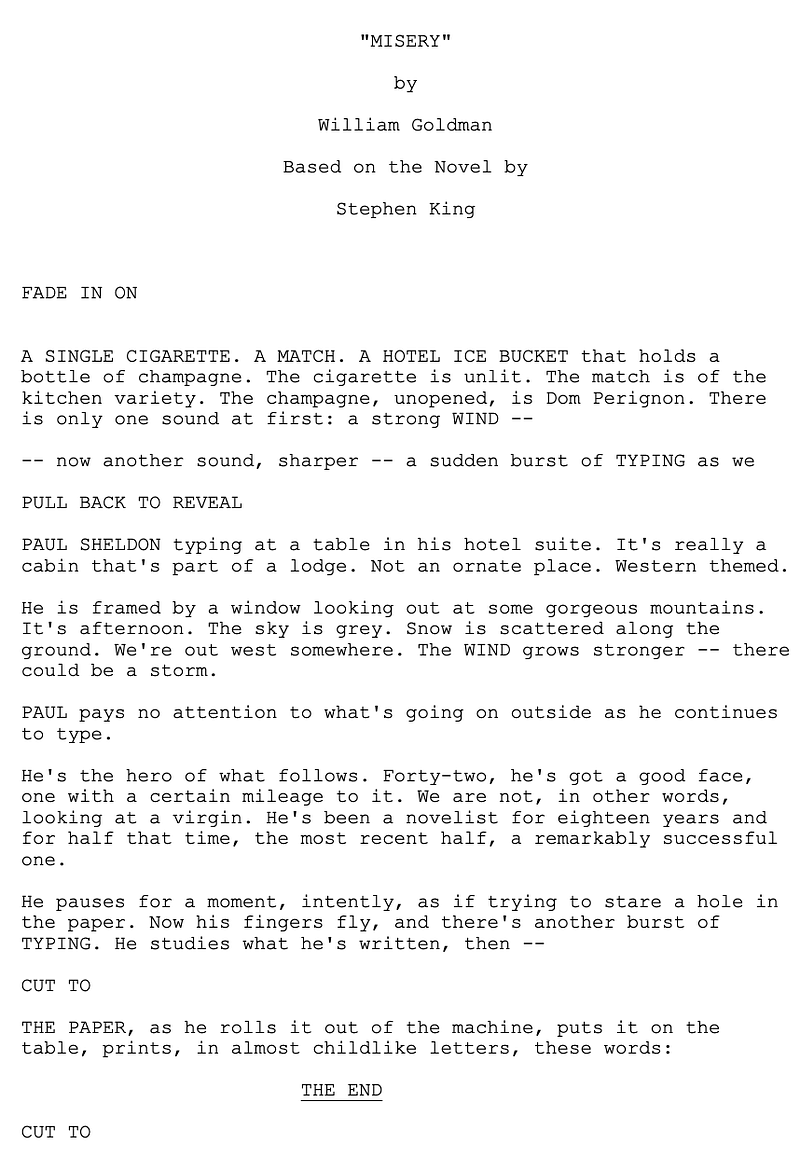
Screenplay by William Goldman, novel by Stephen King
The movie version of the opening:
This. This is how you want to write a screenplay.
Oh, sure, Myers! It’s fucking William Goldman adapting a novel by fucking Steven King! How am I supposed to hit that mark?
I’m not talking content. I’m talking style. There is a clear, distinct narrative voice in the scene description. It’s a writer writing about a writer. This NV understands the process of writing. The value of lean writing. Of varying the length of sentences. Sometimes, not even using complete sentences. Minimum words. Maximum impact. Visual. Evocative. A good read.
There’s also this: Goldman knows how to write for movie stars. Consider the introduction for Paul Sheldon. He’s intent… intense… focusing on the writing. And the writing is described in a way to suggest action: a burst of typing… fingers fly. But it’s this paragraph which provides a key object lesson for screenwriters:

Imagine you’re James Caan reading this. This description is not just about Paul Sheldon. This description is William Goldman trying to seduce James Caan to want to do this role.
Man, you are a hero. You’re handsome, you’ve lived the kind of life where you’re wise, but also a prodigious lover. You’re a novelist, for God’s sake, how cool is that? Not only a novelist, a remarkably success novelist.
Goldman wrote this: “Stars, you have to understand, play gods. They have be perfect. They can’t have a flaw unless they can wink at the audience and say, ‘I’m really wonderful.’ “
Part of our job as screenwriters is to seduce actors to play the roles we write.
What’s the takeaway? Neither you nor I are William Goldman, arguably the dean of contemporary screenwriting. But we can sure as hell learn from him by reading his scripts, studying his style, appreciating his narrative voice, and learning how to woo actors to the characters we write.
Read the screenplay here.
FOR EDUCATIONAL PURPOSES ONLY!
Page One is a daily Go Into The Story series featuring the first page of notable movie scripts from the classic era to contemporary times. Comparing them is an excellent way to study a variety of writing styles and see how professional writers start a story.
For more Page One posts, go here.
You may follow the daily conversation on Twitter as I cross-post there: @GoIntoTheStory.