Page One: “Heat” (1995)
Written by Michael Mann
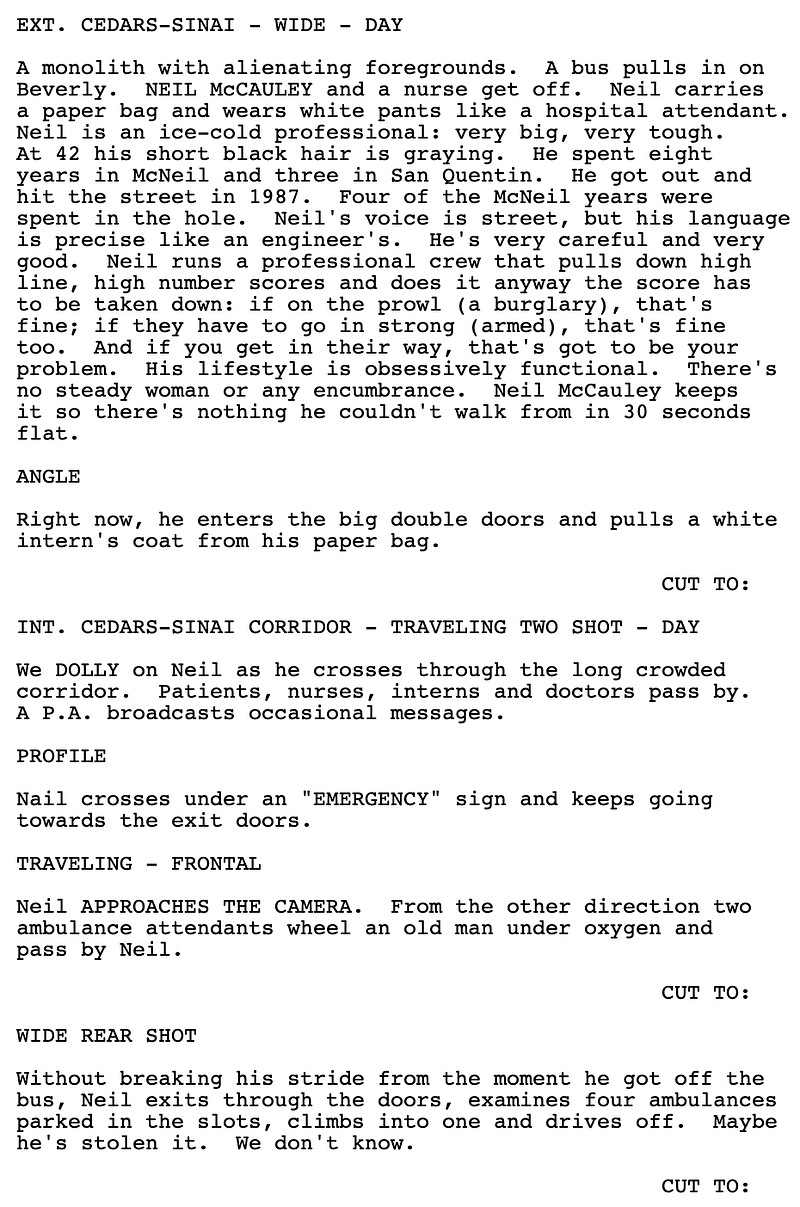
Written by Michael Mann
The movie version of the opening:
Two things right off the bat:
- The script was written in 1995 and screenplay style has changed considerably since then. It’s rare to see a screenplay with an eighteen-line paragraph of scene description, let alone the first paragraph. More common nowadays: Paragraphs three lines or less. But…
- … this is not a spec script, this is a director’s draft. Since there are obvious changes between the action in the script and the movie version of the opening, this is likely not a production draft, but still, when a director with the standing in the business such as Michael Mann is writing a script, they have enormous latitude in how they approach the format and style of that script. Basically, they can do anything they want.
The subtext of which for those writing a spec script: We’d be unwise to write with this approach to screenplay style. The contemporary stylistic conventions include few to no camera shots or directing jargon, some but not a lot of writer commentary on the action, break up scene description into more readable paragraphs, and so forth.
That said don’t overlook an obvious takeaway from Page One of Heat: We can write visually, indeed, should do so. Movies and television are primarily a visual medium. We play to the medium’s strength when we embrace visual writing. Moreover, we can achieve that without using camera or directing jargon. Two keys: (1) Use separate paragraphs of scene description to suggest individual camera shots. (2) Just describe what the “shot” is. You don’t need to write “We see,” simply describe what you envision in your mind’s eye.
One other takeaway: Mann’s introduction of McCauley is an extensive take on the character’s backstory. It’s like a mini-biography. When writing a spec script, that much detail would be unconventional. This might be something which a script reader would expect:
McCauley, 42, big, tough, eight years in San Quentin, four in the hole. Street voice, but an ice-cold professional. Tonight, he’s on the prowl.
A couple of lines of writer commentary to establish the character in the mind of the reader, essentially providing them a lens through which to “see” this figure. In fact, we’re expected to do something like that with all the primary characters we introduce.
Again, something to consider: Who do you think Mann’s audience is for that first paragraph? I’d say… THE ACTOR! Imagine Robert De Niro cracking this script open for the first time and reading that bio. After just those eighteen lines, he’s probably, “I’m in.” Which is to say that screenplays are, as my DePaul colleague Brad Riddell often says, “actor bait.” Therefore, when you introduce characters, especially the Protagonist, write something which has the potential to hook their interest right away.
I fear Matt is right. Hollywood has too many script readers with little appreciation for Story to get past style or format “issues.”
Too bad. Heat is a great script.
FOR EDUCATIONAL PURPOSES ONLY!
Page One is a daily Go Into The Story series featuring the first page of notable movie scripts from the classic era to contemporary times. Comparing them is an excellent way to study a variety of writing styles and see how professional writers start a story.
For more Page One posts, go here.
You may follow the daily conversation on Twitter as I cross-post there: @GoIntoTheStory.