Page One: “Gemini Man” (2019)
Screenplay by David Benioff and Billy Ray and Darren Lemke, story by Darren Lemke and David Benioff
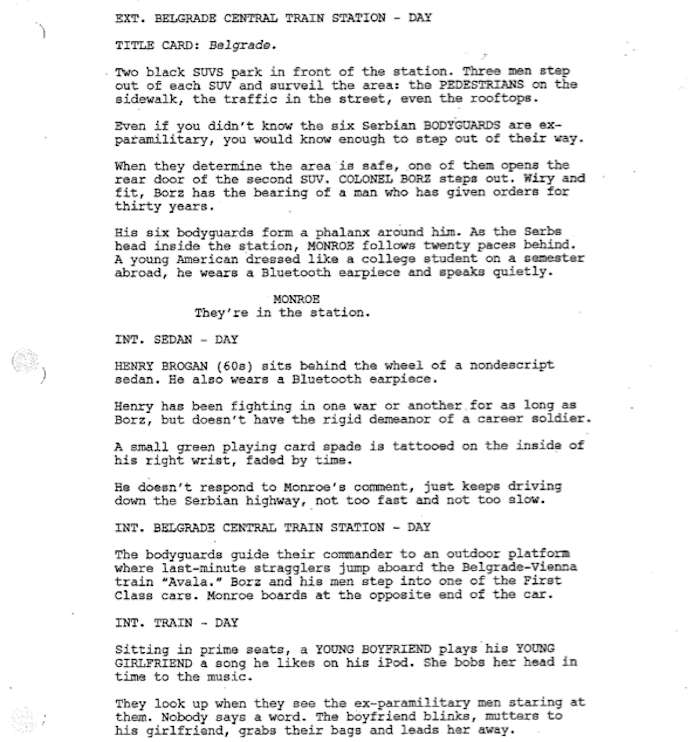
Screenplay by David Benioff and Billy Ray and Darren Lemke, story by Darren Lemke and David Benioff
A trailer for the movie:
FOR EDUCATIONAL PURPOSES ONLY!
Page One is a daily Go Into The Story series featuring the first page of movie and TV scripts from the classic era to contemporary times. Comparing them is an excellent way to study a variety of writing styles and see how professional writers start a story.
For more Page One posts, go here.
Here’s a reprint of an article I wrote in October 2019 when Gemini Man was released in theaters.
The Hollywood Reporter has an article out today about screenwriter Darren Lemke and the movie project he originated: Gemini Man.
Sitting near the back of the Chinese Theatre, in between his wife and his parents, Darren Lemke watched the big Imax screen light up, Gemini Man unfolding before his eyes.
He was at the Paramount-Skydance movie’s Sunday night premiere and had walked the red carpet not too far from star Will Smith and director Ang Lee. And why not? He had his name in the credits, right next to David Benioff, the famous co-creator of the Game of Thrones TV show, and Billy Ray, who was nominated for an Oscar for writing Captain Phillips.
But Lemke was having a vortex of emotion and in the midst of a surreal, almost out-of-body experience that was also tinged with a bittersweetness.
Because despite having his name in the credits, despite walking the red carpet, Lemke had nothing to do with the movie currently playing onscreen.
But the fact that the movie exists at all has everything to do with him. And that’s because Gemini Man is a quirky example of how no idea is truly dead in Hollywood, shows that every movie has its own road to the screen and reminds people that the 1990s spec script market was its own wild animal. [emphasis added].
This story is an example of what Hollywood screenwriters refer to as ‘development hell’ because the movie Gemini Man, which hits theaters this weekend, originated as a pitch over two decades ago:
It was 1997. The spec market driven by high-concept ideas and hotshot writers such as Joe Eszterhas and Shane Black and Ed Solomon and Dan Waters, sometimes creating bidding wars and commanding seven figure deals with maybe their own bar thrown in as part of the package, was still running hot. Big ideas were in demand.
In that context, the producer, Don Murphy, who had already developed a reputation for aligning himself with promising material (he had been a producer on Natural Born Killers, written by Quentin Tarantino and directed by Oliver Stone), liked what he read enough that, after a series of conversations, he flew Lemke out on his own dime to Hollywood, putting him up at the Best Western on the Sunset Strip.
It was a whirlwind. Lemke met with filmmakers and studios. He got an agent at UTA and an attorney.
“In one week, I sold two pitches,” he recalls.
One of them happened to be Gemini Man, a story about an assassin trying to get out of the business who is forced to battle his own clone that is 25 years younger and at the top of his abilities. It had a Western vibe, and was, in Lemke’s words, Shane-like in its telling about a man who latches on to a mother and son, looking for some peace only to be hunted down by his younger self.
You can read the rest of the article here and track the movie’s labyrinthine path from pitch to finished product, but I want to zero in on two points noted in the Hollywood Reporter piece:
- Lemke had nothing to do with the movie currently playing onscreen
Apparently, after writing several drafts of the project in the late 90s, Lemke was cut off from the script development process as a slew of screenwriters took a crack at the story including Brian Helgeland, Andrew Niccol, Jonathan Hensleigh, Benioff, and Ray. It is easy to see how the people involved in making the movie based on the production draft might think Lemke had “nothing to do” with the film they were shooting, but that is not only a slap in the face to the original screenwriter, it also shows a decided lack of understanding about what constitutes a writer’s involvement in a shooting script. At least the article mentions this:
- Gemini Man is a quirky example of how no idea is truly dead in Hollywood
The mere fact Lemke originated the story concept is noteworthy. As another screenwriter tweeted yesterday:
It is impossible to overstate the importance of a story concept to a movie project. Check out these comments by some other Hollywood writers:
“Most aspiring screenwriters simply don’t spend enough time choosing their concept. It’s by far the most common mistake I see in spec scripts. The writer has lost the race right from the gate. Months — sometimes years — are lost trying to elevate a film idea that by its nature probably had no hope of ever becoming a movie.”
— Terry Rossio (Aladdin, The Mask of Zorro, Shrek, Pirates of the Caribbean: The Curse of the Black Pearl)
“Ideas cost NOTHING and require ZERO risk. And yet, oddly, the LEAST amount of time’s usually spent in the idea stage before a small fortune is dumped on a whimsy that’s still half-baked… Ideas cost nothing yet have the potential to yield inexplicably long careers and happy lives.”
— Kevin Smith (Clerks, Mallrats, Chasing Amy, Dogma, Zak and Miri Make a Porno)
“The idea is still king. Spend 90% of your time working on the idea.”
— Tony Gilroy (The Bourne Identity, Michael Clayton, Rogue One: A Star Wars Story
This is particularly true nowadays. When the major studios are addicted to preexisting IP, hence, all of the sequels, prequels, shequels, remakes, and reboots, and they refer to original story ideas as “untested content,” a spec script’s story concept can often make or break the project’s potential.
But Lemke not only originated the story concept for Gemini Man. As the Hollywood article notes:
While Lemke wasn’t involved in the making of the movie at all (numerous, and at this stage, uncredited, writers contributed to the final shooting script) earlier this year he returned to his baby to claim at least some parentage, filing arbitration with the WGA for credit.
Some elements had changed; it was now more of an espionage story, the female lead was a kick-ass spy, but Lemke was awarded story by credit and screenplay by credit.
Per the Writers’ Guild of America ‘Screen Credits Manual,’ there are four major areas of consideration in determining a movie’s writing credits during the arbitration process:
The percentage contribution made by writers to screenplay obviously cannot be determined by counting lines or even the number of pages to which a writer has contributed. Arbiters must take into consideration the following elements in determining whether a writer is entitled to screenplay credit:
— dramatic construction;
— original and different scenes;
— characterization or character relationships; and
— dialogue.
It is up to the arbiters to determine which of the above-listed elements are most important to the overall values of the final screenplay in each particular case. A writer may receive credit for a contribution to any or all of the above-listed elements. It is because of the need to understand contributions to the screenplay as a whole that professional expertise is required on the part of
the arbiters.
For example, many lines of dialogue may be changed, and the arbiters might still find the changes not significant enough to warrant screenplay credit. On the other hand, a small number of lines of dialogue may be changed in such a significant manner that the arbiters deem them highly contributive to screenplay credit.
Here are the final WGA writing credits for Gemini Man:
Screenplay by David Benioff and Billy Ray and Darren Lemke, story by Darren Lemke and David Benioff
The use of the word “and” means that the screenwriters worked independently of each other, not as teams. While Benioff and Ray being in first and second position indicates they contributed more to the shooting script than Lemke, the fact he received a shared screenplay credit suggests that Lemke’s scripts — which all preceded Benioff and Ray — contributed enough in the way of dramatic construction, original scenes, characterizations and character relationships, and dialogue to be entitled to that credit. The fact Lemke is in first position with regard to the ‘story by’ credit points to the influence of the story concept and narrative elements associated with the underlying story idea.
I have participated in perhaps a dozen WGA credit arbitrations as an arbiter and I have always given considerable weight in my determination to the writer who came up with the original story concept. As Daniel Kunkel suggests, “That simple idea is sometimes harder and more important than anything.”
Takeaway: When writing a spec script or developing a pitch, make sure you are working with a strong story concept. It is worth its virtual weight in gold.
For the rest of the Hollywood Reporter article, go here.
To download a copy of the WGA Screen Credits Manual, go here.