Page One: ‘Django Unchained’ (2012)
Written by Quentin Tarantino
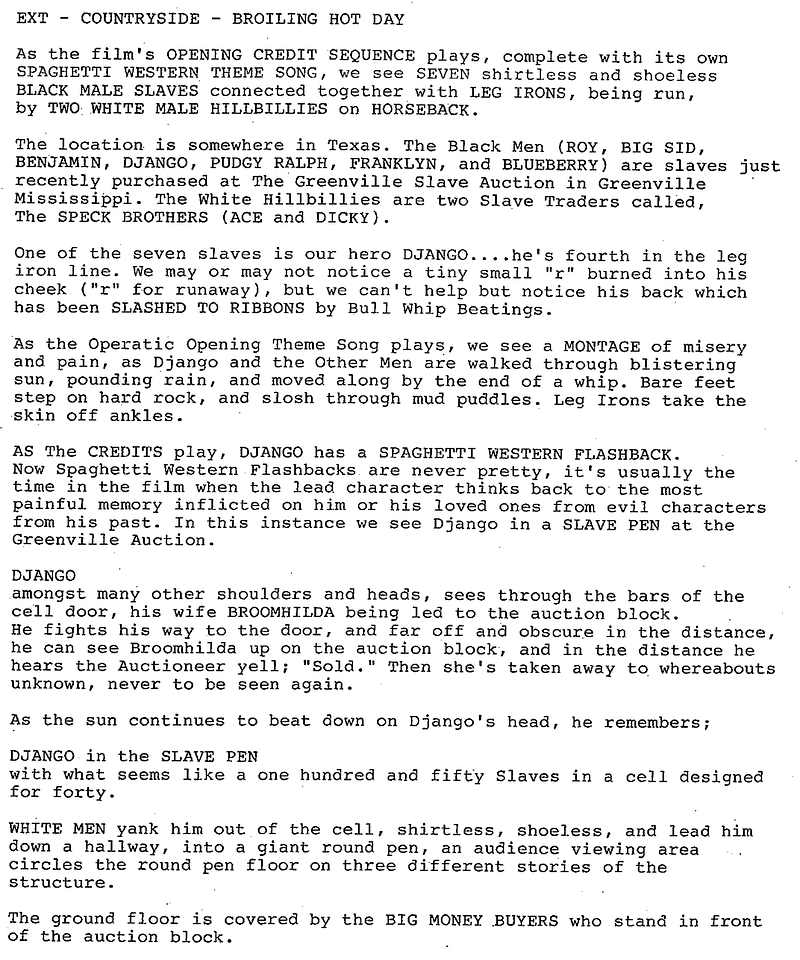
Written by Quentin Tarantino
The movie version of the opening:
A thought experiment: Assume you’re new to screenwriting and you read the screenplay from Django Unchained or any Quentin Tarantino-peneed script. You may think:
- I’m supposed to include a credit sequence!
- I need to use we see to suggest camera shots!
- I’m responsible for suggesting soundtrack music!
- I can break the fourth wall and converse with the reader!
- I’m allowed to write paragraphs of scene description up to 7 lines long!
Among other things.
Here’s a fact: There’s no rule saying you can’t do any of these things. The reality is there do exist some loosely held expectations and conventions relative to screenplay style and format you should be aware of.
Now if you’re Quentin Tarantino, you can do any damn thing you want! He’s an established professional and a director to boot. In effect, he’s writing something akin to a shooting script and includes elements which suggest how he’s going to go about framing shots, use montages to enter the inner thoughts of characters, and so forth.
Even though you’re not Tarantino, you have the freedom to do any damn thing you want, too. Again, there are no rules.
And yet, I hear from writers that their scripts get dinged by readers for doing precisely what Tarantino does in his writing precisely because the readers have come to think of these so-called ‘rules’ as being prohibitive.
The path of least resistance? Avoid breaking conventions. That’s the simplest way around this issue. If, however, your story requires you to, let’s say, break the fourth wall and comment directly to the reader… or include specific camera shots to make absolutely clear what is happening in the moment…
You can do that. Don’t let anything impeded your creativity. As long as what you do serves the story you are writing and that is clear to a reader…
I say, go for it.
[Although speaking as someone who reads thousands and thousands of script pages every year, please try to keep your paragraphs of scene description to a maximum of three lines. It makes the reading experience much easier.]
Page One is a daily Go Into The Story series featuring the first page of notable movie scripts from the classic era to contemporary times. Comparing them is an excellent way to study a variety of writing styles and see how professional writers start a story.
For more Page One posts, go here.
You may follow the daily conversation on Twitter as I cross-post there: @GoIntoTheStory.