Page One: “August: Osage County” (2013)
Screenplay by Tracy Letts
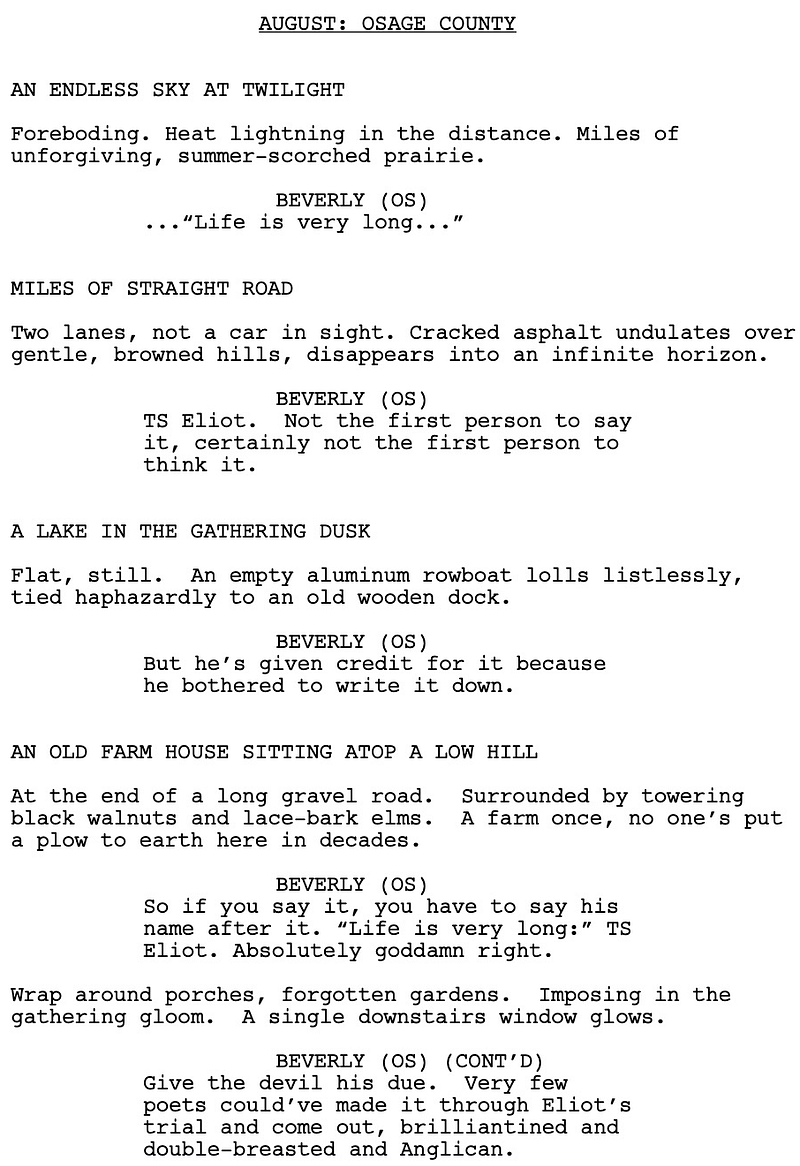
Screenplay by Tracy Letts
The movie version of the opening:
Astute observers will note that Tracy Letts handled Scene Headings as Shots. And not only as Shots, but ones with extended descriptions.
AN ENDLESS SKY AT TWILIGHT
MILES OF STRAIGHT ROAD
A LAKE IN THE GATHERING DUSK
AN OLD FARM HOUSE SITTING ATOP A LOW HILL
While this stands in contrast to the conventional Scene Heading:
EXT. SKY-NIGHT
EXT. ROAD-DAY
EXT. LAKE-DUSK
EXT. FARM HOUSE-DAY
I prefer the more “literary” and less “scripty” approach.
FOR A SPEC SCRIPT!
I’m not talking a production draft / shooting script.
I’m talking about a script you write to tell a story. To lure a reader so deeply into your story universe, they forget they are reading something in screenplay format.
I’m not sure we can call the approach Letts uses a trend, but I have seen something like it in other contemporary scripts. For example, a 2015 Nicholl Fellowships in Screenwriting Award-winning script Great Falls, written by Andy Friedhof, looks like this:

In my interview with Friedhof, he commented on this stylistic choice:
Scott: Speaking of a visual medium, that’s one thing that’s very striking about the script, is your embrace of that in seeing the scripts. It’s a very strong visual sensibility and lots of specific and vivid images. How aware are you of that and how much of that is just instinctive?
Andy: That’s something that’s developed over time. You probably noticed for example that I don’t use conventional sluglines in my script.
Scott: Yes.
Andy: I think it’s an act of folly to write a screenplay as though you’re going into production tomorrow. The first thing you should aim for is to provide a fun and enjoyable reading experience for the reader.
What I really want to do with my scripts is take people through the experience of watching the movie. You might have noticed that I often start scenes with close‑ups on objects or specific details in the scene. That’s how films are shot, basically. When a film is edited together they generally don’t start scenes with wide shots of the interior of a room. So it doesn’t really make much sense to start every scene with some variation on INT. ROOM — DAY. For me, it’s really important to capture the energy, movement and spirit of film.
As screenplay format exists in a constant state of evolution, when writing a spec script or even a development draft before pre-production or production, writers should feel free to use whatever style they need in order to best tell their story.
Page One is a daily Go Into The Story series featuring the first page of notable movie scripts from the classic era to contemporary times. Comparing them is an excellent way to study a variety of writing styles and see how professional writers start a story.
For more Page One posts, go here.