On the Page: LADY BIRD
ScreenwritingMasterClass.com offered its first free online class last Saturday. Hosted by Tom Benedek, the topic was: Brainstorming…

ScreenwritingMasterClass.com offered its first free online class last Saturday. Hosted by Tom Benedek, the topic was: Brainstorming Characters (Case Study: Lady Bird).
Greta Gerwig’s script is clear, clean, emotionally dense and moving.
Throughout the pages, she speaks directly to the reader — the screenwriter’s version of what is known, in theatre and film, as the Fourth Wall — when a character literally turns to the audience and shares information with them.
The Fourth Wall is the space that separates a performer or performance from an audience; the conceptual barrier between a fictional work and its viewers or readers.
On screen, breaking the fourth wall happens when a character speaks directly into the lens to the audience — as in this scene from Fight Club:
In a script, breaking the fourth wall refers to the writer’s speaking directly to the reader on the page.
Usually we describe actions or events literally for the camera. However, the writer can also provide key information about a scene, moment or place directly to the reader, offering emotional flavor or sharing how something might feel to the character.
Lady Bird does this often. And, I think, very effectively.
In screenwriting, breaking the fourth wall allows for:
1.Quick and concise statements about how a screen moment is meant to feel
2.Glimpses into a character’s mind in an important moment
3.Insight into, or reflection upon, the long-term impact of a scene
Used judiciously, it can help with pacing; adding insight into the action; defining the impact or meaning of a moment or scene; letting the reader know directly how something feels to a character.
Here are some examples from the screenplay.
The last line above emphasizes Lady Bird’s emotions in the moment as well as providing a bit of back story.
The Dream House has its own subplot, intertwining important characters. The first line of description provides emotional coloring as well as foreshadowing:

Later in the script, the writer uses fourth wall to provide closure to a big dramatic scene, offering commentary on the future of a difficult relationship:

In the following section the writer uses the strategy to indicate the meaning/emotional flavor of a brief montage, as opposed to describing each shot or behavior:
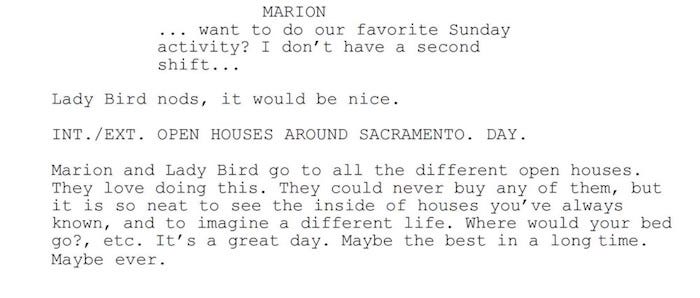
In the next example the writer uses the technique to justify the pivot of the protagonist’s mood in a previously playful scene, pre-dialogue:

Used strategically, the fourth wall can be an invaluable tool for adding impact and engaging readers.
I encourage you to experiment with it.
More Next Week on the Lady Bird script: Scene Structure and Dialogue
Upcoming at Screenwritingmasterclass.com:
CRAFT: WRITING THE CHARACTER DRIVEN SCRIPT
Successful scripts bring vibrant, accessible characters to life on the page. David O. Russell and Alexander Payne consistently breathe life into the characters in their films. We will mine their scripts and films to discover useful and simple character creation techniques, with some Lady Bird material to discuss as well. We will look at examples of character development in these scripts along with specific methods that can be employed at all stages of writing your own script.
PAGES TV: PILOT SCRIPT WORKSHOP
Brainstorm your series concept and write the pilot script in this 10-week online workshop which will provide you with thorough grounding in TV pilot script structure, episodic story development, family of characters, the series bible and more as you go from idea to script.