On Storytelling: Thoughts, Feelings, Mentors, and Attractors
Reflections on two primary character archetypes.
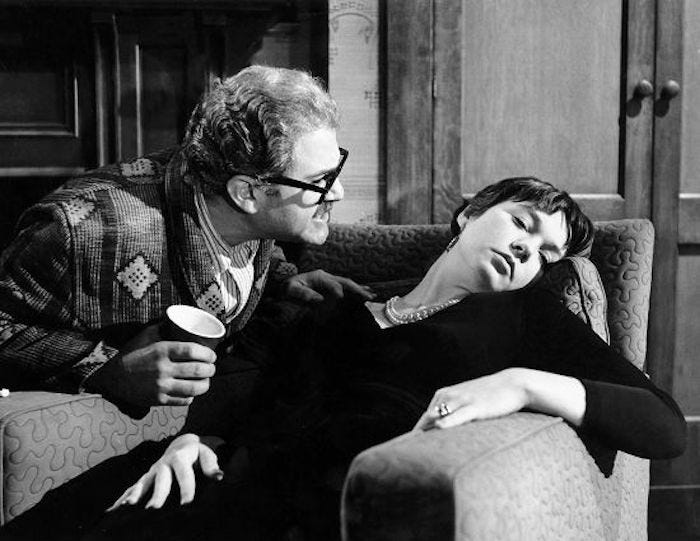
Reflections on two primary character archetypes.
In Part II of my book The Protagonist’s Journey, I explore five primary character archetypes present in countless movies and television series: Protagonist, Nemesis, Attractor, Mentor, Trickster. I call them The Family of Characters.

I find working with these character archetypes both a helpful and fascinating way to develop a story.
In my book, I draw a distinction between the Attractor and Mentor figures. Both impact the behavior of the Protagonist, but in different ways: While the Attractor is most connected to the emotional development of the Protagonist, the Mentor is most connected to the character’s intellectual development. Hence, these associated images:

Recently, when I led a class session on this subject, one of my students wrote this:
I don’t see them just as providing intellectual information and helping with what the Protagonist does, but also more essentially who the Protagonist is, or becomes. For example, in The Apartment, Dr. Dreyfus seems more like a moral compass for Baxter and helps fundamentally change who Baxter is as a person. Or do we say that the “wisdom” Dr. Dreyfus provides allows Baxter to change himself? Or do we say that the wisdom the doctor provides allows Baxter to change his relationship with his Nemesis and thus Baxter changes as a person, and its Baxter doing the changing?
Here is my response:
I would hope they way I discuss Mentor archetypes it doesn’t come across as if I am suggesting they only provide “intellectual” insight. The contrast of Head (Mentor) vs. Heart (Attractor) is a simple way of short-handing the fundamental distinction between their respective narrative functions. It’s a starting point for discussing the two character types.
I assert that at its core, a story asks this question of the Protagonist: Who are you? Everything that happens … all of the plotline events … all of the character interactions feed into what is essentially an existential question. Who are you? The Protagonist begins in a state of Disunity. They are disconnected from their authentic nature. That’s the reason why the Universe creates a circumstance (Inciting Incident / Call to Adventure) which pulls the Protagonist out of their Ordinary World and into the Extraordinary World — to force them to confront who they are and change. In most stories, certainly those coming out of Hollywood, that change is a positive one, what I call the Unity Arc.
If all that is true, then consider that broadly speaking, the Protagonist’s psyche can be divided into two basic aspects: Feelings and Thoughts. [Obviously, the character — like all human beings — is more complex than that, however, from a story-crafting perspective, it is helpful to work with character development with these two frames of reference.
So generally speaking, the Attractor is most connected to the Protagonist as they process their Feelings state. And the Mentor is most connected to the Protagonist as they process their Thoughts state. In order to move toward a state of wholeness (Jung language), the Protagonist needs to integrate both aspects. Feelings. Thoughts.
What they feel about who they are.
What they think about who they are.
So when I say “intellectual,” I am referring to that entire process the Protagonist goes through in reflecting about what they are learning along the way in their journey.
Some of that is knowledge they learn about this new world into which they have entered. Often, the Mentor provides insights there (“Follow the yellow brick road” — The Wizard of Oz).
Some of that is wisdom they learn on how to live an authentic life (“Be a mensch” — The Apartment).
Some of that is insight into their (the Protagonist’s) own nature (“Luke, go with your feelings” — Star Wars: A New Hope).
Dr. Dreyfuss is one of my favorite Mentor characters. Part of that is because he’s in my very favorite movie of all-time: The Apartment. But as you point out, he provides a piece of wisdom to Baxter that is both about living an authentic life and goes to the core of Baxter’s existential dilemma: Are you a lemming mindlessly climbing the corporate ladder to some morally diminished realm called “success,” or are you a human being? So when Baxter throws that line back at Sheldrake:
J.D. Sheldrake: What’s gotten into you, Baxter?
C.C. Baxter: Just following doctor’s orders. I’ve decided to become a “mensch”. You know what that means? A human being.
J.D. Sheldrake: Now, hold on, Baxter…
C.C. Baxter: Save it. The old payola won’t work anymore. Goodbye, Mr. Sheldrake.
It’s not only one of the greatest callbacks in the history of movie dialogue, it also answers the existential question confronting the story’s Protagonist: Who are you?
Baxter’s answer: I am a human being.
Circling back to your original point, a Mentor is much more than dealing with the Protagonist’s intellect. They primarily traffic in the realm of the Protagonist’s thoughts. Meanwhile, the Attractor is “at work” on the Protagonist’s feelings. The Protagonist needs to confront, process, and integrate both aspects of their self in order to move toward wholeness.
Having said all that, I’m sure it reads very psychological and perhaps even complicated, but this goes back to a previous discussion about Receptive and Executive Writing.
Receptive is more about Feelings.
Executive is more about Thoughts.
So we, in our own way, go through a process of integrating what we learn about our characters so we move toward a state of wholeness in understanding them.
I should note the underlying principle for the subject of archetypes is this:
Character = Function
I am talking about a screenplay. In a movie or TV episode, every character exists for a reason. They have a narrative function. That function can be typified as a character’s archetype.
In a character-driven approach to screenwriting, we begin the entire story-crafting process by immersing ourselves in the lives of our characters. Through a series of indirect engagement exercises (Questionnaire, Biography, Free Scene) and direct engagement exercises (Interview, Monologue, Stream of Consciousness), we amass a whole host of narrative elements about each key character. Those elements include memories, associations, images, dialogue, themes, psychological dynamics, traumas, wounds, flaws, shadow instincts, and so forth.
That is the stuff of Receptive Writing.
Then we step back and assess what we’ve come up with for each character. We look for patterns of behavior, the nature of relationships between characters, how each ties into the Protagonist and their journey.
That’s often when a character’s fundamental narrative function emerges into view and with it, their archetype.
Knowing a character’s archetype provides a lens through which we may interpret and shape that character’s role in the story — a sort of lens through which we perceive them.
And in this Family of Characters, there are characters who have the most influence on the Protagonist’s intellectual journey (Mentor) … and characters who have the most influence on the Protagonist’s emotional journey (Attractor).
Thoughts. Feelings.
In the end, if the Protagonist’s journey is a unity arc, the Mentor and Attractor participate in shaping the behavior of the Protagonist which enables this central figure to move toward wholeness.
As I say, I explore this in Part II of The Protagonist’s Journey goes even deeper into the subject.
A final thought. If working with character archetypes is helpful to you, great! If not, don’t use them.
Every writer is different. Every story is different. You have to find the way which works best for YOU.
My book The Protagonist’s Journey: An Introduction to Character-Driven Screenwriting and Storytelling is an Amazon #1 Best Seller in Film and Television. Endorsed by over thirty professional screenwriters, novelists, and academics, you may purchase it here. If you want an autographed copy, go here.
For information on courses I teach at Screenwriting Master Class, go here.