Non-Linear Storytelling in “Pulp Fiction”
“Tarantino, whether intended it or not, hit upon non-linearity as the only way he could tell one particular storyline involving the fates…
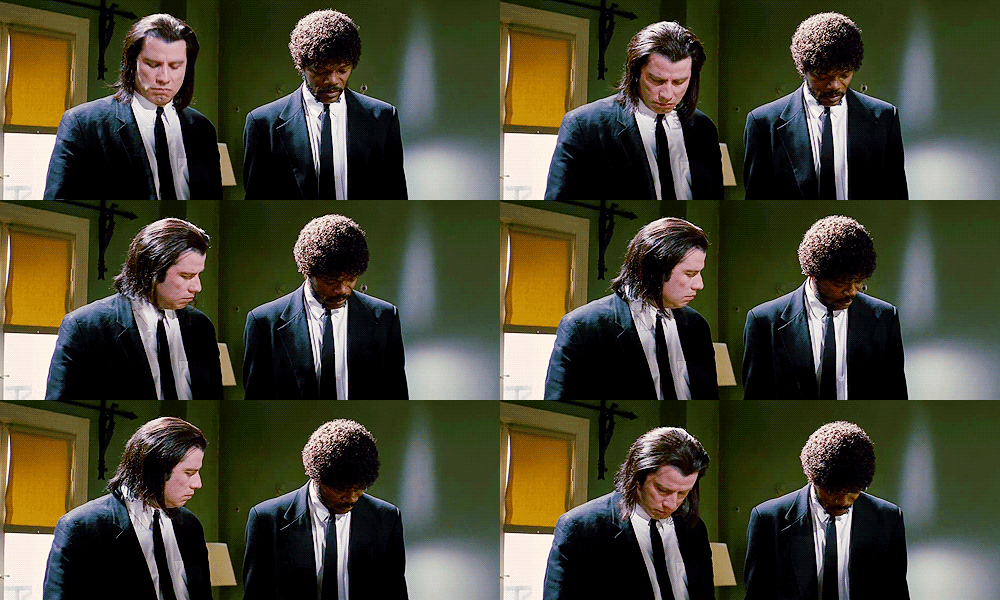
“Tarantino, whether intended it or not, hit upon non-linearity as the only way he could tell one particular storyline involving the fates of Jules and Vincent.”
A great example of non-linear storytelling is Pulp Fiction, written by Quentin Tarantino, stories by Quentin Tarantino & Roger Roberts Avery.
Let’s take a look at individual scenes (Scene) and sets of scenes (Scenes) in the order they appear in the script, tracking the timeline which plays out in a non-linear structure.
SCENE 1 — PUMPKIN AND HONEY BUNNY (P. 1–7)
Coffee shop introduction of two characters, ending with the jittery man and woman as they pull rifles to commit robbery
DATE: UNKNOWN
SCENES 2 — JULES AND VINCENT (P. 7–26)
After the famous “Le Quarter Pounder” business between Jules and Vincent (enforcers for a crime lord named Marsellus Wallace), the pair retrieve a mysterious black briefcase, but not before killing Roger and Brett. The sequence ends with a “Fourth Man” emerging from the bathroom, blasting away at Jules and Vincent, only to end up dead.
DATE: Again unknown, but for our purposes, let’s call this MONDAY MORNING.
SCENE 3 — BUTCH AND MARSELLUS (P. 26–27)
A scene at a topless bar Sally LeRoy’s. Introduces Butch, a prizefighter, and Marsellus, the crime lord. Marsellus bribes Butch to take a dive in an upcoming boxing match.
DATE: MONDAY PM
SCENE 4 — VINCENT AND BUTCH (P. 27–30)
Carrying the black briefcase from Scene 1, Vincent enters Sally LeRoy’s. We learn that Vincent is supposed to take out Marsellus’ wife, Mia, “tomorrow night.” Vincent and Butch cross paths — immediate bad blood.
DATE: MONDAY PM (CONTINUOUS)
SCENE 5 — VINCENT AND LANCE (P. 30–34)
The next night, Vincent visits Lance, a drug dealer, at Lance’s house. Vincent buys some heroin for personal use.
DATE: TUESDAY PM
SCENE 6 — VINCENT AND MIA, PART 1 (P. 34–38)
Vincent drives to Marsellus’ house, meets Mia.
DATE: TUESDAY PM (CONTINUOUS)
SCENES 7 — VINCENT AND MIA, PART 2 (P. 38–50)
At Jackrabbit Slim’s, Vincent and Mia flirt and dance.
DATE: TUESDAY PM (CONTINUOUS)
SCENE 8 — VINCENT AND MIA, PART 3 (P. 50–53)
Mia mistakes Vincent’s heroin for cocaine and overdoses.
DATE: TUESDAY PM (CONTINUOUS)
SCENES 9 — VINCENT AND MIA, PART 4 (P. 53–64)
At Lance’s house, Vincent forces Lance to give Mia a shot of adrenalin to bring her out of her overdose.
DATE: TUESDAY PM (CONTINUOUS)
SCENE 10 — VINCENT AND MIA, PART 5 (P. 64–66)
Vincent drops off Mia at Marsellus’ house.
DATE: TUESDAY PM (CONTINUOUS)
SCENE 11 — BUTCH AS A YOUNG BOY (P. 66–68)
Butch hears a story about how his POW father died in Vietnam and receives his father’s watch as a memento.
DATE: 1972/PRESENT
SCENES 12 — BUTCH (P. 69–77)
Butch escapes from boxing match (he didn’t throw the fight per Marsellus’ bribe) and takes a taxi ride.
DATE: WEDNESDAY PM
SCENE 13 — BUTCH AND FABIAN, PART 1 (P. 77–84)
In a motel room, Butch hooks up with his girlfriend, Fabian, and they plan to skip town the next day.
DATE: WEDNESDAY (CONTINUOUS)
SCENE 14 — BUTCH AND FABIAN, PART 2 (P. 84–92)
Revealed that Fabian left Butch’s watch at his apartment.
DATE: THURSDAY AM
SCENES 15 — BUTCH, PART 1 (P. 92–97)
At his apartment, Butch finds his watch but discovers Vincent in the bathroom. Butch shoots and kills Vincent.
DATE: THURSDAY (CONTINUOUS)
SCENES 16 — BUTCH, PART 2 (P. 97–101)
Butch has a run-in with Marsellus. They both end up in the Mason-Dixon Pawnshop, held captive by Zed and Maynard.
DATE: THURSDAY (CONTINUOUS)
SCENES 17 — BUTCH AND MARSELLUS (P. 101–109)
Butch escapes from Zed, Maynard, and the Gimp, and frees Marsellus. In appreciation, Marsellus grants Butch his freedom. Butch leaves.
DATE: THURSDAY (CONTINUOUS)
SCENES 18 — BUTCH AND FABIAN (P. 109–111)
The couple leaves town on Zed’s motorcycle.
DATE: THURSDAY (CONTINUOUS)
SCENE 19 — THE FOURTH MAN MEETS JULES/VINCENT (P. 112–115)
Same as the very end of Scenes 2, only from the POV of Fourth Man, who is blown away by Jules and Vincent. Jules convinced they survived surprise attack by Fourth Man because of a miracle. They take the black briefcase.
DATE: MONDAY MORNING (3 DAYS BEFORE SCENES 18)
SCENE 20 — JULES AND VINCENT, PART 1 (P. 115–120)
They take the only guy to survive the shoot-out, Marvin, in Vincent’s car. Convinced of the miracle, Jules determines to quit his work as a hired thug. Vincent accidentally shoots and kills Marvin inside the car.
DATE: MONDAY (CONTINUOUS)
SCENES 21 — JULES AND VINCENT, PART 2 (P. 120–126)
At Jules’ friend Jimmie’s house, Jules calls Marsellus about what to do with dead body (Marvin). Marsellus contacts “The Wolf” to help clean up.
DATE: MONDAY (CONTINUOUS)
SCENES 22 — JULES AND VINCENT, PART 3 (P. 127–139)
The Wolf oversees the clean-up operation, prepping Marvin’s body for disposal, and getting Jules and Vincent new clothes, UC Santa Cruz and “I’m With Stupid” T-shirts.
DATE: MONDAY (CONTINUOUS)
SCENE 23 — JULES AND VINCENT, PART 4 (P. 139–143)
Jules and Vincent thank the Wolf for disposing of Marvin’s body. The pair decide to get some breakfast.
DATE: MONDAY (CONTINUOUS)
SCENES 24 — COFFEE SHOP-PUMPKIN/HONEY BUNNY (P. 143–159)
Eating breakfast in their goofy T-shirts, Jules announces again he is going to quit his violent line of work. Interrupted by Pumpkin and Honey Bunny robbery beat — same as the end of Scene 1, only from Jules and Vincent’s POV, this time played out to the movie’s finale.
DATE: MONDAY (CONTINUOUS)
ANALYSIS
1. The movie begins and ends with the Coffee Shop scene. It is the only time we see Pumpkin and Honey Bunny.
2. We do not know until the very end of the movie, when Jules (p. 155) refers to the business about retrieving the black briefcase “this morning” that the opening scene occurs on our Monday dateline.
3. The story takes place over the course of four days, Monday through Thursday.
4. There are two scenes which are played out, then replayed from a different POV: Scene 1 (Pumpkin and Honey Bunny) and Scene 24, and the very end of Scenes 2 (Jules and Vincent) and Scene 19 (The Fourth Man).
5. At the end of the movie, Vincent is alive. Of course, this is Monday. He ends up dying at the hands of Butch on Thursday (Scene 15, p. 96).
6. The script is comprised of several subplots strung together: Jules and Vincent, Vincent and Mia, Butch and Fabian, Butch and Marsellus.
There is much more we could discuss about this inventive script, but for purposes of this lecture’s subject matter, let’s go directly to the heart of the matter:
Why tell the story in a non-linear style?
I have thought about this quite a bit. The first time I saw Pulp Fiction, I thought Tarantino had gone the non-linear route because it was stylistically cool. And indeed, it is cool. Arguably, this movie spawned an entire wave of cinematic storytelling, everything from end-scenes placed up front movies (The Usual Suspects), movies which employ occasional non-linear storytelling elements (Out of Sight) to movies which plot is told in reverse (Memento).
But after reading the script several times, I have come to the conclusion that Tarantino, whether he intended it or not, hit upon non-linearity as the only way he could tell one particular storyline in the script, the tale which comprises the ‘moral’ center of the movie, the story around which the screenplay’s Themeline revolves.
That story involves the fates of Jules and Vincent.

Tarantino goes to great lengths up front, enormous gobs of seemingly inane dialogue (p. 7–17), to establish Jules and Vincent as sort of philosopher-goofballs, whose vocation, as it happens, is to whack people. So Tarantino has set us up to anticipate yet another post-modern ironic take on violence.
But what is really going on in my opinion is far more traditional: A tale about morality and humanity, one guy who finds it (Jules), and one guy who does not (Vincent). The guy who finds it, lives. The guy who does not, dies.
Look at it this way: Jules and Vincent are Co-Protagonists. Both are confronted by the same story-turning event, the Fourth Man shoot-‘em-up (which coincidentally happens on page 26, smack in the middle of the traditional end of Act One Plotline point). Against all odds and logic, both men survive without a scratch.
Jules is convinced this is a supernatural phenomenon (“We just witnessed a miracle!” — p. 115), but Vincent denies it, choosing to see the incident as “a freak, but it happens.”
Jules is moved by the event to decide to change his lifestyle (“That’s it for me. From now on in, you can consider my ass retired.” — p. 116), while Vincent is convinced that Jules is “freakin’ out.”
The fact that one of them chooses to change and the other doesn’t — that is the reason the non-linear approach to telling the story works.
Again, whether Tarantino intended it or not, by presenting the story’s seminal moment up front, then moving forward in time to see how Vincent handles the event (no change in attitude) and his resulting death, underscores the importance of the story’s other significant moment, one which plays directly to the script’s Themeline.
On P. 152, back in the coffee shop where we began, Pumpkin and Honey Bunny have drawn their weapons, and are going about rousting people, pulling off their twitchy robbery. Eventually, they come upon Jules sitting calmly at his booth, wearing his absurd “I’m With Stupid” T-shirt (Vincent happens to be off in the bathroom, a second time his gastrointestinal timing impacts the plot, his other visit to a bathroom resulting in his untimely death). Pumpkin has his gun trained on Jules, unaware that Jules has his own gun drawn out of sight beneath the table.
Jules is faced with the script’s big choice: He could easily blow away Pumpkin, an act which would in effect renounce his recent determination to live a different (moral) life. Or he could try another, more peaceful tact.
Tarantino literally presents two potential futures: The first is Jules killing Pumpkin. The second is Jules talking his way through the situation, going so far as to give up his own hard-earned cash to the robbers, allowing them to go free (when Vincent returns from the john, he demonstrates that he still does not ‘get’ where Jules is coming from — “Jules, if you give this nimrod fifteen hundred bucks, I’m gonna shoot ’em on general principle.”)
The movie ends with the second future ‘winning’ out — Pumpkin and Honey Bunny do not die and make off with the cash they have thieved, followed by Jules and Vincent who wordlessly shuffle out of the joint, heading off toward their respective fates.
Bottom line, you, the writer, could not introduce Jules and Vincent in the coffee shop on p. 8 in the middle of a robbery and expect the reader to have any understanding of what the moral dilemma is, what the symbolic lay of the land is, what your thematic point is. No, in order to understand what is at stake in this key moment, the reader needs to know more. Otherwise, the impact of Jules’ transformation would be utterly minimized.
What works so beautifully with the non-linear approach to Pulp Fiction is that we get a chance:
- To witness the opening shoot-out and wonder how it has anything to do with anything else for 141 pages — until we finally see it pay off.
- To meet Jules and see the ingrained violence of his world, setting the bar especially high for him to change.
- To live with the Fourth Man’s stunned expression after he unloads his .357 to no effect and his pursuant comment, “I don’t understand,” knowing that something odd took place at the end of that scene; again how will this pay off?
- To live with Vincent who doesn’t show a depth of soul akin to Jules (and ends up dying for his lack of human potentiality).
- To see another tortured soul with a choice, Butch, who makes the right decision (dignity in refusing to throw the fight), then makes another and even harder choice (goes back to help save Marsellus, the guy who wants him dead), but whose ‘moral’ decisions result in earning him his ‘freedom’ and the ability to live a new life.
All that story material, so when we rejoin the Jules’ storyline, we ‘get’ Tarantino’s moral landscape. When Jules has his life-altering confrontation with Pumpkin and a single twitch of a finger could turn their little world into an instant bloodbath, we buy the meaning of the last words Jules says to the nervous robber, “The truth is you’re the weak. And I’m the tyranny of evil men. But I’m tryin’. I’m tryin’ real hard to be a shepherd.”
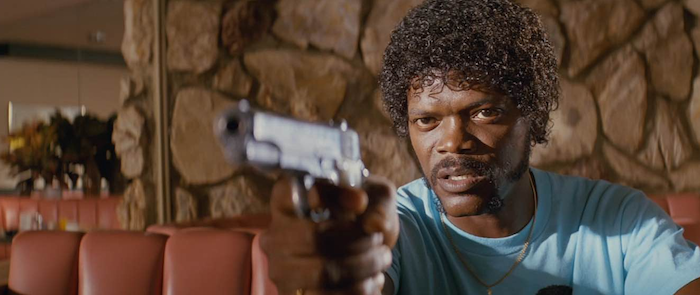
Jules sees the light… and lives. Vincent does not… and dies.
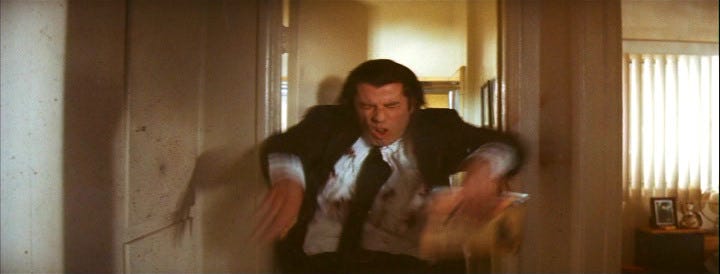
In sum, Pulp Fiction is a great example of non-linear storytelling because that narrative approach serves the morality tale of Jules and Vincent.
Plus… it’s just cool.