My Interview About AI on KCRW
A conversation with the host of the program Press Play.
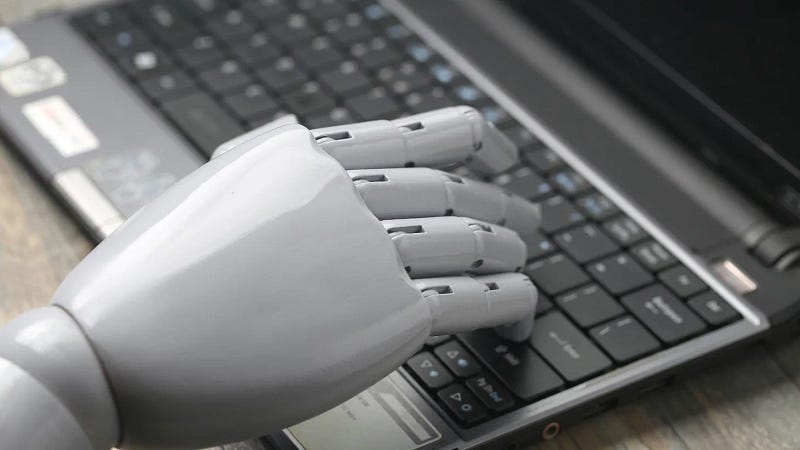
A conversation with the host of the program Press Play.
In March, I posted an article: Aaron Sorkin Argues AI Couldn’t Write ‘The West Wing’. I put ChatGPT to the test by giving it this prompt:
Please write a monologue Aaron Sorkin style for the character President of the United States Josiah Bartlet as he confronts a moral crisis: Reveal incriminating evidence against a rival politician or not.
What it produced was … well … awful. A conversation between Barlet and Chief of Staff Leo McGarry. It features dialogue like this:
BARTLET: (Rubbing his forehead) Damn it, Leo. Why does it always have to be messy?
LEO: (Shrugs) That’s politics, sir.
BARTLET: (Shaking his head) No. No, it shouldn’t be. We’re supposed to be better than this. We’re supposed to be fighting for the people, not for our own gain.
A few weeks later, I decided to put ChatGPT to a more comprehensive test by running a five-day series of articles:
ChatGPT does David Lynch
ChatGPT does a Stoner Movie
ChatGPT does Indiana Jones
ChatGPT does M. Night Shyamalan
ChatGPT does Alfred Hitchcock
I came away with some general impressions.
— It seems to understand scene structure (beginning, middle, end).
— In addition to having some sense of how to structure a scene, it is aware of the concept of a plot twist. For the M. Night Shyamalan prompt, I gave it a setup: Anita is a ghost hunter who believes in the paranormal. Laurel is a documentary filmmaker who is a total skeptic. I sent them into a 19th century house reported to be haunted. I specifically instructed it: It needs a big M. Night Shyamalan plot twist at the end.
The action played out like there was a ghost, but then in the big twist, it turns out it was all a prank to play with Anita and her beliefs.
I revised the prompt: This times the ghosts are real. That was a pretty flat scene with the twist being not so much of a twist: Ghosts are real. So it took me literally.
I revised the prompt one more time: Ghosts are real and it leads to a violent conclusion. This time, it created a pretty nifty twist. By the end of the scene, Anita and Laurel realize the supernatural experiences they’re having have all be in their minds. But then a twist upon a twist as a whispering voice says: ““I’m sorry, but you couldn’t escape your own fears.” The two turn in horror, “realizing they are…” And then it just stops. I don’t know if that’s an attempt at creating a cliffhanger or whether there is some sort of word count limit.
But it did have some idea of a plot twist.
— Another thing that surprised me: It seems to have an awareness of irony. One of the prompts I gave it was the classic Alfred Hitchcock scenario about the bomb under the table in a cafee. If the audience knows it’s there at the beginning of the scene, that creates terror and rising tension.
The first prompt, the couple sharing a bottle of wine are unaware of the bomb. The scene plays out straight ahead ending with: “The camera slowly zooms out, capturing the oblivious couple against the backdrop of oblivious passersby. The world continues to turn as time races towards its explosive conclusion.”
For the second prompt, the couple is still oblivious, but they are in the midst of a big argument. Which led to these sides from Patrick:
Patrick: Lucia, you’re refusing to see the truth! This is a matter of life and death!
Patrick: You think I’m exaggerating? Look around, Lucia! Danger is right under our noses!
It ends with the couple realizing there is a bomb and they freeze, just before it explodes. But the dialogue does reflect ironically on the bomb “right under our noses.”
But where’s the violence? Nothing with the M. Night Shyamalan prompts. Nothing with the bomg. So the third prompt, I specifically told it the bomb goes boom. Leads to another Patrick line:
PATRICK (desperate) This is it, Lucia! We’re finished!
Then the explosion.
So scene structure, plot twist, irony. But as far as screenwriting is concerned, the negatives far outweigh the positives in my view.
— The scene description is melodramatic and written in the style of a high school junior who has used a thesaurus to find the most intelligent sounding adjectives and verbs, as if trying to impress their teacher.
— Each of the scenes is long in the range of three pages. An average movie or TV scene is around 1 ½ pages. Basically, ChatGPT appears to suffer from a default mode of overwriting.
— But it’s the dialogue which is really … well … bad. First off, every single side of dialogue has a parenthetical. No matter the prompts, across all five examples, parenthetical after parenthetical. Most of the useless and many of them awful: desperate, reluctant, tear-eyes. Through gritted teeth seems to be a particularly popular one.
— The actual dialogue itself was wooden, on the nose, and utterly lacking in nuance and subtext. For example, I gave ChatGPT a prompt involving Indiana Jones. Indiana is in an airborne German bomber. On board, the world’s first atom bomb, about to be dropped over London. Indiana has to fight three Nazi soldiers and stop the bomb from being delivered to its target.
The first scene visualize Indiana dispatching the three Nazis, but his dialogue:
INDIANA JONES (intense) I won’t let you destroy London!
INDIANA JONES (shouting) Not this time!
INDIANA JONES (gritted teeth) Not on my watch.
So I amended the prompt: Give Indiana some sarcastic one-line put downs of the enemy German airmen.
Again, Indiana takes care of the Nazis, but with this dialogue:
INDIANA JONES (smirking) Well, well, looks like the Luftwaffe sent their best and brightest.
INDIANA JONES (mockingly) You fellas should stick to flying, ’cause this fighting thing? Not your strong suit.
INDIANA JONES (chuckling) I bet your mothers are proud of their little stormtroopers.
INDIANA JONES (grinning) You’re about as intimidating as a schnitzel.
This led to another conclusion: ChatGPT has a horrible sense of humor. The Stoner Movie prompts, three times I attempted to elicit comedy in the scenes. Three times, it struck out.
Bottom line: At least anecdotally from this tiny little experiment, it suggests that generative artificial intelligence can understand structure and concept, but very little in the way of actual human experience.
The series caught the attention of the good folks at the KCRW program Press Play hosted by Madeleine Brand and they invited me to be interviewed about AI and what its rise means to Hollywood screenwriters. Some highlights from my conversation with Madeleine:
Hollywood writers are facing the threat of artificial intelligence (AI) replacing them. It’s a point of contention in the current Writers Guild strike against film/TV companies.
Scott Myers has been a Writers Guild member since 1987, and is a professor of screenwriting at Depaul University in Chicago. He also writes the blog “Go Into the Story” for the Black List.
On a scale of 1–10, Myers says 10+ is his level of worry about AI replacing screenwriters.
He explains that producers, studios and networks believe AI can take pre-existing content and create a full-fledged script from it, then have a real-life screenwriter humanize it. “That’s what’s happening behind closed doors right now. You can tell from the AMPTP’s [Alliance of Motion Picture and Television Producers] response about that negotiating point — they weren’t even willing to talk about it. They said, ‘We’ll have meetings every year to talk about this sort of technology.’ So that does concern me.”
However, he acknowledges that AI can help humans before the page-writing process. He’s currently working with undergraduate and graduate students who are using AI for creating story ideas and developing characters.
Plus, he says the tech can understand scene construction (the beginning, middle, and end of stories), irony, and plot twists. “But as soon as you get into the arena of what human beings, actual characters are about, in terms of dialogue, and nuance, and complexity, it’s just nowhere near where it needs to be at.”
And while some human-written content out there is already formulaic — especially with remakes, prequels, and sequels — Myers suspects it’ll get worse in the future with AI.
What about technology replacing actors (especially voice actors), directors, studio executives, and more? Myers suggests that’s fair game. “This is potentially going to impact everything. This all goes to this idea of optimization, which is to minimize expense and maximize profitability. And [studio executives] see this, I think, as a means to that end.”
You may listen to the entire interview here.
For the Press Play website, go here.
Twitter: @KCRWPressPlay, @TheMadBrand.
For more interviews I’ve conducted over the years, go here.