Mr. Potter and the Billionaire Class
Current events bring to mind the Nemesis of It’s a Wonderful Life.

Current events bring to mind the Nemesis of It’s a Wonderful Life.
So … billionaires. These guys — most of them are guys — with their super yachts, space travels, and political ambitions are all up in the headlines.
I mean, they’re a thing, right?
But why?
Oh, I don’t mean why does this gilded group exist. After all, being a billionaire is the ultimate expression of unchecked capitalism.
My question is more existential: Why do these people do what they do?
They’ve got power, prestige, and live lives in their private world of plenty, not wanting for anything.
But apparently, they do want something … beyond mere wealth. Why else would they spend … well, billions … on politics or even seek political office, and so much of what they do seems to make life miserable for ordinary citizens a.k.a. the Little People?
Why? What drives them?
Seeing as it’s the Christmas season, that question conjures the image of Henry F. Potter in It’s a Wonderful Life (1946). He’s rich. By Bedford Falls standards, really rich. In comparison to the town’s common citizens, he might as well be a billionaire.
It occurred to me: What if I went through the movie and focused solely on scenes involving Potter? Would this study of his character offer insight into the psychological makeup of the current billionaire class?
So, here we go: It’s a Wonderful Life: Mr. Potter’s Saga.
This is how the movie introduces his character.
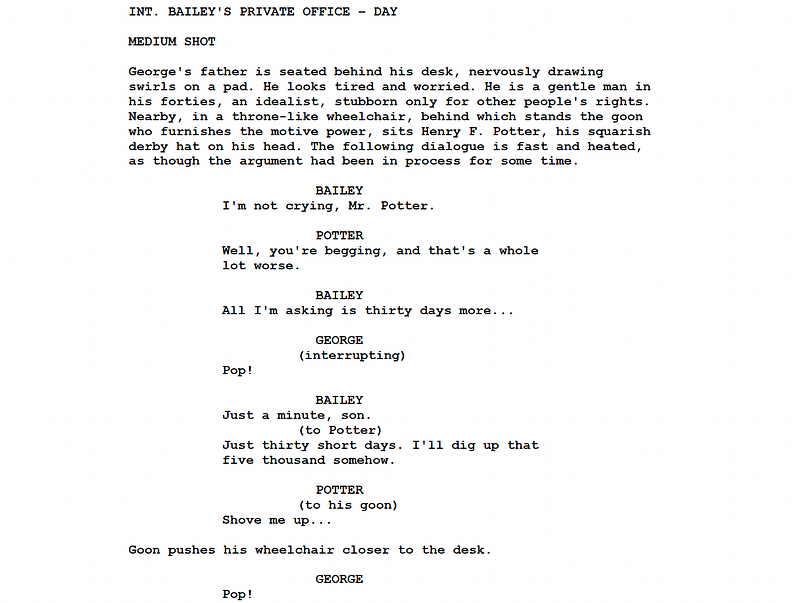
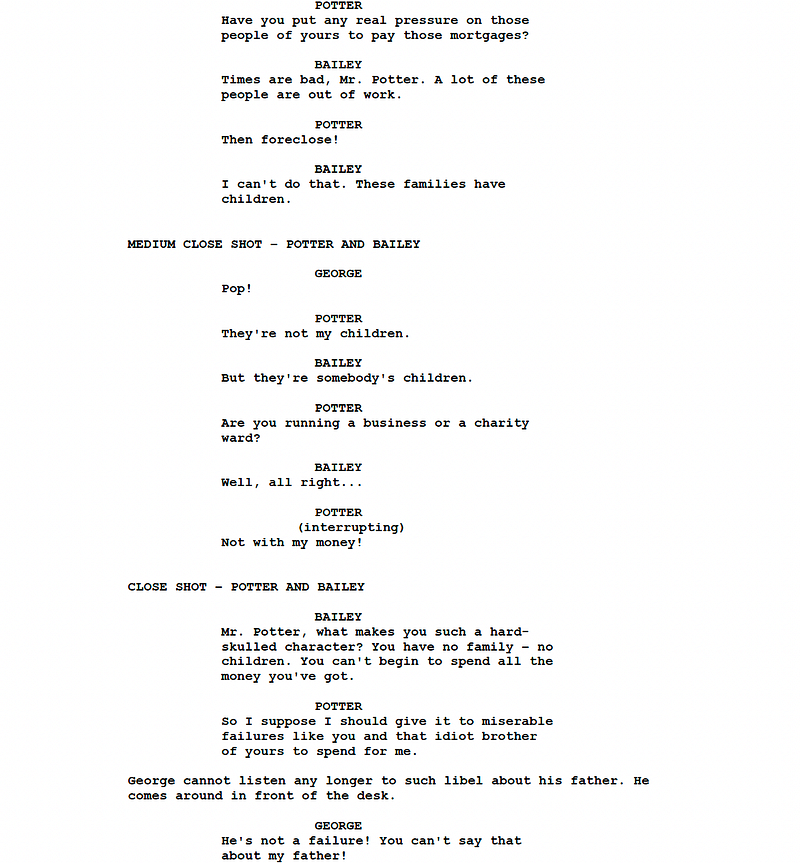
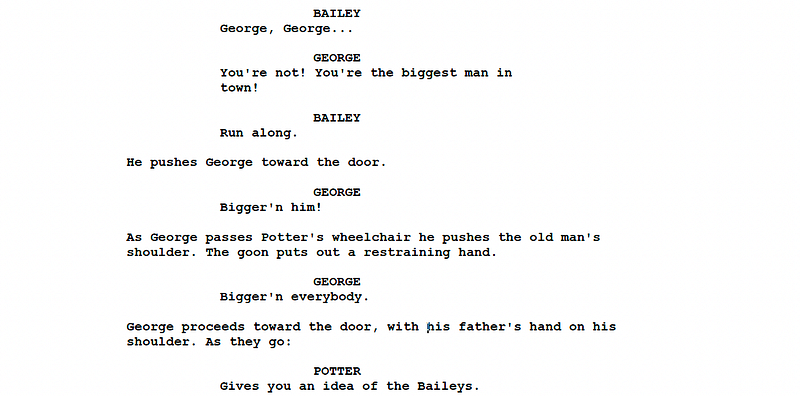
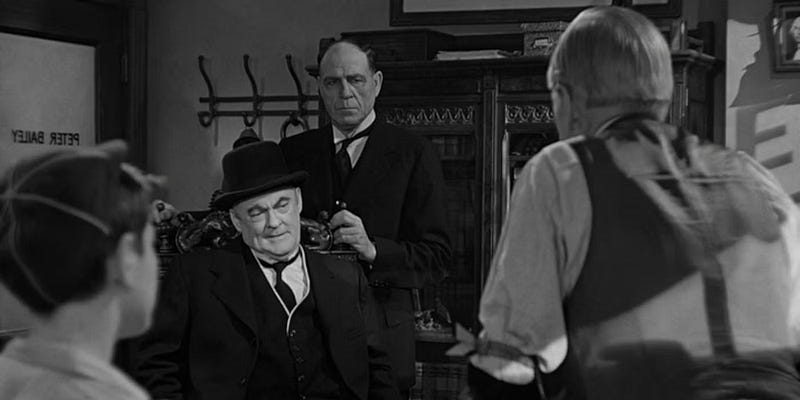
The very first scene with Potter presents two key dynamics which play throughout the entire story:
- Are you running a business or a charity ward? Potter exhibits zero compassion for others. They’re not my children. A point which Peter Bailey makes here …
- Mr. Potter, what makes you such a hard-skulled character. You have no family — no children. You can’t begin to spend all the money you’ve got. Precisely, and this goes directly back to the question I posed up front: What drives these obscenely wealthy ghouls to do what they do? That question arises in the next scene involving Potter.
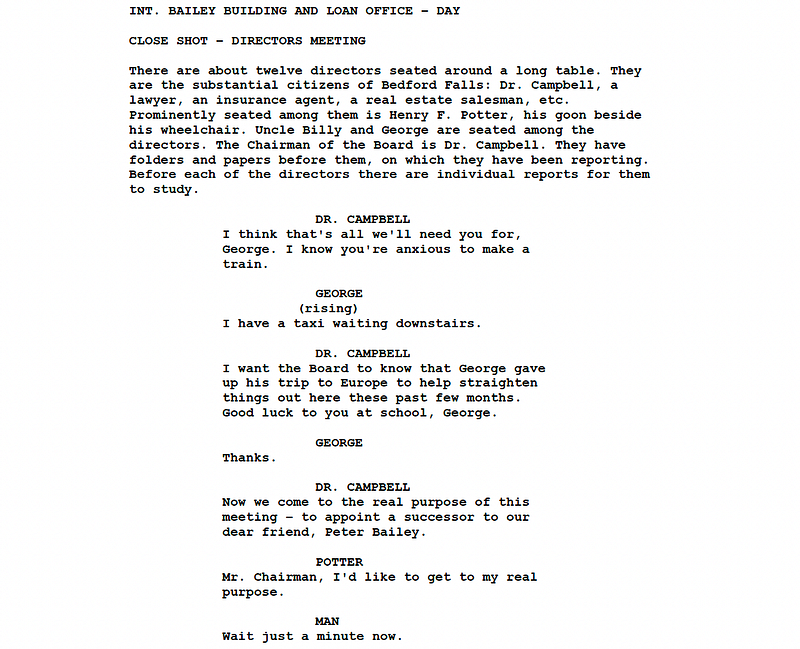
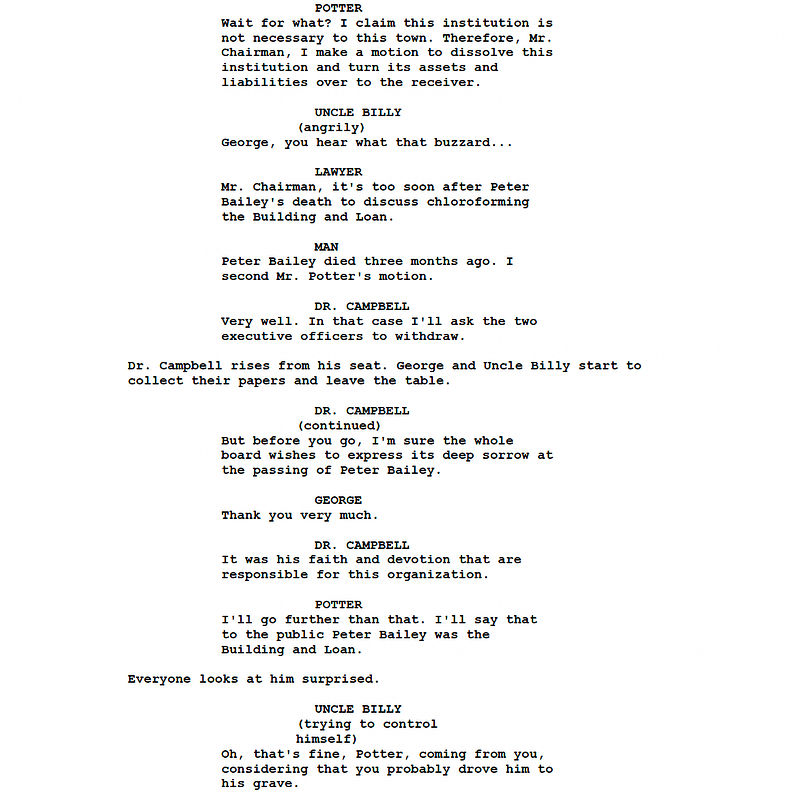
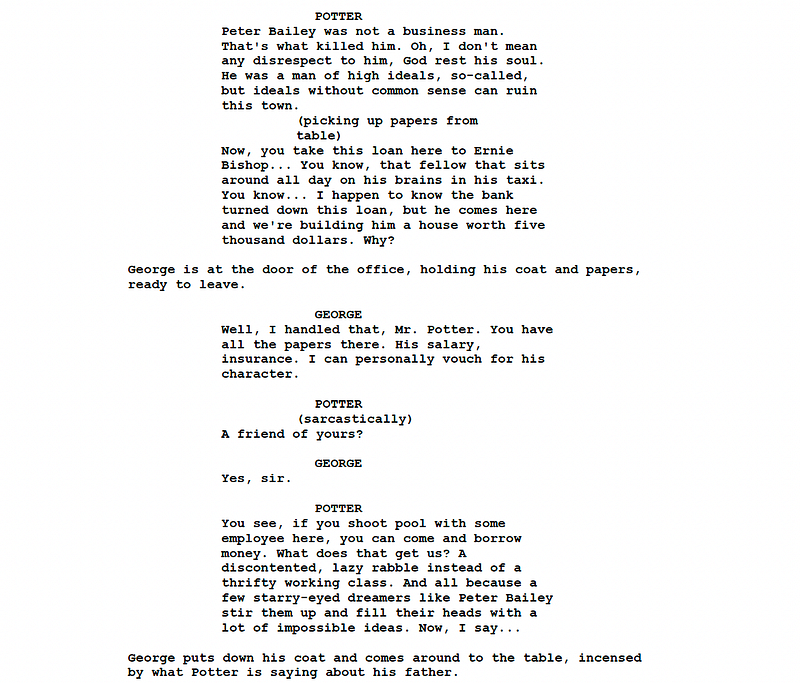
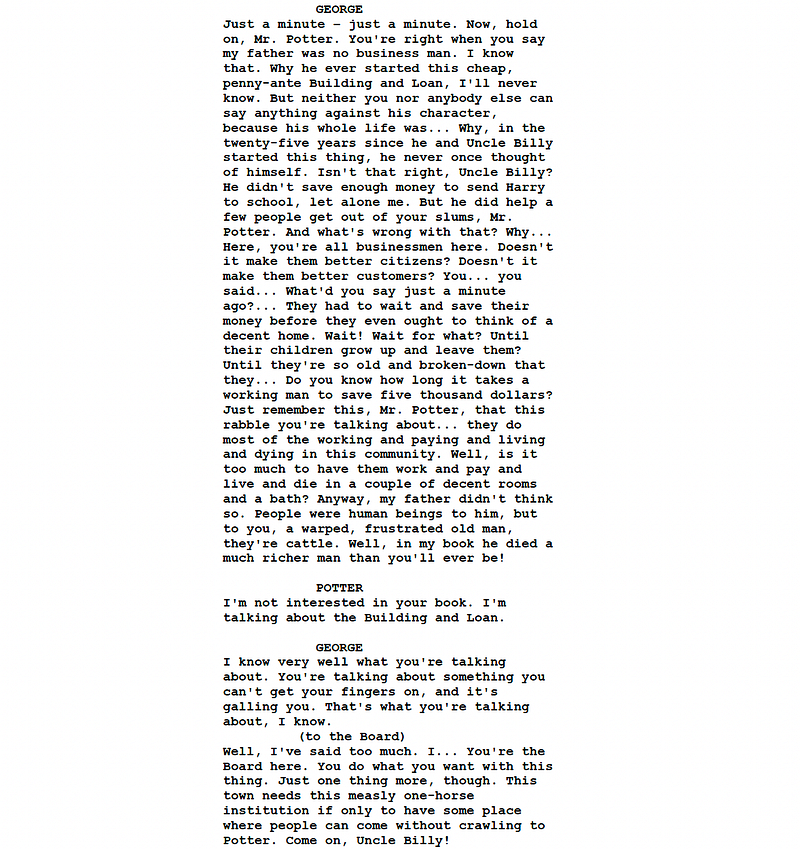

This scene takes place mere days after Peter Bailey has been buried and here is Potter already working a scheme to take over the Bailey Building & Loan. That alone says quite a bit about the character’s nature, stomping around on the ol’ man’s grave. But then, George has a lot more to say about Potter including two key insights:
- People were human beings to him [Peter Bailey], but to you, a warped, frustrated old man, they’re cattle. No wonder Potter has no empathy for the Little People. He doesn’t seem them as a You, a human being equal in status to him, rather in his eyes, they’re an It. An object. [see: Martin Buber]. As such, Potter acts toward them as he would with any other commodity — to use for his benefit.
- I know very well what you’re talking about. You’re talking about something you can’t get your fingers on, and it’s galling you. George is right. Potter wants something beyond money, something more tangible than cash. Presumably, George is referencing the Building & Loan, but what does that business represent? The subtext of George’s accusation suggests there is something deeper going on with Potter.
I should underscore what we’ve known since the first minute of the movie: George Bailey is the story’s Protagonist. Now that he is forced to take over his father’s business, Potter functions as the story’s Nemesis for the simple reason: He wants to squash the Bailey Building & Loan. This becomes manifestly clear in the next Potter scene.
Fresh from their wedding, George and Mary are heading off to their honeymoon, intent on spending $2,000 they’ve saved for the celebration: We’re going to shoot the works. A whole week in New York. A whole week in Bermuda, The highest hotels — the oldest champagne — the richest caviar — the hottest music, and the prettiest wife. I imagine this is the type of life George envisioned for himself as a youth, a perk for him “building things” and as part of “seeing the world.”
But as so often happens in George’s life, fate intervenes. There is a run on the bank which leads to a crowd of frightened Building & Loan customers desperately wanting money from their accounts. Potter’s response?
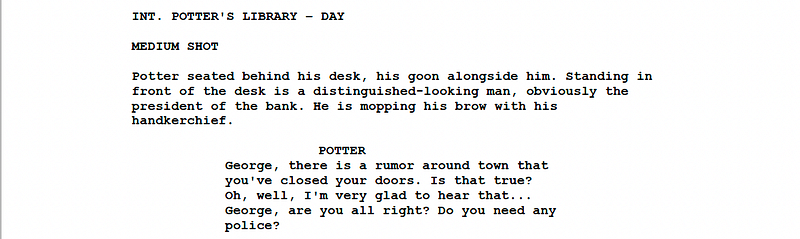
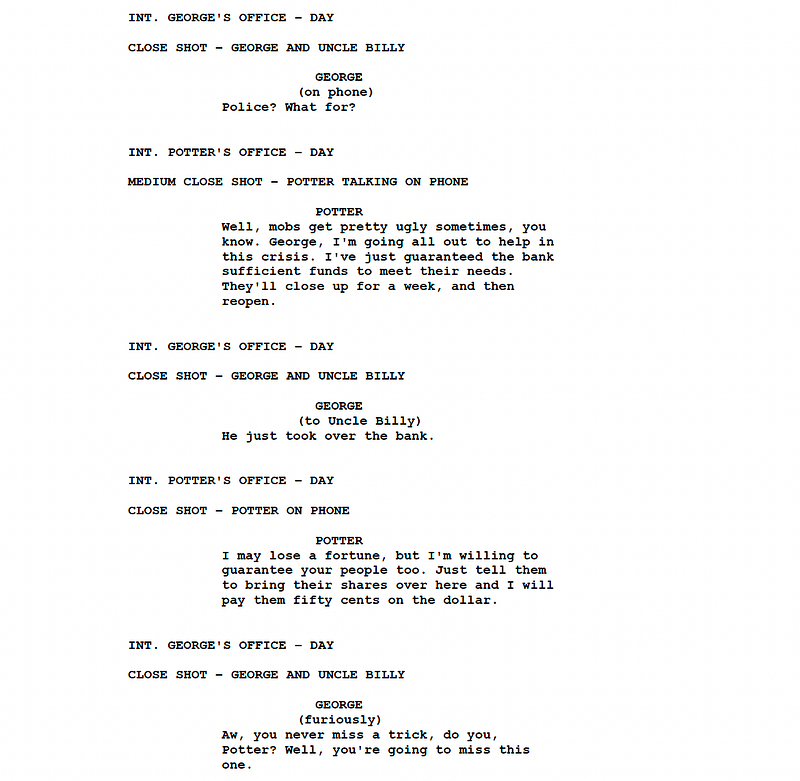
When customers start to head off to the bank to take up Potter on his “generous” offer, George heads them off explaining:
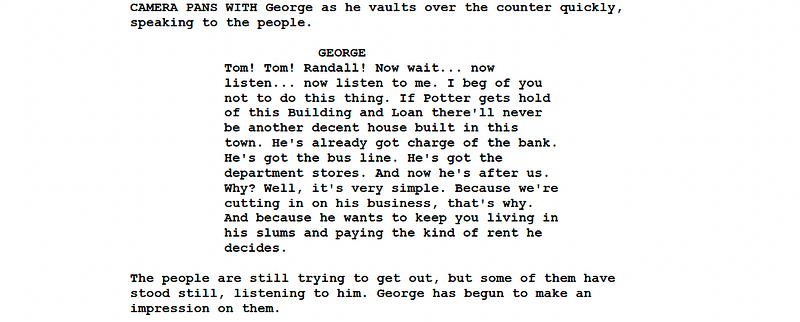

Potter owns almost everything in Bedford Falls … everything except the Bailey Building & Loan.
Again, that question: Why? What is it about this last remaining property which drives Potter’s obsession to own it? And obsession it is as we see in the next Potter scene.
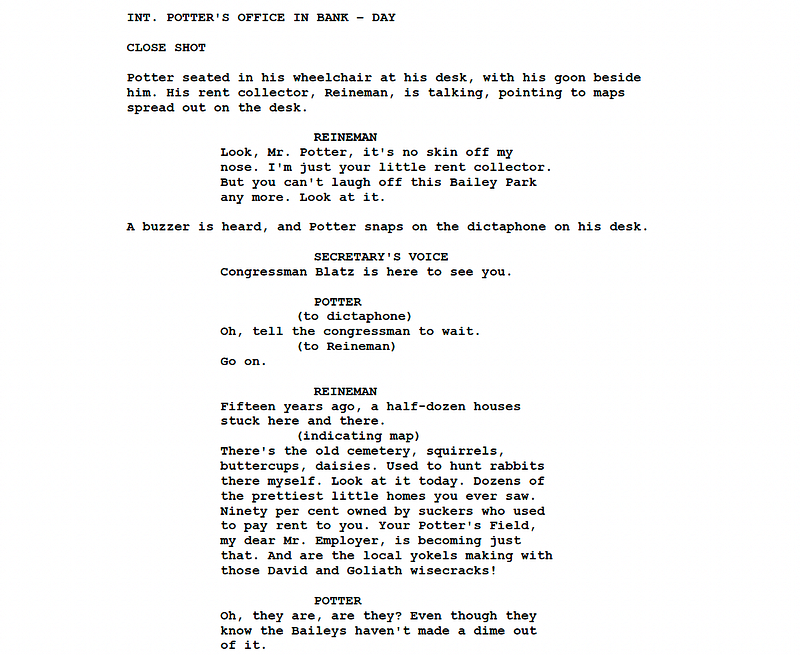
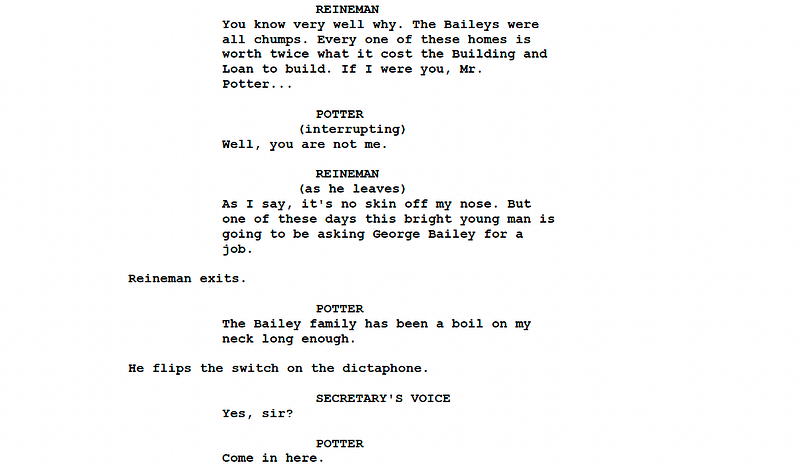
Potter is so obsessed with the Building & Loan, he keeps a congressman cooling his heels so Potter can focus his attention on what George has managed to do over time: create Bailey Park, a place where Building & Loan customers may acquire a home of their own, rather than pay rent to Potter for his decrepit properties.
At this point in the story, it has become clear: Potter’s feelings about the Building & Loan — and George specifically — is more than just dollars and cents. This contest is personal to Potter. It agitates him that the locals are making “David and Goliath” jokes about the two businessmen.
He may not understand why George does what he does, financing new houses which are worth “twice what it cost the Building and Loan to build.” That makes zero business sense to Potter, but he thinks he understands human nature well enough to take care of the problem: He’s going to buy off George Bailey.
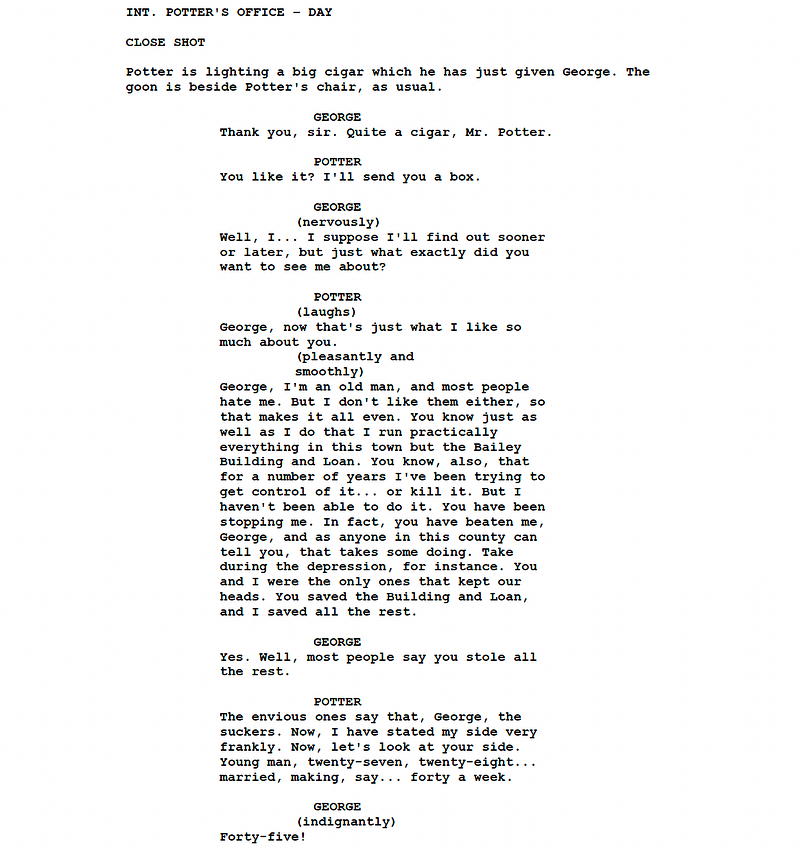
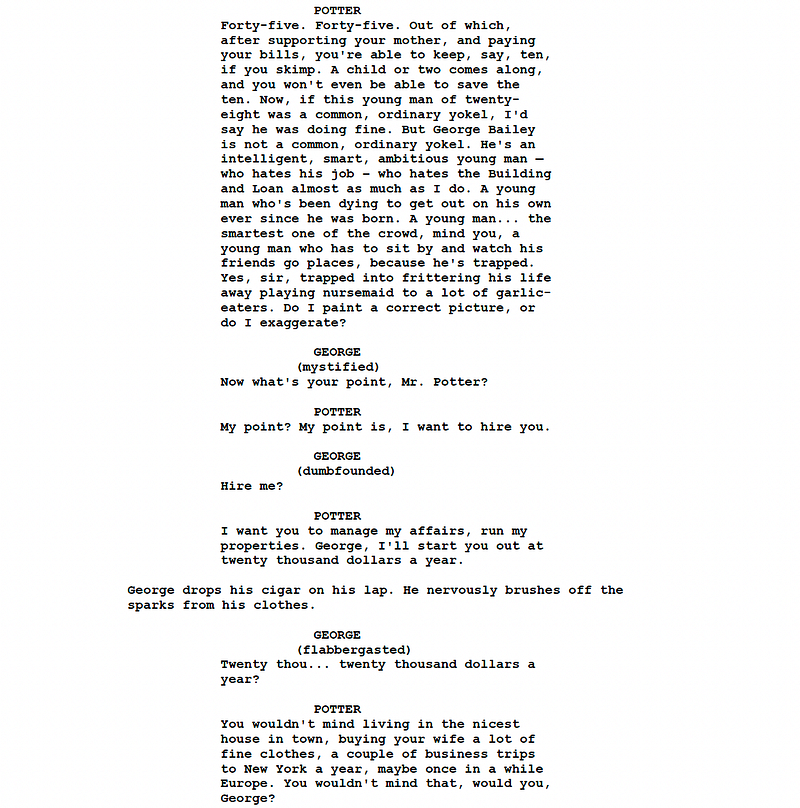
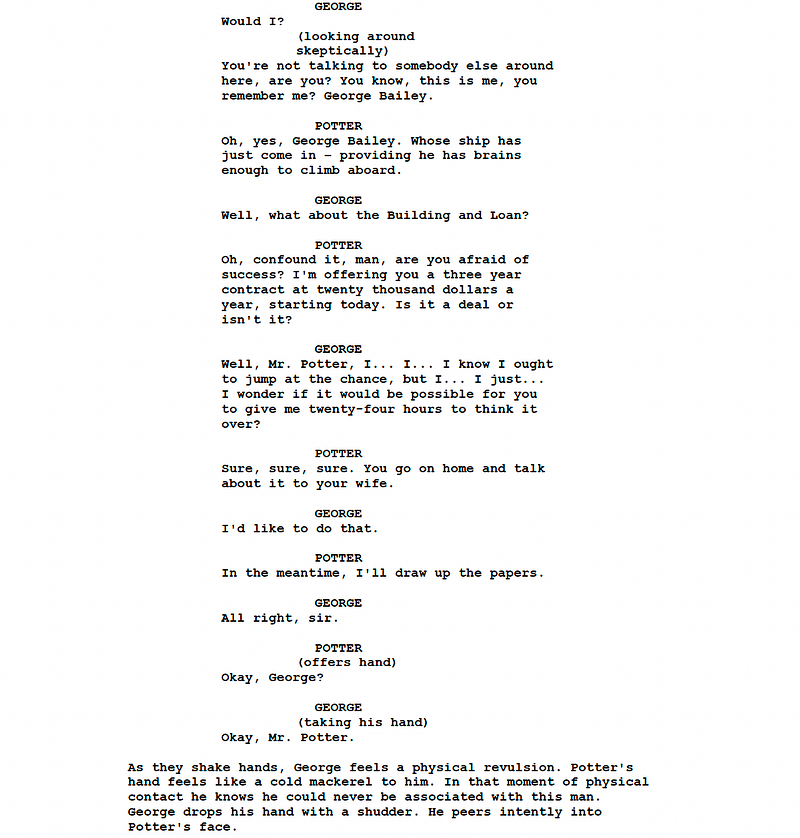
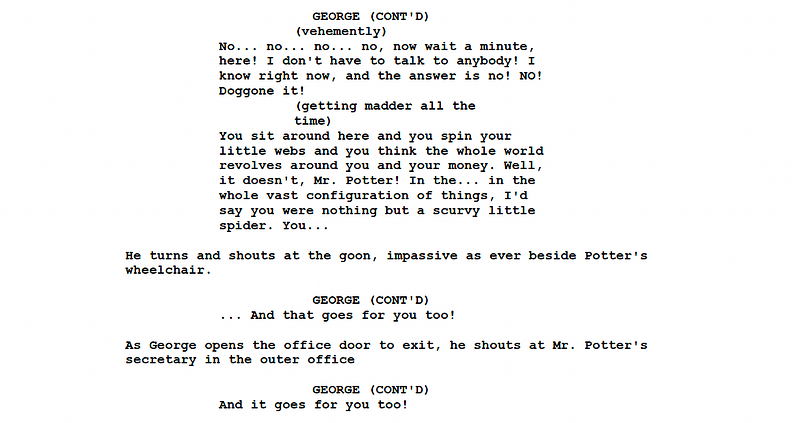
Potter appeals to what he thinks lies at the core of most every living soul: Greed. Of course, he would look at the world that way. Greed is Potter’s blood type. Plus, he knows enough about George to understand how (A) he desperately wants to make something big of himself, yet (B) he’s shackled with his deceased father’s business legacy.
This scene recalls the third temptation Satan presents to Jesus in his days wandering in the wilderness:
Next the devil took him to the peak of a very high mountain and showed him all the kingdoms of the world and their glory. “I will give it all to you,” he said, “if you will kneel down and worship me.” — Matthew 4:8–9
The dynamic between Potter and George is very definitely a power play with Potter dealing his ace in the hole: Wealth. Power. A chance for George to achieve some semblance of his Want: Travel the world. Be a Big Shot.
But George rejects Potter: As they shake hands, George feels a physical revulsion. Potter’s hand feels like a cold mackerel to him. In that moment of physical contact he knows he could never be associated with this man.
Just as Jesus denies Satan, George turns his back on Potter. Temptation refused. There’s a lot going on in this moment:
- George recalls how Potter probably drove Peter Bailey to an early death.
- The taint of Potter’s wealth, built on the backs of the hardworking citizens of Bedford Falls, disgusts George, manifest as a literal physical revulsion when touching Potter’s hand.
- Yes, George wants to travel and “see the world” as he expressed in Act One as a youth, but his desire to “build things” is based on his sense of self that he has the talent and drive to do that. He doesn’t want things handed to him, rather to fulfill what he believes is his own potential.
Potter cannot comprehend any of this. He’s shocked that George rejects what lies at the core of his being: Money.
This speaks to what we’ve already noted: Potter’s utter lack of empathy. Because he cannot see beyond the restrictive confines of his world view, shaded as it is by his fixation on money, he lacks any understanding of selflessness. For ultimately, that is the factor which clenches George’s rejection of Potter’s offer. He knows if he were to accept a position working for Potter, that would mean the end of the
Building & Loan … and that would result in economic stress and pain for the customers he serves.
In other words, instead of accepting Potter’s offer, which would have been a selfish choice on George’s part, he forcefully declines Potter’s overture, a decision that is a selfless act. It demonstrates George’s compassion for his fellow townspeople.
This lies in stark contrast to Potter’s lack of compassion which pops up in the next scene where the character appears. During a World War II series of shots, there is this:
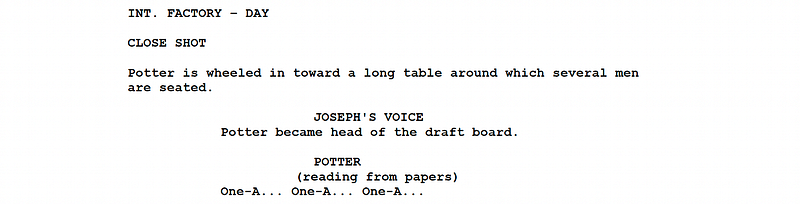
Okay, let’s stop for a second. Imagine you are Mr. Potter. Richest man in town. You have members of Congress showing up at your beck and call. Why in the world would you volunteer to become the head of the draft board? The position smacks of bureaucratic drudgery, but there he is, seated at a table surrounded by other draft board lackeys.
I’m thinking this has to do with power. When we see Potter scarcely glancing at draft notifications, then summarily grunting, “One-A … one-A .. One-A,” each one of those declarations compels those individuals to part with their ordinary life, become a member of the military, then likely head overseas into combat. In effect, Potter has the power to decide the fate, and potential life or death, of each person he decides is draft-worthy.
I believe Potter took this gig because he enjoys this type of power. Revel in the power to screw with the Little People.
Of course, Potter is too old to qualify for military service, but this does present an opportunity to talk him being bound to a wheelchair. In real life, the actor Lionel Barrymore who portrayed Potter, was himself restricted to a wheelchair due to his own debilitated physical condition from 1938 onward.
In the story world, while Potter’s condition is never explained, I wonder if his physical limitations generated a sense of resentment at the way the universe had treated him. In most of his scenes, Potter does exhibit anger.
Perhaps part of his anger toward the Little People of Bedford Falls arises from them leading normal lives with lovers … families … even something as simple as having the ability to walk.
Maybe the wealth Potter accumulated, no matter how much, is insufficient to fill an emptiness inside arising from the emotional and psychological distance he experiences separated from a “normal” life.
Moving on, as painful as this next scene may be: Uncle Billy loses $8,000.
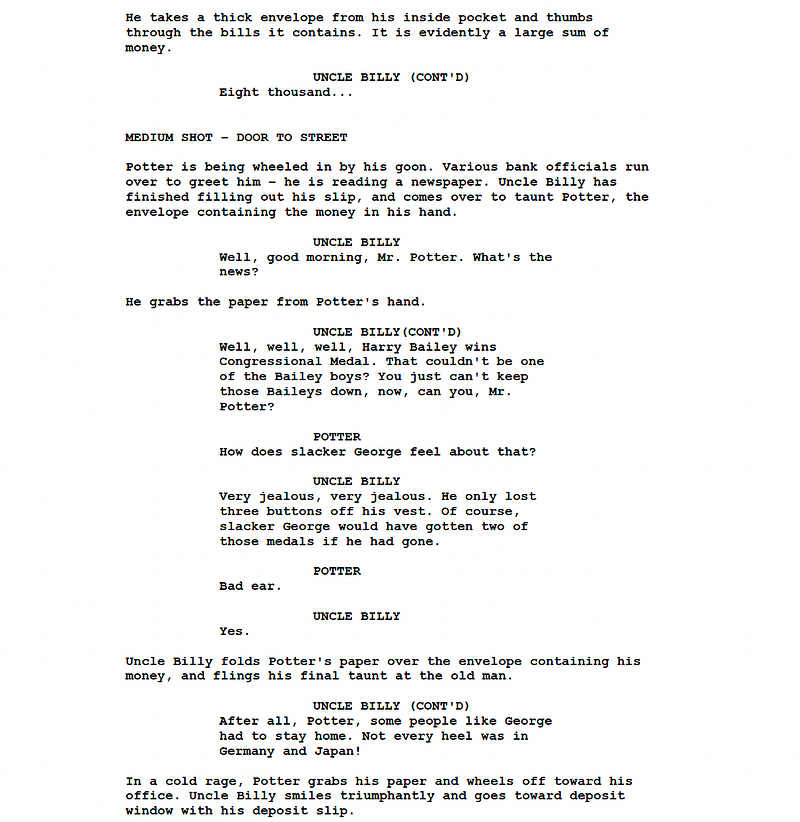
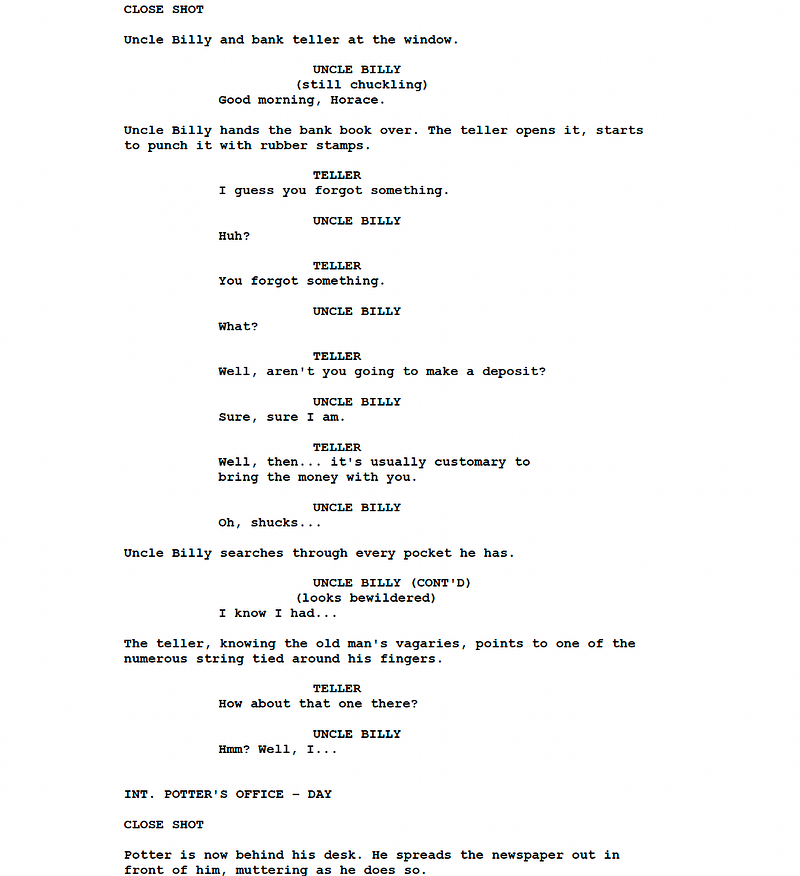
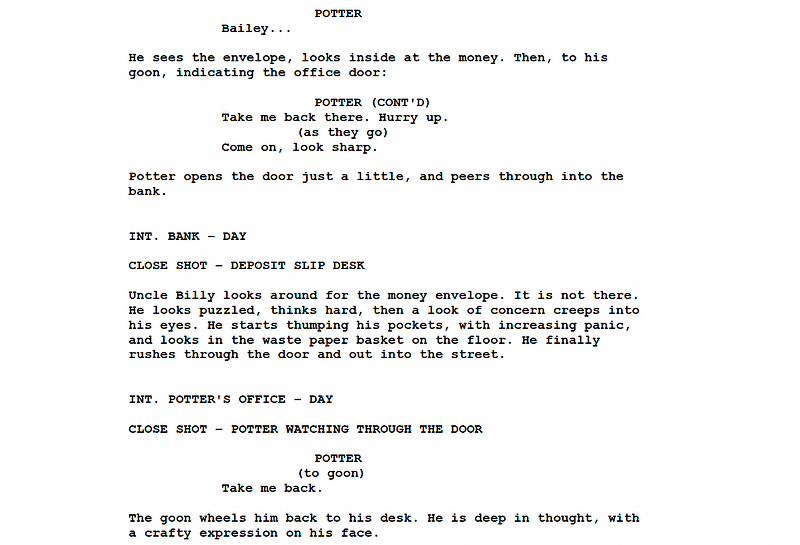
From Team Protagonist perspective, this scene is a real gut punch. From the Team Nemesis POV, this is fate providing Potter a gift. If he had any empathy at all, Potter would have returned the $8,000. But no. He with the “crafty expression on his face” is already calculating what this could mean for his Nemesis (George Bailey) and the vexing Bailey Building & Loan.
Which leads to the penultimate Potter scene: George drags himself to Potter’s office seeking a Hail Mary to make up for the lost $8,000.
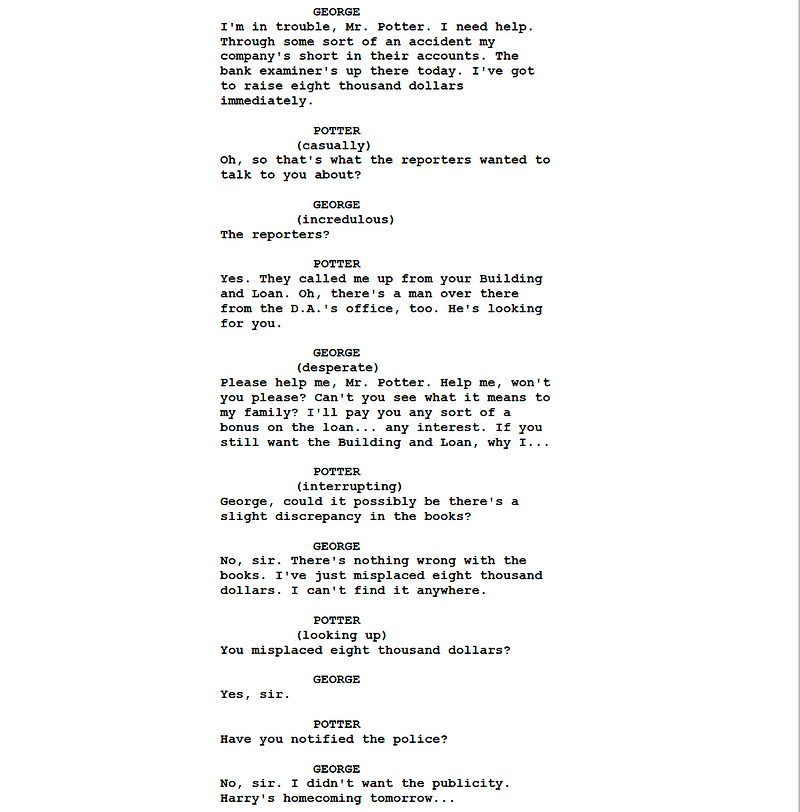
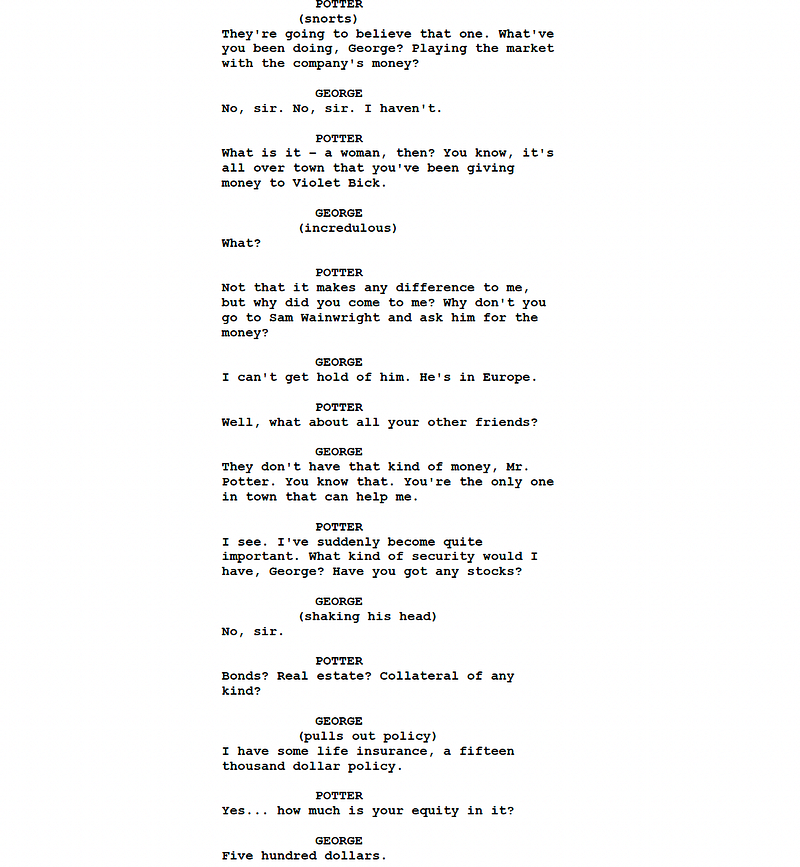
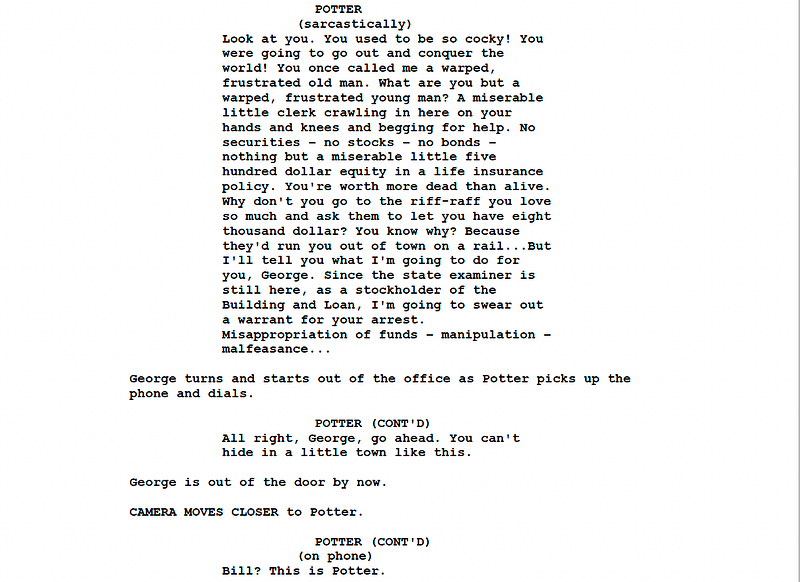
Following through with our thought experiment — seeing the story through Potter’s eyes as the Protagonist — this is the high point. He’s got George by the throat. He’s startled just for a moment when George covers for Uncle Billy’s mistake — You misplaced eight thousand dollars — a selfless act beyond Potter’s comprehension. But that doesn’t derail Potter seizing upon the gift handed to him. He’s going to facilitate the process whereby George Bailey ends up in jail … and the Building & Loan will finally be his.
Here, we see another aspect of Potter’s nature: He actually enjoys watching George suffer. This is beyond a character’s lack of empathy. This enters into the terrain of a sociopath who relishes others’ pain.
Amidst all this is a little moment:
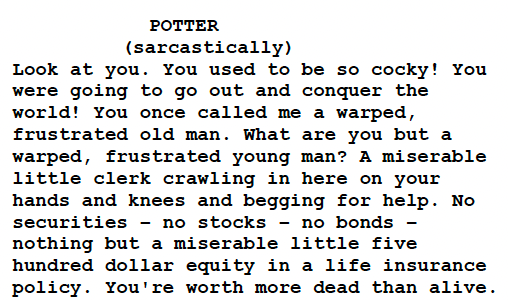
Isn’t it interesting how Potter remembers the exact words George spat out at Potter in a previous meeting: You once called me a warped, frustrated old man. Think about that from Potter’s perspective. You’re the wealthiest person in town. The most powerful. As the head of the draft board, you quite literally hold the destiny of individual lives in your hands. With all the business dealings you have going on …
You remember a passing comment from a pissant like George Bailey?
This suggests an individual who while wearing a public-facing mask of certitude and power actually hides from view a vulnerability of self-critique, probably even self-loathing.
It’s understandable why the accumulation of wealth is critical to understanding who they are as money represents external validation. I’m richer than God, therefore, I must be a worthy individual.
Yes, Potter assesses George’s desperate plea for money from a purely financial perspective, but his decision is based on something more personal … as we’ve noted.
What lies at the core of that personal enmity toward George Bailey?
I think the answer lies in Potter’s line: You’re worth more dead than alive.
Potter sees no value in what George offers as a human being, let alone businessman. Of course, his take derives from a monetary perspective. Potter finds it ironically humorous that George, who has been forced to lead a life as an advocate for the Little People, is worthless as a living human being … and worth at least something as a dead person (i.e., life insurance payout).
Whatever Potter’s take, his observation is what leads George Bailey here.
Clarence who is George’s guardian angel provides grants George’s wish: To see what the world would be like if he’d never been born. The specter of that parallel world is not a pretty sight.
- Martini’s family bar now a trashy drunken emporium
- Mr. Gower a dissipated “rummy”
- Uncle Billy in an insane asylum
- George’s mother a bitter old woman
- Mary a lonely spinster
- His brother Harry drowned instead of a war hero
- Bedford Falls now Pottersville
Experiencing what Bedford Falls would have become without his influence on civic events and personal relationships, George seeks God’s mercy.
Which leads to a final, brief interchange with Mr. Potter.
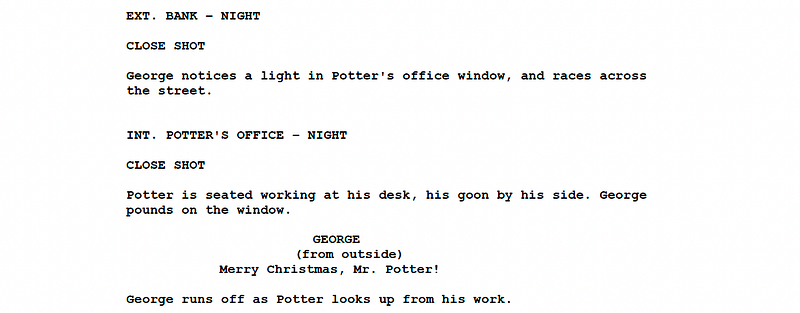

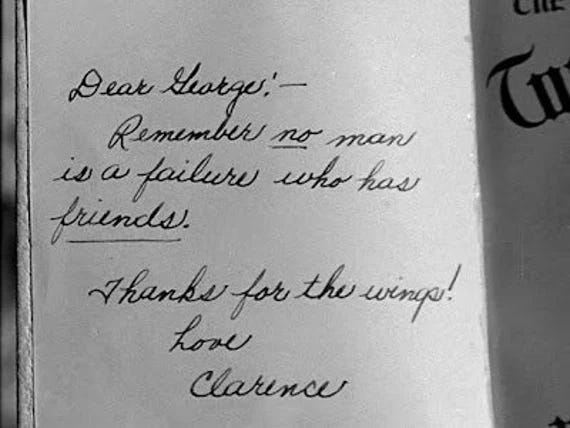
Sorry, Mr. Potter. This is Hollywood and the movie has a happy ending for Team Protagonist. The “riff raff” you denigrated unite in support of George. No jail. Family reunited. And a lesson learned by your arch-rival:
So, there you have it. Every single scene in It’s a Wonderful Life involving Mr. Potter. Where does this thought experiment leave us in terms of our understanding of Mr. Potter and by extension our contemporary class of billionaires? Here are attributes exhibited by this Nemesis character:
- A total lack of empathy and compassion. Billionaire class? Check.
- A sole concern with accumulating wealth.. Billionaire class? Check.
- Enjoy watching other people suffer. Billionaire class? Check.
- Lust for more and more power. Billionaire class? Check.
And lest we forget … a racist: Yes, sir, trapped into frittering his life away playing nursemaid to a lot of garlic-eaters. Check.
Even given all that, we still return to my original question: Why do billionaires do what they do?
This analytical exercise brings to mind two explanations: one psychological, one theological.
A psychological explanation arises from what I’ve hypothesized about Potter: There is a void within his psyche, a hole where the ability to love and be loved should be. He seeks to fill it with material possessions, increasing wealth, and positions of power, anything to create a sense of external validation. But it’s not enough. It’s never enough. Even if we changed the ending of It’s a Wonderful Life and Potter did vanquish George Bailey and gain control of the Building & Loan, it’s entirely likely Potter would continue his existence as a narcissistic lost soul… just like Potter’s next door cinematic neighbor.
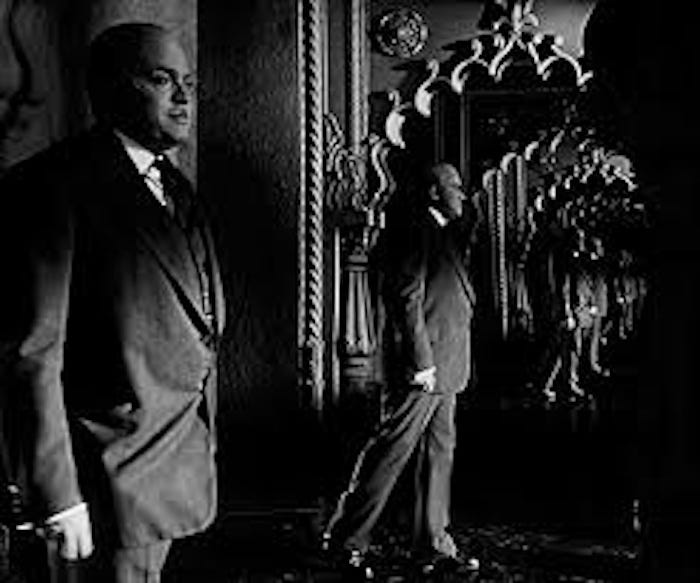
But there is, I think, a simpler explanation for why Mr. Potter and his billionaire class do what they do and it’s found in the Bible:
For the love of money is the root of all evil. — 1 Timothy 6:10
Not money. The LOVE of money. The allure of wealth — its seductive nature — transmogrifies love into lust.
In the eyes of us common folk, we ask of billionaires: Why do they need more? Don’t they already have enough?
In the eyes of a billionaire, they respond: It’s never enough.
Millionaires long to become billionaires.
Billionaires strive to become trillionaires.
They’re like a dragon hoarding their treasure.
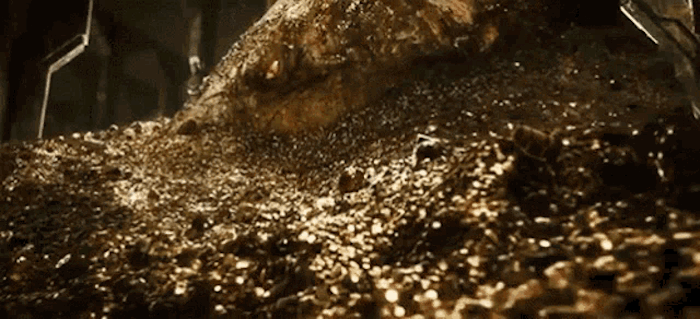
The thing is this current crop of tech-bro billionaires is like Mr. Potter on steroids. The allure of wealth and power has eviscerated whatever idealism they may have embraced at the beginning of their venture (see: Google). They influence entertainment … social media … communication … finance … increasingly politics … and potentially the fate of the world.
To this contemporary group of billionaires, Mr. Potter is the Little People. George Bailey and the Building & Loan? They would have swatted aside that infinitely small nuisance in a nanosecond.
Where does this all end? Who knows. It’s long been rumored that the original ending of It’s a Wonderful Life involved Clarence the angel confronting Potter resulting in his heart attack and death.
We can only hope …
… that they discover love for people over love of money.