Movies You Made: “Oh, Baby!”
An award-winning live-action and stop-motion animation short film that you simply must see!
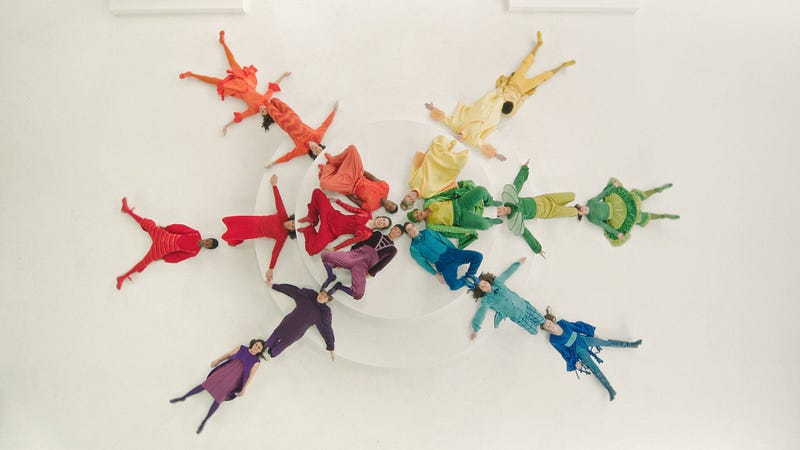
An award-winning live-action and stop-motion animation short film that you simply must see!
My faculty colleagues at the DePaul University School of Cinematic Arts are not only a wonderful group of teachers, they also have a ton of creative talent. Witness the latest cinematic effort by Meghann Artes, a professor in the school’s animation program.
Meghann Artes is an award-winning filmmaker and animator who has worked with Sesame Street, Warner Bros., Nickelodeon, Bix Pix, NBC and ABC. Her short films have enjoyed success in festivals across the country and, in 2009, her work for Sesame Street was awarded both an Emmy and a Peabody.
Drawing from her small town childhood and her urban career, Meghann’s independent works artfully utilize handmade elements and modern techniques. Meghann’s whimsical subject matter as well as her use of color and texture draw in audiences of all ages.
Meghann holds an MFA from the Animation Workshop at UCLA and is currently an independent filmmaker and a professor at DePaul University in Chicago.
Meg has written, directed, and produced short films which not only have had strong festival runs, but also been Vimeo staff picks including Speed Dating:
And Sleepy Steve:
Meg’s latest movie Oh, Baby! is her most audacious effort yet combining a live-action musical component with stop-motion animation. I was so impressed with the movie, I asked Meg if I could do a Q&A with her and she agreed. Here it is!
Scott: You’re a filmmaker and animator. When and how did you develop your interest in this type of storytelling?
Meghann: I actually think my real love of making movies started when I was 10 years old and my dad won a video camera in a raffle. He never really picked it up, but I used it all the time to make movies with my sisters and our pets. It was a whole new world. It wasn’t until college that I learned about Jan Svankmajer and realized that I loved stop motion filmmaking. So I’ve been this sort of hybrid between traditional live action filmmaking and animation ever since.
Scott: How would you describe the type of animation you create?
Meghann: Well, I guess it depends on what film you’re talking about, but it’s all essentially stop motion. For a good portion of Oh Baby! I focused purely on the stop motion animation of objects. But in the past I’ve also done a lot of stop motion with people, which is called pixilation. Both methods have their joys and pains. Pixilation can be very challenging, but there is just something so magical and fun about the effect. And I just love animating with props and everyday objects to make them come alive. There’s a fair amount of magic in that, too!
Scott: Let’s jump to your latest film project, Oh, Baby! Could you talk about the inspiration for the project and in particular, how your daughter Millie is involved?
Meghann: The idea for Oh Baby! came mainly from my experiences with pregnancy. My husband and I had tried for years to have babies the good old fashion way, but ultimately we had to turn to science and IVF in order to get pregnant. On top of that process, I had to have a surgery and do a lot of other not so fun things to make my body “ready” to have babies. The amount of tubes, blood draws, poking and prodding I had to endure to get pregnant was just crazy. It all felt a bit like the second part of the movie, which sort of represents all that my body went through while getting and being pregnant.
Around the same time this kernel of an idea was forming, I had also been taking a lot closer look at the world that I was about to bring these babies into. All of the division and anger and strife was suddenly very stark to me and obviously has only gotten worse since. So I wanted to make something that reminded people that what unites us is greater than what divides us. We are all made of the same stuff and come into this world in the same way.
As for how my daughter, Millie, is involved, I was having a hard time with the ending of the film and felt that something was just missing. I couldn’t seem to wrap it up in just the right way. It was a very personal film for me, but I felt that I could still add a little something more to make it even more personal. We had already shot the movie, I was pregnant with Millie and we were somewhere in the middle of post when we had to stop for a little bit as my due date came up. Just before we took the break, I had this idea that I would like to record Millie’s first cry and somehow use it in the film. Luckily, the idea worked and now whenever I watch the film, it takes me back to our first moments with Millie.
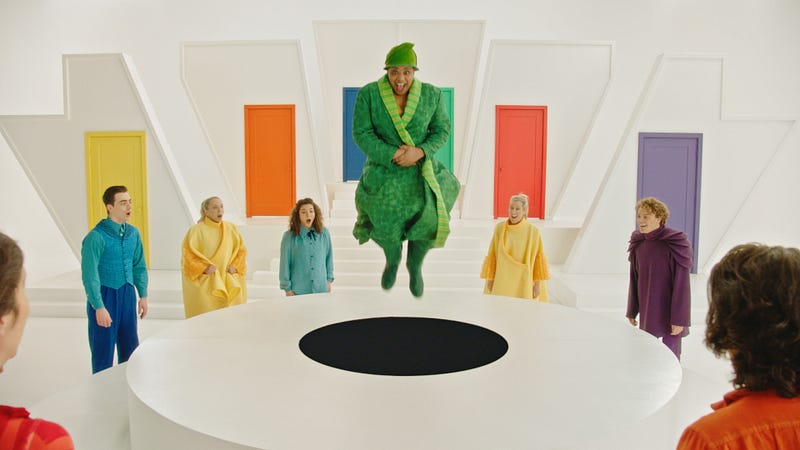
Scott: At 8 ½ minutes, it’s an audacious project featuring live-action music and dancing, as well as stop-motion animation, and probably a lot of other special effects I don’t know anything about. Could you talk about some of the challenges meshing together all of the visual and audio elements.
Meghann: Honestly, when I wrote this film, I had no idea how it would get made! But I think outside of what it means to me personally, the challenge of a project is what really drives me to make it. As you describe, there is a lot going on here both on the screen and certainly behind the scenes. I had done plenty of stop motion before, but never at the 1 to 1 scale of the set we used in the second part of this movie. And I had worked with VFX before, but never as much as this movie required. As for the big Hollywood dance number and all the work with the musical score, the casting of dancers, the choreography, the huge set design, all of that was new to me at the start of this project. I really learned a lot as we went along and I’m so grateful to all the brave souls who jumped in and went on this journey alongside me. It ended up being the best filmmaking experience of my career so far. It’s so amazing to see it all together and to finally get it out to people.
One of the great advantages I had going for me was DePaul. As this project was coming together and as all of the different disciplines that I would need to wrangle together to pull it off became apparent, that’s when I was able to look to the DePaul creative community for help. We worked with the School of Music for arranging and recording the score and we went to the Theater School for the cast, the choreography and all of the costuming. These are programs at DePaul that I had never interacted with before, but this project became the perfect vehicle to bridge that gap and show the amazing things these schools along with the School of Cinematic Arts could do. So that really put the experience over the top for me.
Scott: You’re a professor at the DePaul University School of Cinematic Arts. How involved were university students and faculty in the production of Oh, Baby!?
Meghann: There were a lot of students, faculty and staff that made major contributions to this film. In addition to the students and faculty of The Theater School and The School of Music, the live action portion of this film was also a class in the School of Cinematic Arts known as a Project Bluelight. That means that a faculty member with a project to make can submit it as a class where students who enroll get to work on the film alongside hired professional department heads for an incredibly hands-on experience in filmmaking. This process also allocates funds to help make the project. In the end, over 60 students, 8 faculty and 5 staff members joined the professional department heads to bring this film to life. This is all not to mention the incredible support of the administration, especially Deans David Miller and John Culbert as well as SCA Director Gary Novak. It ended up being a first-of-its-kind collaboration between the three schools at DePaul, and hopefully not the last!
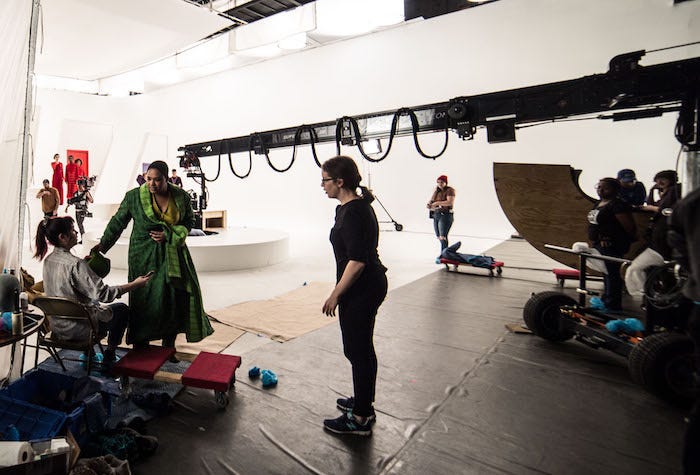
Scott: Let’s break down the specific components. First off, did you write a script for the film, just use storyboards, or both?
Meghann: I definitely write a script first! I write it and then rewrite it a number of times. First, I try not to think about the budget or anything and just write what is coming to me. After it’s in a place that feels kind of solid, I usually bring it to my producer, who is also my husband, Joe Lyons, and he helps refine it as well as starts to bring some of the ideas more in line with what the budget will likely be. Once we both like where it’s at, I begin to work with an artist to create an animatic, which is basically a moving storyboard. In this case, I hired one of my former students, Jennifer Stachovic, who is an amazing animator and board artist. The animatic is a pretty important part of the process for animation because getting the timing correct in the animatic will keep me from shooting too much time-consuming footage that probably won’t make the edit in the end. Having the animatic also helps the composer, DePaul SCA faculty member Rob Steel, get a jumpstart on the music. That was particularly important on this project because we needed the musical score to rehearse and ultimately film the dance scene at the beginning of the film.
In terms of what the script looks like, most of my films do not have dialogue so they don’t tend to look as much like traditional scripts with character A saying this and character B saying that. They are really all settings and descriptions. But I try to keep the text blocks down to manageable sizes by breaking up the descriptions and eliminating as much unnecessary wording as possible.
Scott: How long were you in pre-production? Production? Post-production?
Meghann: The film took about 3 years to complete from beginning to end. For pre-production, from writing to completing the animatic to getting the funds together to getting rehearsals going was about a year and a half. And we were able to do a week in the middle of pre-production to shoot the 1 to 1 scale stop motion scene. The live action scene and the stop motion scene at the end took about two weeks to shoot. And then, with my pregnancy with Millie breaking it up a little, post took a little over a year. So yeah, a long time for 8 1/2 minutes, right?
Scott: Then there’s the choreography. Had you ever directed a film with dancers? Where did you find the dancers and what was that process like working with them?
Meghann: Oh, that was one of my favorite parts of this whole thing! It was daunting in the beginning. Outside of my love of musicals, I had never been a part of any organized dance or movement art at all. But I was given a gift when Kristina Fluty signed on to do the choreography for this film. Kristina is a dancer and movement professor in the Theater School at DePaul. She was a true kindred spirit throughout this process. Although I had no dance experience and she had never worked on a film before, through this process we bonded and learned so much from each other. She is a force and has an energy that you just want to be around. And it was through her that we put out the casting call for dancers from the Theater School to be in the film. I know everybody showed up to audition strictly because she was involved. Once we had our cast set, rehearsals were just this great part of the process that I had never had experience with before. Now I just want to do it again!
Scott: About 2 minutes into the film, the dancers do an homage to the Busby Berkeley movies from the 30s and 40s, even down to the overhead shots. Did you study some of those films and what was your vision for that part of the choreography?
Meghann: Oh yeah! I’ve always been a fan of old Hollywood musicals and dance numbers, but Busby Berkeley was a real master of the form. My husband and I watched a number of Berkeley’s greats in preparation like Gold Diggers of 1933 and 42nd Street as well as other standouts like Singing in the Rain. We knew a crane needed to be involved if we really wanted to do this right as well as a fairly major set piece that had real scale. I knew that I wanted the dance to build slowly as more dancers get added to the mix and that once everyone was on stage, I wanted to be sure to get a lot of angles to get a feeling of motion and excitement building as the music grows with it. And all along I knew that at some point, I wanted the action to transition to overhead so we could get that kaleidoscope-like view of all of these dancers in these incredible costumes making geometric patterns. Speaking of the costumes, they were created by Wardrobe Designer Anna Wooden and constructed by Theater School faculty member Deanna Aliosius with her amazing Costume Technology students.
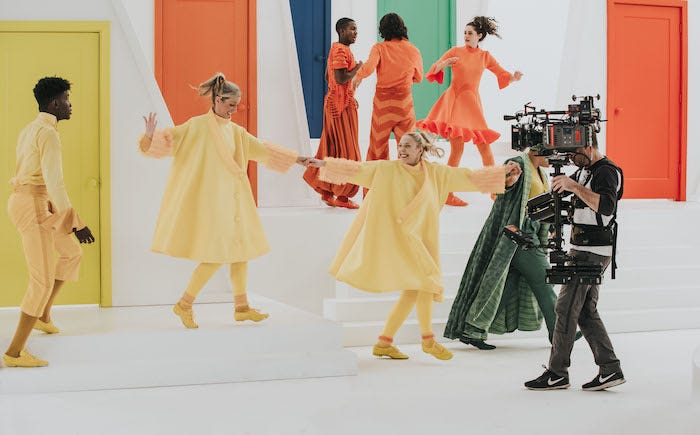
Scott: How about the music? Who was responsible for composing the score and how involved were you with that aspect of the project?
Meghann: Your colleague and mine, Rob Steel, composed the score. He is such a great collaborator and I have now worked with him on just about all of my projects since Speed Dating in 2013. Since he comes in early on, just after the animatic is complete, he really contributes so much to the overall feel of the films. Because there is usually no dialogue, a lot of the story ends up being conveyed by the music and Rob is just a master at that. He also helped connect me to Tom Matta and Tom Miller, both faculty members in the School of Music at DePaul. And they in turn brought in an all student and alumni orchestra to record the score. I had such a great experience going to I.V. Labs here in Chicago for the recording session and working with the musicians to get the performance just right. It was pretty magical and I feel like I was grinning ear to ear the whole time.
Scott: The set for the live-action component, what was the production and set design team for that? Where was the set built?
Meghann: John Corba was the Production Designer and he brought in set designer David Tennenbaum to make the drawings. Each of them brought everything they know to the project and really played off of the old Hollywood musical style to come up with the set. We knew we wanted stairs because we wanted a sense of elevation so we could play at multiple levels. And we also knew we wanted a centerpiece that we could get a good bird’s eye view of. And finally, the doors where the cast enters from was something that was in my mind from the beginning of the whole idea so we had to work those in too. At first, we all had to treat it just like the writing process where there was no budget and the sky was the limit. The great thing was, even though the designs were pretty spectacular, we ended up not having to constrain it too much and figured out how to make it work with what we had. John was able to hire a professional crew to build the set at DePaul’s stages at Cinespace where we used it to rehearse with the cast. However, because the scene takes place in an infinite white space, our stages at Cinespace aren’t set up that way and we had to find a solution. We were able to negotiate some help from Essanay Studio and Lighting in Chicago, where they have a large three walled white cyclorama, which really made the scene work. The tough part was that after a week of rehearsals at Cinespace, the set building crew had a day to tear it down, pack it, transport it and then rebuild it at Essanay for a week of shooting there. It is a miracle that they pulled it off, but it was a flawless transition. Just incredible to witness. I should also mention that even though we were able to shoot in a white space, it still required a fair amount of technical wizardry from DePaul faculty member and VFX Supervisor Brian Andrews, who seamlessly made it all spectacular and yet believable at the same time.
Scott: About a third of the way through the film, the action shifts to the animation part of the story, set in a Rube Goldberg-type of world. What was the inspiration for that and how did you go about creating it?
Meghann: Rube Goldberg has basically been an obsession of mine for most of my filmmaking career, since before I even knew who Rube Goldberg was. I think I trace it back to PeeWee’s Big Adventure, in the opening scene where PeeWee’s breakfast is made by a crazy contraption with all kinds of household items doing things like dropping bread in the toaster to flipping the eggs to pouring the orange juice. I always wanted to make those kinds of things and have definitely used the idea a few times in my films, especially Sleepy Steve.
For this scene in Oh Baby!, we were really able to push the limits again. Usually a scene like this would be on a smaller scale, to try to help curtail all of the materials needed to build the set pieces and props. But we knew that there was going to be so much going on in this scene that we needed space for a few animators to be able to get to the different parts of the machine at the same time. That would have been a nightmare in a miniature set and really slowed things down. With the life-sized set we were able to get the people we needed where they needed to be and also to set up a second camera to get different angles of the same motions. It was still painstaking and took a week to shoot, but I love how it all came out. The inspiration for the set was the factory scenes in Charlie Chaplin’s Modern Times. The overall look was a combined effort from a lot of people, John Corba and David Tennenbaum again, but also Jennifer Stachovic in her animatic as well as Art Director Shawn Spear in designing the machinery that would have to be built from scratch because they didn’t really exist. John was able to take Shawn’s 3D design files and go to Event Creative, a local live event company, to have them constructed on their CNC machine. And again, I was just floored with the results. Shawn also hand built and painted many of the set pieces in that scene as well as a lot of the miniatures in the final scene.

Scott: The direction and editing is wonderful with one creative camera angle and transition after another. The effect is this fun roller coaster type ride, but I imagine that took a lot of work. What was involved in pulling that together?
Meghann: Thank you. That is a great compliment. I work with the same DP a lot, Scott Thiele, and we have worked together so much that we really trust each other to get the visuals right. Scott is extremely talented and really knows what can be done with lenses and lighting to create the saturated look and the fun angles that I like to have. In terms of editing, I usually edit a lot of what I do, but when the project is more complicated like this one was, I like to work with an editor instead. Our colleague at DePaul, Savvas Paritsis, then stepped in as the editor as well as the Post Production Supervisor. I have worked alongside him for years and just love his attitude when it comes to editing. He is a calming force who is a storyteller at heart. He brings both of those attributes to the editing room and we just work and work and work until we get it right. It can be a painful process for a director, losing shots and trimming this and that, especially when you know how much work went into each frame, but you need someone else who can be objective and only wants to make the best film possible to get you to the other side. And that is Savvas to a T.
Scott: One thing I love about the story is we’re not really sure what the entire journey is about until the very last moment of the movie when we hear a particular sound where we go, “Now I get it!” Did you always have that ending in mind?
Meghann: Haha, that’s great. Just what I would want the experience to be. That particular ending was not exactly what was intended from the beginning. For this project, I don’t think I really had a great ending in mind while writing it. What we had was passable, but it was the one thing that really never felt just quite right. It wasn’t until after we were done shooting that I had the idea to end it the way it is now. By then, I was pregnant with Millie and I saw this as a way to get her involved in a small but meaningful way, even though she wasn’t even born yet!
Scott: Okay, here’s my story interpretation. You know how each individual is a composite of dozens of emotions, feelings, moods, and personality aspects. My take is the combination of all those colors at the beginning, baked into the final ‘product’ suggests that we are born with those complex set of dynamics which we learn to integrate into a whole. Am I anywhere close with that interpretation or have I been reading too much Carl Jung?
Meghann: You have pretty much summed it up perfectly. I wanted to convey that all of these aspects of our personalities exist before we are born and that they are all mixed into each and every one of us. Never in exactly the same way but every one of us has some of these same things in our makeup and we are all the same in the end. We all are made of the same stuff and get here the same way. Anything that seems to divide us in our short time on earth really doesn’t matter if we can look at each other in this way.
Scott: Talk about the film’s reception and festival run.
Meghann: We’ve had a great festival run. We played at some pretty cool festivals around the world like LA Shorts, the Cleveland International and the Festival du Nouveau Cinema in Montreal. All in all I believe we’ve screened in about 30 festivals so far!

Scott: What’s next for Meg Artes?
Meghann: That’s a great question! I’m doing a lot of brainstorming during our current covid situation. Anything is currently on the table because my ideas are all over the place, big, small and places in between. I do have one bigger project on the horizon. For that I have been working with our good friend and colleague, Anna Hozian, on a great feature script of hers. We are really hopeful to be able to make it next summer! Fingers crossed. I’ve had the chance to work with Anna on a short film in the past and she is amazing, just a dream collaboration partner!
Scott: Finally, let me just say I have so enjoyed getting to know you in my time at the DePaul University School of Cinematic Arts. You’ve been here many more years than I have, so could you talk about your overall experience with the school?
Meghann: Ditto! I still remember when I first met you. I felt like I could talk to you for hours and I still do now. I’m so glad you decided to come to DePaul! I think we are both lucky because we landed in a pretty cool place to work. I feel so supported here at DePaul. There’s a real collaborative spirit among our colleagues, like everyone is willing to work together and root each other on.
Scott: Congratulations on Oh, Baby! and good luck with all your future creative endeavors!
Meghann: Thanks Scott! This is one of the more in-depth interviews I’ve had with Oh Baby! Thank you for all your thoughtful questions. I’m not sure if anyone has made it to the end of this interview, but if you have, you are awesome and I feel like I owe you a drink or something!
After a successful festival run, here is the film Oh, Baby! which debuts online today. Enjoy!
To see the roster for the entire cast and crew, click here.
Oh, Baby! Festival Run
USA Film Festival *Winner- Best Experimental Film
UFVA Conference *Winner — Silver Award for Animation
LA Shorts Fest
Festival du Nouveau Cinema
Sidewalk Film Festival
Freedom Shorts *Winner- Best Film
Barcelona Planet Film Festival *Nominated Best Female Director
Woods Hole Film Festival
Cleveland International Film Festival
Oaxaca FilmFest
Walla Walla Movie Crush
Breckenridge Film Festival
Birmingham Museum of Art’s Art on the Rocks
Milwaukee Short Film Festival
Topaz Film Festival by Women in Film Dallas
Washington West Film Festival
Pittsburgh Shorts Film Festival
RIFF (Rome International Film Festival)
Midwest International Film Festival
MarDelDance Presents: Dance on Film Festival *Nominated Best Story/Message
Grenada Afterglow Film Festival *Winner- Best Feel Good Film Award
Eindhoven Film Festival
Anchorage International Film Festival
Underexposed Film Festival yc,
Bucharest Short Film Festival
Blackbird Film Festival
Chicagoland Shorts
Cordillera International Film Festival
Here is a behind the scenes video about the production of Oh, Baby!
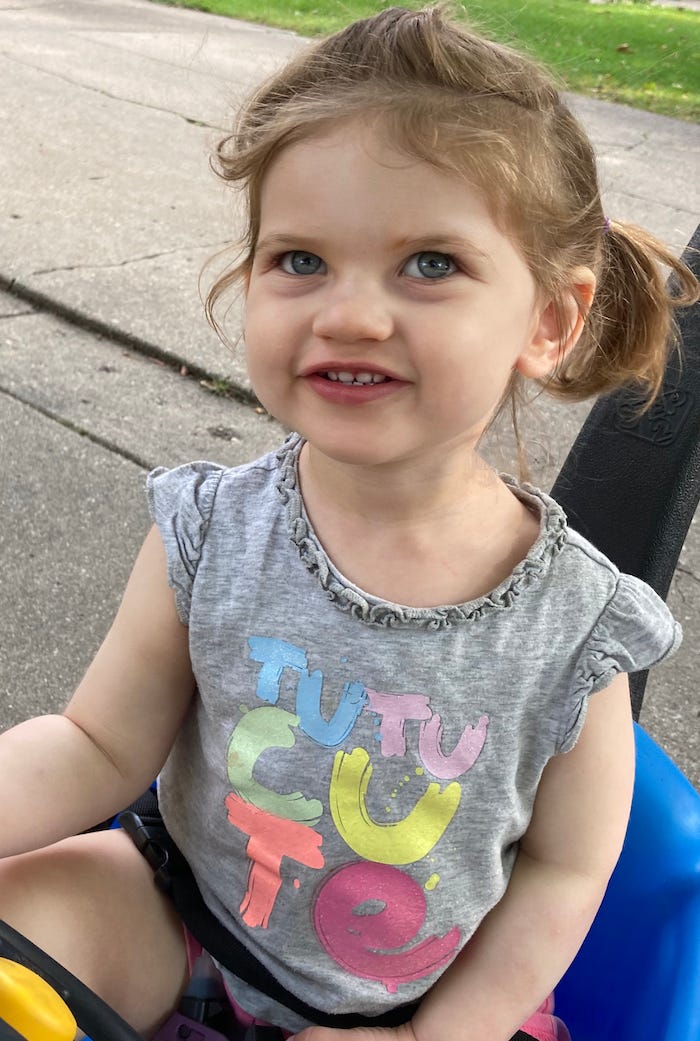
Finally, here’s a photo of Millie who was an inspiration for the movie!
To learn more about the animation program at the DePaul University School of Cinematic Arts, go here and here.
Congratulations, Meg, on this wonderful movie!