Movie Analysis: “The Shining”
What if we look at the story with Jack Torrance as its Protagonist?
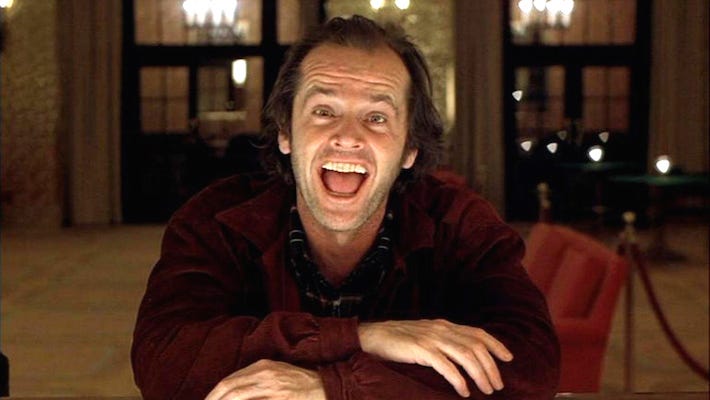
Looking at the story with Jack Torrance as its Protagonist. What about his character arc?
I recently posted an article in which I responded to the question: Can a Protagonist evolve into an Antagonist?
So this is my question: in “possession” films where a character’s personality is taken over/subsumed by something “evil” or “demonic” or whatever … does the protagonist become the nemesis? And if so do we then end up (ideally) switching the protagonist to someone else?
It seems to me these type of stories are a special case. One example would be The Shining — the Jack Torrance character is the protagonist at the beginning of the movie but once the evil forces/entity that haunts or indeed “is” The Overlook Hotel he becomes the nemesis and from then on we’re rooting for Wendy and Danny.
I also wonder whether some of these films can only work with an initial co-protagonist/ensemble setup? I mean you could argue with The Shining Danny is the protagonist all along.
Here is an excerpt of my response:
In possession stories, such as you note, if the Protagonist succumbs to the demonic power, I don’t see that as the Protagonist becoming the Nemesis, rather the demonic power is the Nemesis. The Plotline question is who’s going to win the battle for control: Protagonist or Nemesis? If the Nemesis wins, such as in the case of Jack in The Shining, then Jack is still the Protagonist, he’s simply lost the battle against the Nemesis.
This led to a comment by Steven Hale:
I’d never thought about the structure of The Shining before. Wendy and Danny do seem like the typical protagonists of a horror film — their goal is to escape the monster. But I think your explanation of Jack as a protagonist who gives in to his shadow side is more fruitful.
Some noodling:
So what’s Jack’s goal? His external goal is to take care of the inn during the off-season. Who opposes this goal? The dark forces from the inn’s past. As he succumbs to their lure (e.g. the scene in the bar), he becomes more malevolent.
Jack’s need is to write his novel. In theory the isolation of the inn should be a productive environment, but if anything the external loneliness makes him vulnerable to the dark pre-existing (hence the historical photograph with him in it) internal demons. His inability to escape these demons parallels his writer’s block (i.e. the inability to put himself on paper — “all work and no play” = he can’t integrate his dominant side and his shadow, so the shadow takes over).
To which I responded:
Ultimately, Steven, as you know, it’s all semantics. There’s no one way or right way to analyze a story. So allow me to toss my Want and Need take re Jack in The Shining.
His Conscious Goal (Want) is to write the novel. That’s why he took the gig (ostensibly). But of all the gigs in the world, he takes *this* one! Pure Jung: “When an inner situation is not made conscious, it happens outside as fate.” Jack lands a job in a remote hotel which is cut off from the outside world during winter. The hotel, its ghosts, and violent history can be seen to be a projection of Jack’s own psyche as *he* has ‘ghosts’ (shadow) and violent instincts. When he settles in at the bar and begins to drink (again), that symbolizes how he’s moving away from his efforts to control his shadow instincts and give into them. Which leads to…
Unconscious Goal (Need): His fate is to allow his shadow side to take over his psyche. That’s the story’s narrative imperative. “It happens outside as fate.” This gig at the hotel offers him a choice: Confront his shadow and synthesize it in a healthy, emotional way… or yield to it and become a monster.
His fate is the latter.
The Shining is Taxi Driver set in a hotel, both Protagonists ceding their conscious behavior to their shadow. It’s the same as Breaking Bad where Walter White becomes Heisenberg.
This is yet another reason why I wince when screenwriters get caught up in the “what is the Protagonist’s wound” or “what is the Protagonist’s flaw.” Protagonists — at least compelling ones — have much more going on, not just issue or incident in the past (which, of course, they may have), but an active psychological dynamic roiling around in the subconscious layer of their psyche. It’s *that* they have to deal with. And when the external circumstances of the Plotline are tied specifically to that dynamic which has yet to be synthesized, then you have the makings of great drama.
As in Jack stuck in a hotel inhabited by ghosts and a violent past — LIKE JACK’S PAST! — so he is forced to confront his shadow self.
In the end, the shadow swallow up his conscious efforts to control that behavior. Jack becomes his version of Travis Bickle… Walter White… and any other story Protagonist who loses their ‘soul’ to their shadow.
So there’s my Jungian take on The Shining. More to come in my book.
Once a writer taps into the deepest level of a Protagonist’s Need, what I like to call their Unconscious Goal, that translates into that character’s psychological end point. And that awareness can shape the emerging story structure whereby the events of the plot and the characters with whom the Protagonist intersects serve and support that character’s transformation arc.
Once again per Carl Jung: “When an inner situation is not made conscious, it happens outside as fate.”
In The Shining, Jack Torrance’s Need was to cede his Ego to his Shadow and become the ‘monster’ he does by story’s end.
That was his Narrative Imperative.