Movie Analysis: “Gravity”
When we think of the movie Gravity, we most likely think BIG. Yet in interview after interview, co-writer and director Alfonso Cuarón has…

When we think of the movie Gravity, we most likely think BIG. Yet in interview after interview, co-writer and director Alfonso Cuarón has been emphatic in making this point about the movie: Its small story was equally as important as its big story.
The movie’s trailer is all about spectacle:
However, check out this Studio 360 interview in which Cuarón says the following:
The movie is almost a metaphorical journey. Outer space is a metaphor for the inner space of our character (i.e., Ryan Stone).
In this io9 interview, Cuarón says this:
Did you have to fight for the film to be more of a small, character-focused piece? Instead of focusing on all of the destruction?
When we set up to write the script, it was about that. What we were trying to do was a film about adversity and the possible outcome of a rebirth. All of things that fall apart metaphorically, and in the life of this woman.
And in this Indiewire interview with Anne Thompson, Cuaron says this:
At the end of the day, it’s about theme and emotion.
Big story? Yes. A wild roller coaster ride in outer space with survival at its core. But also a small story: How Ryan Stone (Sandra Bullock) comes to terms with the death of her young daughter. You don’t think that is important to the story? Go check out that trailer again, starting at 01:35:
Kowalski: Where's home, Dr. Stone?
Stone: Lake Zurick, Illinois.
Kowalski: Is there somebody down there looking up, thinking about you?
Stone: I had a daughter. A little girl with brown hair. Tell her that I'm not quitting.
Why would the Warner Bros. marketing department make sure 15 seconds of this trailer referenced Stone’s ‘small’ story if they didn’t think it was important?
I’m not suggesting the small story in Gravity is wholly responsible for its ginormous box office success. What I am saying is this:
- At least some of the positive BWOM (By Word Of Mouth) about this movie derived from the audience’s emotional connection with a mother who has lost her child and is forced to cope with her grief under remarkable circumstances.
- If the filmmakers themselves looked at the movie as a metaphor for the Protagonist dealing with her personal issues, then it makes sense for us to think about the story that way as well.
- No spectacle movie can be considered to be great unless it has a compelling small story at work in it.
In this article, I’m going to go through the script for Gravity and strip out every single scene that references the movie’s small story. In that process, I am going to focus on three dynamics:
1. The overall arc of that subplot moving from Beginning to End.
2. How the metaphor of outer space services the psychological nature of this subplot.
3. Stone’s metamorphosis as she is forced to grapple with her grief.
More generally, I am hoping each of us will come away with an appreciation for the importance of the machinations of a story’s Internal World balanced against the entertainment value of all the action in its External World.
In that regard, let’s think how filmmakers like Cuarón, Pixar, Steven Spielberg, and James Cameron have a knack for working with small stories in the Internal World that audiences find emotionally resonate and support the spectacle of the External World.
“The silence. I could get used to it.”
Plot Summary: A medical engineer and an astronaut work together to survive after a catastrophe destroys their shuttle and leaves them adrift in orbit.
Background: Dr. Ryan Stone is a biomedical engineer on her first Space Shuttle mission. She is accompanied by Matt Kowalsky (George Clooney) and Shariff (voiced by Phaldut Sharma).
Ryan is on a space walk, attempting to make a repair on the Hubble Space Telescope. Matt Kowalsky (George Clooney) approaches:
MATT: So, what do you like about being up here?
RYAN: The silence. I could get used to it.
This is the very first indication of Ryan’s inner conflict. Why does she like “the silence”? Why could she get used to it? Presumably there is some ‘noise’ in her life that is problematic. At this point, we only have this oblique reference, but it does set the subplot into motion by hinting at the mystery of what it might be about.
Then disaster strikes. From the IMDB plot summary:
Houston tells them that debris from a Russian missile strike on a defunct satellite has caused a chain reaction, destroying other satellites… High-speed debris strike the STS, sending it spinning wildly, with Stone at the end of the boom arm. A piece of debris breaks the robot arm off from the STS, and Stone is forced to release the tether holding her to the robot arm.
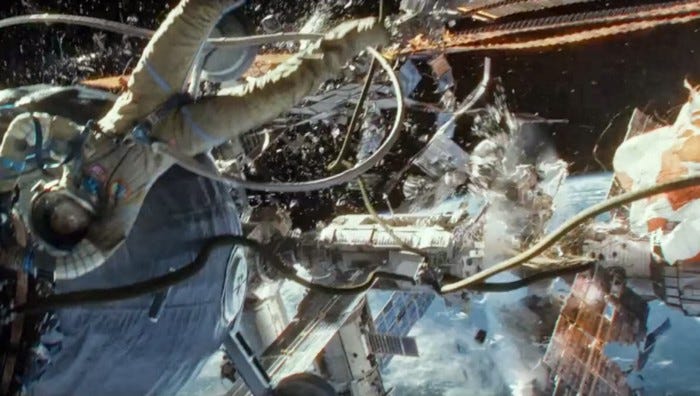
During this sequence, Matt says this:
Matt: Dr. Stone, detach! You must detach! If you don’t detach, that arm’s gonna carry you too far!
Let’s keep that dialogue in mind for later reference. More bad stuff happens:
Once free, she is thrown far from the STS. Stone panics, trying to contact Houston or Kowalski. Kowalski, who is wearing a thruster pack, suddenly appears and attaches her tether to him. He flies them back to the STS, where they find the engineer Shariff, his helmet smashed and his skull mostly open and empty. They find that the STS Explorer has been catastrophically damaged. The station’s interior has been ripped open by debris and the remainder of crew are dead. Kowalski decides to use the thruster pack to get to the International Space Station (ISS), which is in orbit about 100 km (60 mi) away. Kowalski estimates they have 90 minutes before the debris field completes an orbit and threatens them again. With Stone’s oxygen reserve running low, they float through space to the ISS.
As they float through space, there is this exchange:
MATT: Okay. Pretty scary shit being untethered up here, isn’t it?
RYAN: Yeah, pretty scary shit.
MATT: Well, you did all right.
A second reference to ‘detach / untethered’. Again file that away. In an attempt to calm Ryan down, Matt engages in what he thinks will be small talk:
MATT: That’s what I’m gonna miss the most. So where’s home, Dr. Stone? Ryan, where’s home?
RYAN: Home?
MATT: Mm-hm. Down there. Mother Earth. Where do you pitch you tent?
RYAN: Lake Zurich.
MATT: Where the hell is that?
RYAN: Illinois.Matt floats, pulling Ryan behind him.MATT: Illinois. Central Time Zone. (sighs) That would make it roughly... eight PM. What are the good people of Lake Zurich doing at eight o’clock?
RYAN: I don’t know. I’m not gonna make it. I’m slowing you down.
MATT: What would you be doing? Come on, Ryan. It’s eight o’clock. You've just left the hospital after an eighteen-hour shift. Driving home.
RYAN: The radio. I listen to the radio.
MATT: There we go. Let me guess. NPR? Classical? Top forty?
RYAN: Anything. I don’t care, as long as they don’t talk. I just drive.
MATT: And where are you driving to?
RYAN: I just drive.
MATT: What do you miss down there? Is there a Mr. Stone?
RYAN: No.
MATT: Nobody special?Ryan slowly floats. The reflection of the Earth appears on her helmet.MATT: Somebody down there looking up, thinking about you? Ryan?
RYAN: I had a daughter.Matt glances at the mirror affixed to his wrist. The mirror on his wrist depicts the reflection of Ryan.RYAN: She was four. She was at school playing tag. Slipped, hit her head, and that was it. Stupidest thing. I was driving when I got the call, so... ever since then, that’s what I do. I wake up, I go to work, and I just drive.
So here we have it, the entire backstory of her daughter’s death… with one significant detail left to be revealed down the road. What can we glean from this exchange?
- When Matt presses her about what people are doing in Lake Zurich, Ryan switches subjects: I don’t know. I’m not gonna make it. I’m slowing you down. The text of the dialogue is an expression of her anxiety about whether they will survive or not. The subtext suggests the subject of her home / personal life is an uncomfortable one, something she’d prefer not to discuss.
- Then this: Anything. I don’t care, as long as they don’t talk. I just drive. This calls back her line about liking the “silence” of space. Music she can handle. Talk she can’t. My interpretation of this is Ryan suffers from a never-ending internal dialogue… and it is not a pleasant one. This chatter, the content of which I will discuss at a later point in this subplot, vexes her, and she uses music and driving to try to dull the noise. But there are other reasons for Ryan’s habit of “just driving” which we will discuss later below.
- I had a daughter. She was four. She was at school playing tag. Slipped, hit her head, and that was it. Stupidest thing. The raw, brutal truth of this tragic event is how mundane the circumstances were. Kids slip and fall all the time. For some mystifying, “stupid” reason, this time killed her daughter.
- I was driving when I got the call, so… ever since then, that’s what I do. I wake up, I go to work, and I just drive. She discovered her daughter had died while she was driving. Therefore my guess this has become something of a ritual for her in two respects: (1) Driving reminds her of that fateful call. For reasons yet unknown, it is important for her to keep that memory vivid in her experience. (2) Driving also does something else: It keeps her away from her house. What is in her house? A void created by her daughter’s absence. In other words: Space.
That right there aligns with what I think Cuarón meant in large part when he said: “Outer space is a metaphor for the inner space of our character.” That inner space is this huge vacuum, a gaping hole which her daughter used to fill. What has been filling her now is the chatter of her mind, incessantly going over the details of her daughter’s death, the necessity to “just drive” as some sort of ritual related to the tragedy, listening to music to try to drown out the voices in her head, and the knowledge that when she goes home, she will confront an awful emptiness there.
In this regard, Ryan begins the story in a classic state of Disunity. Moreover, she has made little progress in terms of her grieving process, almost in a state of psychic stagnation.
I think the single best question one can ask of a Protagonist character is this: Why does this story have to happen to this character at this time? Again, Cuarón provides the key: “What we were trying to do was a film about adversity and the possible outcome of a rebirth” [emphasis added].
At a psychological level, the entire point of this disaster story is to compel Ryan to deal with her grief related to her daughter’s death, to force her to move out of her life-less state of suspended animation and be ‘reborn’.
Cuarón was intentional about mining this dynamic and we will see plenty of themes throughout the story that explore this dynamic.
“I’m not letting you go.”
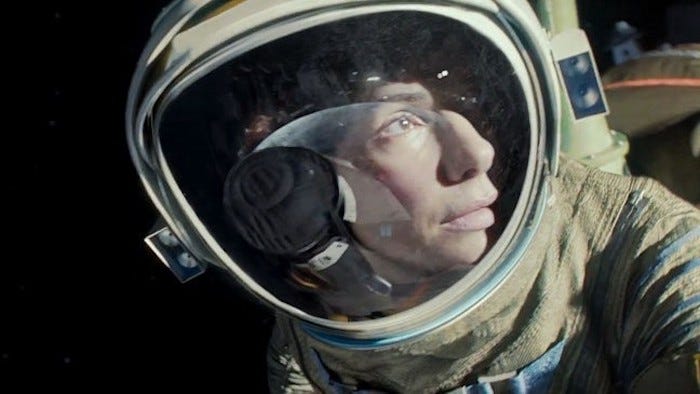
As they [Stone and Kowalski] approach the slightly damaged ISS, they see that its crew has already evacuated in one of the Soyuz modules and that the parachute of the other Soyuz, designated TMA-14M, has accidentally deployed, making it useless for return to Earth. Kowalski says that the Soyuz can still be used to travel to Tiangong, the nearby Chinese space station, to retrieve another module that can take them to Earth. All but out of air and maneuvering fuel for the thruster pack, the two try to grab onto the ISS as they zoom by. At the last moment, Stone’s leg becomes entangled in the Soyuz’s parachute lines, and Stone grabs Kowalski’s tether, just barely stopping him from flying off into space.
More script excerpts:
MATT: Ryan!Matt flies past, pulling Ryan with him. Ryan bumps into a solar panel and their tether snaps. Ryan falls.RYAN: The tether broke, I’m detached! I’m detached!
MATT: Grab a hold! Grab anything!Ryan falls.She becomes entangled in some of the Soyuz’s parachute rigging. The
rigging pulls her up. She reaches out her hand.MATT: Ryan! Give me five!
RYAN: I’ve got you.He flies toward her, unsuccessfully grabs for her hand.RYAN: I’ve got you. Right here, right here. Okay, get it.Ryan grabs hold of the tether attached to him.MATT: Shit! Shit.
RYAN: No. No, no, no, no, no, no, no, no.EXT. OUTER SPACE - SPACE STATION - DAYRyan is pulled by the tether.RYAN: Got ya.Matt holds firmly onto the tether as he is yanked. Ryan holds firmly onto the tether. Ryan’s left leg is entangled in the parachute rigging.RYAN: Got ya. You just... hold on and I’m gonna start pulling you in. I’m gonna star--
MATT: Hey, Doc.
RYAN: Just hold on. Hang on. I am gonna pull you in. I’m gonna pull you in.
MATT: Ryan, listen. You have to let me go.
RYAN: No.
MATT: The ropes are too loose. I’m pulling you with me.
RYAN: No.Matt takes hold of the tether clip.RYAN: No, no, no.
MATT: You have to let me go, or we both die.
RYAN: I’m not letting you go!Ryan is pulled and Matt yanks her back.RYAN: We’re fine!
MATT: No. Ryan, let go.
RYAN: No. No. You’re not going anywhere. You’re not going anywhere.Matt starts to unclip the tether.MATT: It’s not up to you.
RYAN: No, no, no, no, no... no... Please don’t do this.Matt unclips the tether.RYAN: Please, please, please, please don’t do this. Please don’t do this. No, no, no. Please don’t, Matt. Please don’t do this.Matt lets go of the tether and floats off.MATT: You’re gonna make it, Ryan.
RYAN: No!Ryan floats toward the space station. Matt floats away.RYAN: I had you. I had you! I had you.Ryan smacks into a part of the space station and flips over. She grabs hold of a metal railing. We see Matt far away now in the b.g. Ryan’s C02 alarm goes off, indicating that she’s out of oxygen.
So you are probably asking, “Why is Myers excerpting this? It’s not ‘small’ story, it’s Big Story. Action. Survival. And the drama of Matt’s selfless act and Ryan being left alone.
Certainly that is the meaning of the text of the dialogue, but I suggest there is something else going on, a layer of subtext.
To make my point, we need to shift gears and go back to an older draft of the script, dated November 2, 2009. There are a bunch of significant differences between that draft and the shooting script. Here is a key one: In this earlier draft, Ryan did not have a daughter. Instead she had a dog.
That’s right… a dog.
She hardly has anything to say about it, summing up her pet this way: “Just — a dog. A regular dog.” She doesn’t even provide a name for the creature. We are talking a generic dog.
Let’s cut to the very last scene in the 2009 draft which has a similar ending as the movie: Ryan successfully makes it back home. The last lines of scene description in the earlier draft:
SHE BEGINS TO WALK ON EARTH, laughing.SHE IS PUNCH DRUNK.SHE IS FREE.
Question: Free of what?
Compare to the finale of a movie that also takes place on a beach: The Shawshank Redemption where Red meets Andy in Mexico. Here is the final side of dialogue in the movie:
RED (V.O.)
I hope I can make it across the
border. I hope to see my friend
and shake his hand. I hope the
Pacific is as blue as it has been
in my dreams.
(beat)
I hope.
When Red says, “I hope,” that is the culmination of his personal metamorphosis, moving from cynicism born of “institutionalization” to hopefulness, which is what Andy has been ‘preaching’ and teaching by example for 19 years. “Get busy livin’, or get busy dyin’.” Brooks, who committed suicide, represents the latter. Andy the former. Red chooses to follow Andy’s path, not Brooks.
So “I hope” is replete with all sorts of meaning, a fitting capstone to a truly great movie.
Compare that to Ryan and the final line of scene description in the 2009 draft of Gravity: SHE IS FREE.
Again: Free of what?
Given where Cuarón and his son, who co-wrote the script with him, went with subsequent drafts, my guess is they hit the end of the 2009 draft and asked the same question.
Basically it boils down to this: What is the point of this entire journey? I don’t think they felt like they had nailed that in the 2009 draft.
So my guess is that is likely where the dog evolved into Ryan’s daughter. And the daughter’s death. And Ryan being stuck in her grieving process. And the metaphor of “space” related to the void created by the daughter’s death. And the whole idea of “rebirth” which Cuarón has suggested is thematically what Gravity is about: “What we were trying to do was a film about adversity and the possible outcome of a rebirth.”
Rebirth = Freedom. Freedom from the soul-sucking attachment to the death of her daughter. As noted yesterday, Ryan is stuck in a rut, leaving work and “just driving,” avoiding going home so she won’t have to face the gnawing absence of her daughter, unable to face the finality of her personal tragedy.
Why do I think this is going on in the movie? Because all of that dialogue and action cited in the Big Story scene above… is not in the 2009 draft at all. Simply. Not. There. This is what happens instead:
The very tips of their fingers touch...BUT THEY MISS.Matt passes by her and continues floating away.
That’s it. The entirety of their separation.
So why the drawn-out affair in the shooting script — 3 pages!! — where Matt ends up choosing to uncouple himself from Ryan?
Here’s one reason: It amplifies Matt’s character, giving his character a selfless act to save Ryan’s life. I’m sure that appealed to George Clooney as an actor.

But there’s another reason and to get to it, I invite you to re-read the entire section excerpted above and consider the subtext: Ryan not talking to Matt, but rather to her daughter. Check out this dialogue from that perspective:
RYAN: I’ve got you. Right here, right here. Okay, get it.
MATT: Shit! Shit.
RYAN: No. No, no, no, no, no, no, no, no.Just hold on. Hang on. I am gonna pull you in. I’m gonna pull you in.
MATT: Ryan, listen. You have to let me go.
RYAN: No, no, no.
MATT: You have to let me go, or we both die.
RYAN: I’m not letting you go!
RYAN: We’re fine!
MATT: No. Ryan, let go.
RYAN: No. No. You’re not going anywhere. You’re not going anywhere.
MATT: It’s not up to you.
RYAN: No, no, no, no, no... no... Please don’t do this.
RYAN: Please, please, please, please don’t do this. Please don’t do this. No, no, no. Please don’t, Matt. Please don’t do this.Matt lets go of the tether and floats off.RYAN: I had you. I had you! I had you.
Obviously the text of the dialogue is about Ryan communicating with Matt amidst this crisis situation, but if we look at the dialogue metaphorically as Ryan ‘talking’ to her daughter with regard to her death, it works on so many levels:
- Ryan desperately trying to alter the past: “I’m going to pull you in”.
- Ryan refusing to give up her grieving, her final connection to her ‘living’ daughter: “I’m not letting you go.”
- Matt speaking as a Mentor: “You have to let me go.” This line is, in my view, the foundation of Ryan’s metamorphosis-journey.
- Again as Mentor: “You have to let me go, or we both die.” Psychologically this is totally true for as long as Ryan cannot move beyond her state of psychic stagnation related to her daughter’s death, she will persist in a life-less existence, eventually resulting in her psychic dissolution.
- Ryan: “We’re fine!” This is Ryan denying her Disunity state.
- Matt: “It’s not up to you.” For whatever reason, fate chose to ‘take’ Ryan’s daughter away from her, no matter how “stupid” it may feel to Ryan.
- Ryan: “No. No. You’re not going anywhere. You’re not going anywhere.” Again refusing to move on with her grieving and accepting her daughter’s death.
- Ryan: “No, no, no, no, no… no… Please don’t do this. Please, please, please, please don’t do this. Please don’t do this.” Again desperation to avoid the truth of what has happened to her daughter.
And then this:
- Ryan: “I had you. I had you! I had you.” Yes, she did. She ‘had’ her daughter as a mother giving birth. She ‘had’ her daughter as a parent raising a child. She ‘had’ her daughter as one human being bonding in a powerful way with another human being.
But now the daughter is gone… yet Ryan cannot allow her to go. She needs to be set free from that constrictive psyche state. Which, again, is why I think Cuarón moved from Ryan having a dog to Ryan having a daughter, the latter providing a much more specific and powerful emotional challenge.
“I hate space.”
As Kowalski floats away, he radios her with additional instructions about how to get to the Chinese space station, encouraging her to continue her survival mission. Stone enters the ISS through an airlock and gets out of the spacesuit. She begins to get familiarized with the ISS when an alarm suddenly alerts her to a fire. She makes her way to the module where the fire is and attempts to put it out, but she is momentarily stunned when the force of the extinguisher thrusts her backward into the bulkhead. She recovers and knocks the flames down again and pushes through them towards the Soyuz. With the fire closing in, she closes the hatch, pulling in the fire extinguisher at the last moment when it blocks the hatch. She separates from the ISS only to find that the Soyuz’s parachute lines are entangled in the ISS. She dons a Soviet spacesuit and exits the spacecraft to release the cables when the debris field completes its orbit. Clinging to the Soyuz, the ISS is destroyed around her.
At this point, Ryan utters these words:
Ryan: I hate space.
Text: Outer space.
Subtext: The vacuum created by her daughter’s death. Then:
Free of the ISS and the parachute lines, Stone reenters the spacecraft and aligns it with Tiangong. She fires the thrusters but the fuel gauge is wrong: the tanks are empty.
Shooting script excerpts:
INT. SOYUZ - DAYThe edge of the window, which starts to gather frost and freeze over.RYAN (O.S.): (into radio; wavering voice, sniffs) Houston, this is Missish -- Mission Specialist Ryan Stone, do you copy?
ANINGAAQ (V.O.): (over radio) (Indistinct)THE TOP OF A CONTROL PANELA card depicting a Russian religious character is affixed to it.RYAN (O.S.): (into radio) Houston, Houston, please confirm identity.
ANINGAAQ (V.O.): (over radio) (Indistinct)
RYAN (O.S.): (into radio) Houston, you’re coming in over an A.M. frequency. Copy.RYAN’S HELMET AND A FIRE EXTINGUISHERBoth floating in the air.RYAN (O.S.): (into radio) Do you copy? (pants) Is this the Chinese station? Is this Tiangong? Copy.ANINGAAQ (V.O.): (over radio) (Inuit)
RYAN (O.S.): (into radio) Mayday, can you copy?RYANleaning toward the control panel, reacting as a transmission finally comes through the radio.RYAN: (into radio) Mayday, mayday, mayday.
ANINGAAQ (V.O.): (over radio) (Inuit)
RYAN: (into radio; panting) Ma-- Yes, yes. Mayday, mayday. Mayday, mayday. An-- (whispering) Anin-- Aningaaq, is that -- ? Is that your -- ? Is that your name? Aningaaq is your -- is your name? Is that your name?
ANINGAAQ (V.O.): (over radio; in Tagalog) Mayday!
RYAN: (into radio) No, no, no. No, my name is not ‘Mayday.’ I’m Stone. Dr. Ryan Stone, I need help. I am --She reacts as she hears dogs over the radio.RYAN: Wh-- Those are dogs. They’re calling from Earth. They’re calling from Earth.Ryan sits back in her seat and moves her fingers, trying to keep them warm.RYAN: (into radio) Aningaaq, make your dogs bark again for me, would you please? Your dogs. Dogs, you know. Woof, woof. Dogs.Aningaaq makes barking sounds, howls. Ryan makes howling sounds along with him.RYAN: (into radio) Woof, woof. Whoo, whoo!Ryan starts crying.RYAN: (into radio; crying) Oh, I’m gonna die, Aningaaq. I know, we’re all gonna die. Everybody knows that. But I’m gonna die today. Funny, that. You know, to know...Aningaaq starts to sing.RYAN: (into radio, crying) But the thing is, it’s that I’m still scared. I’m really scared. Nobody will mourn for me, no one will pray for my soul. Will you mourn for me? Will you say a prayer for me? Or is it too late?A tear falls from her eye, freezes, and floats. CAMERA RACK FOCUSES ON IT.RYAN: (into radio) I mean, I’d say one for myself, but I’ve never prayed in my life, so... Nobody ever taught me how. Nobody ever taught me how.CAMERA RACK FOCUSES BACK ONRyan as she hears a baby over the radio. She reacts and cries, as she hears Aningaaq singing.RYAN: (into radio) A baby. There’s a baby with you, huh? Is that a lullaby you’re singing? (whispering) That’s so sweet. I used to sing to my baby. I hope I see her soon.She leans over and presses a button on the control panel. CAMERA PANS WITH her as she reaches up and switches off the lights. She turns some dials, decreasing the oxygen in the cabin’s atmosphere, preparing to kill herself.The monitor, displaying the atmosphere levels and vital statistics of the cabin. The oxygen meter drops rapidly as an alert sounds. Text under the meter reads: “O2.”Ryan, now sitting back in the seat. She closes her eyes.
RYAN: (into radio) That’s nice, Aningaaq. Keep singing, just like that. (exhales sharply) Sing me to sleep, and I’ll sleep. Keep singing. And sing, and sing.
Here is the scene from the movie:
This is where the ‘small story’ takes a theological turn. Naturally so. As a minister I knew once told me, “Dying men always find God.”
This theme is established at the head of the scene with this visual: A card depicting a Russian religious character is affixed to it. Indeed despite Ryan’s confession that she has never prayed before, the entire conversation between Ryan and Aningaaq is like a prayer, only in inverse: Ryan, the Human, is in the heavens. Aningaaq, the Divine Being, is on Earth.
The initial back and forth is played very much up top, Ryan desperate to determine who this person is and if he can be of some assistance to her in this time of crisis. For his part, Aningaaq has no idea of Ryan’s predicament.
Then a turn in the scene: Dogs barking. This is almost assuredly a vestige from the 2009 draft in which, as we noted in yesterday’s post, Ryan did not have a daughter, rather she owned a dog. Thus the presence of dogs in the previous draft would serve as a callback to Ryan’s own dog.
Here the moment is played differently than the 2009 draft. Specifically, she asks Aningaaq to “make your dogs bark for me.” My guess this is about Ryan wanting to hear another sound (other than Aningaaq’s voice) that reminds her of Earth.
Then Ryan begins to howl: “Woof, woof. Whoo, whoo!” And as opposed to the 2009 draft where the moment of barking by Ryan and Aningaaq results in shared laughter, here it leads to Ryan finally breaking down. It suggests the beginning of a transition point, where all of her psychic defenses have collapsed, and the howls she voices get her in touch with a primal part of her Self: Fear of death.
Here she confronts that prospect: “Oh, I’m gonna die, Aningaaq. I know, we’re all gonna die. Everybody knows that. But I’m gonna die today.” Death is staring her in the face, a tactile reality at this point. And this is where she tries to ‘find’ God: “But the thing is, it’s that I’m still scared. I’m really scared. Nobody will mourn for me, no one will pray for my soul. Will you mourn for me? Will you say a prayer for me? Or is it too late?”
In response, a moment of grace… in the form of a baby’s voice. Afraid of death and alone, with no philosophical or religious training of any sort to help handle her impending demise, Ryan is given a lifeline, something to which she can relate: a child.
I used to sing to my baby. I hope I see her soon.
Another turn in the scene as Ryan makes a choice: To die and be with her dead daughter. This suggests movement on two fronts with her character. First, she is willing to ‘detach’ herself from her grieving and move on. Second, she is open to believing in a reality that transcends what she can touch and see, beyond her rational scientific mind… which lays the groundwork for what happens next [to be discussed in tomorrow’s post].
Want to see the conversation between Ryan and Aningaaq from the Inuit’s perspective? Here is a featurette directed by Jonás Cuarón, who co-wrote the script for Gravity:
Aningaaq has some dialogue not in the script:
Aningaaq: Do you hear that? It's my dog Naanak. She's sick and in very bad pain. There's nothing I can do but sacrifice her. Yes, I know it's normal. She's a very old dog. But I can't give up on her. I can't say goodbye. I love that dog so much."
“I can’t give up on her. I can’t say goodbye.” You can take this dialogue, give it to Ryan regarding her daughter, and it would fit like a glove. Here’s the thing: Unless we understand the Inuit language, we can not possibly know what Aningaaq is saying at this point in the movie… but it’s there… which means it is intentional on the part of the filmmakers. And the lines’ connection to Ryan’s psychic plight is indisputable.
Whether the ‘small story’ of Gravity worked for you emotionally or aesthetically, the critique some have offered — that this aspect of the narrative was somehow slapped on and is disconnected from the events of the plot — does not hold water. The Cuaróns embraced the idea that Ryan’s harrowing experiences in outer space were metaphorically tied to the fractured nature of her inner space related to her deceased daughter. As they said: Ryan’s psychological journey is one of rebirth.
“Tell her I’m not quitting.”
As she returns to full consciousness, Kowalski is gone, part of a hallucinatory dream. Stone restores the flow of oxygen and uses the landing thrusters to navigate towards Tiangong. With no fuel to slow or to dock the Soyuz with the Chinese station, Stone ejects herself from the Soyuz via explosive decompression. She uses the remaining pressure in the fire extinguisher as a makeshift thruster to push herself towards Tiangong, which has also been abandoned. She enters the Tiangong space station and makes her way through its interior to the Shenzhou capsule.
Excerpts from the shooting script:
ANOTHER ANGLERyan stops on a graphic in the instructions, displaying what to
do next.RYAN: All right. Okay. (as if to Matt) Hey, Matt?Ryan reaches toward the control panel.RYAN: (as if to Matt) Since I had to listen to endless hours of your
storytelling this week, I need for you to do me a favor.Ryan presses another button.HIGH ANGLE - RYANcontinues pressing buttons according to what the instructions tell
her.RYAN: (as if to Matt) You are gonna see a little girl with brown hair, very messy, lots of knots. She doesn’t like to brush it. That’s okay. Her name is Sarah. Can you please tell her that Mama found her red shoe? She was so worried about that shoe, Matt. But it was just right under the bed.Ryan presses more buttons. The monitor changes to display new graphics in Russian.RYAN: (as if to Matt) Give her a...HIGH ANGLE - RYANcontinues pressing buttons whilst perusing the instructions.RYAN: (as if to Matt) ... big hug and a big kiss for me, and tell her that Mama misses her. You tell her that she is my... (voice wavers) ... angel. And she makes me so proud. So, so proud.ANOTHER ANGLERyan presses several buttons. She manually sets the current altitude at 3 meters. A counter on the monitor changes to read: “000 003.0”RYAN: (as if to Matt) And you...HIGH ANGLE - RYANcontinues to press buttons.RYAN: (as if to Matt) ... tell her that I’m not quitting. You tell her that I love her, Matt. You tell her that I love her... (voice wavers) ... so much.Ryan looks up.RYAN: (as if to Matt) Can you do that for me? Roger that. (to herself) Here we go.Ryan looks back at the control panel in front of her. She presses a
button.
At this point, Ryan has made a choice. And so the dialogue in this scene is a kind of merging, both theological — ‘praying’ to Matt who is presumably in ‘heaven’ along with her daughter — and psychological — Matt representing the Higher Knowledge she’s gained, realizing that she does want to live. I’m not quitting.
Two things I find quite interesting about this dialogue:
- This is the first time we learn her daughter’s name: Sarah. It’s an interesting choice of names. In the Bible, Sarah was the wife of Abraham, the name deriving from ancient Hebrew. Whether intentional or not, it’s in keeping with some of the religious themes in the story.
- The red shoe. Sarah’s favorite pair. On the morning Ryan drove her daughter to school, they couldn’t find her red shoes. I imagine Ryan was in a hurry, like most parents are busily attempting to move their children along. Of all the things Ryan would ask Matt to convey to Sarah, it’s that Ryan found her lose red shoe. My gut tells me this is the physical object onto which Ryan projected her guilt. Her little girl died not knowing the fate of her favorite pair of shoes. There is something so specific about that, so mundane yet so familial. Now that Ryan has made her decision to try to live, she is able to confront the issue of the lost red shoe and in asking Matt to pass along that information to Sarah, bring that issue to closure.
Here is that scene from the movie:
This represents the penultimate stage of Ryan’s metamorphosis. She has transformed from an individual seeking to quite the voices in her mind, seeking silence in outer space, to someone giving expression to her deepest fears and confronting her shadow.
Now comes the Final Struggle in the realm of the External World. She is ready to move on with her life… if she can survive reentry to Earth.
She struggles to her feet. She unsteadily walks off.
The Tiangong station’s orbit has deteriorated due to hits by the debris field and it begins to break up on the upper edge of the atmosphere. Stone is unable to separate the capsule from the space station, and she resigns herself to her fate, whatever it may be.
As the space stations begins to break up, the Shenzhou capsule is broken off from the station, and Stone fires the device that separates the capsule from the rest of the spacecraft. As the capsule falls towards earth, it rights itself and descends through the atmosphere. The radio crackles with traffic from Mission Control, who are tracking the capsule, and tell her that rescue is on its way. The chute automatically deploys and Stone lands in a lake near the shore. The cabin is full of smoke, and after she blows the hatch the capsule tilts, allowing water to enter. Just when she thought she was safe, she’s unable to exit the capsule. The capsule sinks to the bottom with Stone inside. Stone finds a bubble of air inside the capsule and exits the capsule, shedding her spacesuit so she can get to the surface.
A final excerpt from the shooting script:
EXT. LAKE - DAYRyan surfaces. She floats on her back.The CAMERA TILTS UP TOthe sky. Burning debris from the space station soars through.TILT BACK DOWN TORyan swimming.She crawls onto the shore and lies down, exhausted.RYAN: (chuckles) Thank you. No.She struggles to her feet. She unsteadily walks off.OVER BLACKEND CREDITS.
Ryan has survived the Final Struggle — her reentry through Earth’s atmosphere and her descent into the lake’s water. Both recall religious imagery: The “refiner’s fire” (Malachi 3:2) and baptism (Matthew 3:13–16). The act of being submerged in water, then raised up out of it is symbolic of one’s old life being washed away, and emerging into a new life. Clearly this reinforces the nature of Ryan’s metamorphosis.
As Ryan makes her way to shore, the moment brings to mind another theological image: The creation myths of the Old Testament with Ryan in the role of Eve, the First Woman. Indeed that image is underscored by the paradise type quality of her immediate surroundings, a version of the Garden of Eden.
As she struggles to her feet, this recalls Matt’s words (actually her own words projected into a phantasm of Matt): “You gotta plant both your feet on the ground.” Now that she has landed, she does precisely that, her first steps into a New Life.
Standing there and peering up toward the heavens, once again we are reminded of The Shawshank Redemption:

All of this brings us back to this observation by Alphonso Cuarón noted up front in this article:
Did you have to fight for the film to be more of a small, character-focused piece? Instead of focusing on all of the destruction?
When we set up to write the script, it was about that. What we were trying to do was a film about adversity and the possible outcome of a rebirth. All of things that fall apart metaphorically, and in the life of this woman (Ryan Stone).
Rebirth. Ryan began this story in a life-less state, trapped in a purgatorial existence by a combination of her grief and guilt over her daughter’s death. From a purely psychological level, therefore, the ‘big’ story of Gravity, all of the crazed machinations of the Plotline, exist to service the ‘small’ story of Ryan’s rebirth.
Takeaway: Whether you resonated with the ‘small’ story in Gravity or not, one thing is clear: The filmmakers were intentional in crafting it. And if there is a bottom line takeaway from this series it’s something I have noted before, but it bears repeating:
Your stories have to be about something.
There must be some emotional meaning to the events. To do that, you have to conscious of it and work on it. The Internal World of your screenplay universe is every bit as important as your External World. Spectacle means nothing without a human, psychological context.