Mickey Fisher on Writing, Selling, and Producing a TV Pilot Spec Script — Part 4
7-part series on going from original TV pilot script to network series.
7-part series on going from original TV pilot script to network series.
On May 24, 2013, I posted about a TV pilot spec script which had Hollywood all abuzz:
Amidst the hustle and bustle of the Hollywood development world — movies and TV — nothing shifts the tectonic plates of The Biz more than a spec script that gets people salivating over it. It’s also a time when writers can learn an awful lot about the buying pulse of Hollywood.
Such is the case right now as Hollywood froths over a 56-page spec TV pilot “Extant” written by newcomer Mickey Fisher. Background from TheWrap [emphasis added]:
Mickey Fisher, an unknown and unsigned writer until recently, has film studios drooling over his script “Extant” for weeks. There’s just one twist: it’s not a film script.
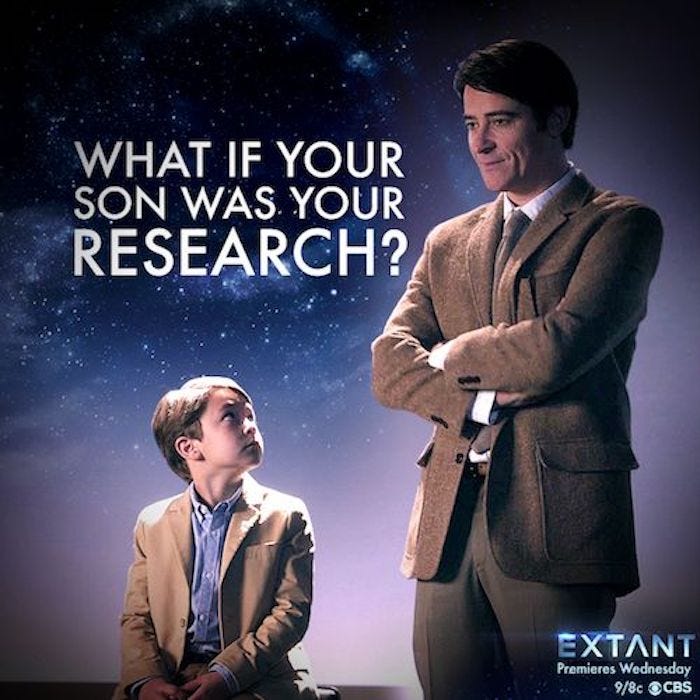
Fisher wrote “Extant” as a TV pilot. It’s a one-hour sci-fi drama about John and Molly Watts and their son, a human-like robot named Ethan. Molly, the space-traveling wife, is also pregnant with a baby that is part human and part alien. The family intrigue deepens in subsequent episodes.
Multiple agencies sought to sign the writer after reading the script, and WME won out. WME and manager Brooklyn Weaver, who discovered Fisher, sent the script around to the studios who are hot to trot for a high-concept script mixing sci-fi and familial drama.
“Everyone is freaking out about it,” an agent at a rival firm said. “It’s ‘A.I.’ as a TV series.”
— —
Warner Bros. still made an offer to acquire the project and turn it into a movie, according to multiple individuals inside and outside the studio, but now the studio is talking with Fisher about acquiring a different pitch. The studio declined to comment.
WME and Weaver always harbored dreams of turning “Extant” into a TV series with Steven Spielberg producing. They are halfway there: Amblin TV, which produced “ER” and “The Americans,” is developing and packaging it. It remains unclear if Spielberg will take a credit, though his involvement would make it even more attractive to networks.
Here is Mickey Fisher. Apparently he is a Hollywood outsider. He writes a spec TV pilot script. It turns the town on its head. Now he has interest from movie studios. TV networks. Perhaps “acquiring a different pitch.” Steven Freaking Spielberg.
That script turned into a CBS series which ran for two seasons.
In 2016, Mickey Fisher — a long-time fan of the blog — posted this:
It’s a tremendous read with lots of information and insights into the craft, so I reached out to Mickey and he agreed to let me serialize his entire missive. It’s a great story and I’ll use the opportunity to spotlight the many takeaways Mickey touches on in his observations.
Today in Part 4, Mickey shares what it took to prepare to take “Extant” to market and pitch it as a TV series:
WINDING UP FOR THE PITCH
For two months Greg and I kicked the overview document back and forth — I’d do a rewrite and he’d sit with me and give me notes as we brainstormed. A lot of the notes were about honing in on the central emotional story of the main characters and the family as a unit. We separated out the mythology from the family so it would be easy to track both things and came up with a few specific beats and scenes to dramatize, things we could dig into in the pitch.
This part of the process was a HUGE lesson for me. Before this, all of my concept and pitch documents were very dry. They were essentially a “this happens, then this happens, then this happens,” kind of delivery. Greg’s direction was really about getting into HOW these characters feel about these events and how those emotions drive the story in new directions. I realized this had been a huge problem of mine.
Shortly before I started working with Greg, because of interest in the pilot script, I had an opportunity to pitch an original sci-fi thriller to Warner Brothers and also pitch an angle on a writing assignment for a movie star’s prod co. Looking back, I realize that I FAILED miserably in those pitches because I neglected to dig into the emotional state of the characters. I was too preoccupied with concepts, too pleased with myself for clever details and plot twists. I’d neglected the most important part of all: who are these people really and what is their simple emotional journey? Not because I didn’t care about that stuff. I just assumed everyone would know that would be in the script! This is one of the most important things I learned from Greg and it affected everything I write these days, even in script. I’m always writing from a character POV — what they see, how they feel, what they’re thinking — except for the rare times I need to jump out and let the reader learn something the character can’t yet.
Greg and I sent an updated version to Amblin and Steven and they gave us some really important direction as well. They pushed us even more to find the balance between the family story and the science-fiction, between character and genre. They were all hands on in the best way, helping guide us toward a document that would serve as the foundation for our pitch.
Takeaways:
- For two months Greg and I kicked the overview document back and forth — I’d do a rewrite and he’d sit with me and give me notes as we brainstormed: Two months. On a pitch document. That speaks to the importance of breaking a story in prep and this is especially true when developing a TV series.
- This part of the process was a HUGE lesson for me… Greg’s direction was really about getting into HOW these characters feel about these events and how those emotions drive the story in new directions: There are many important elements of a story to handle when pitching it, but if you forget the emotional dimension, you assure yourself of almost certainly getting a pass. The buyers need to feel it. How do they feel it? Through the characters you describe and your own passion for the project.
- I’d neglected the most important part of all: who are these people really and what is their simple emotional journey… This is one of the most important things I learned… I’m always writing from a character POV — what they see, how they feel, what they’re thinking — except for the rare times I need to jump out and let the reader learn something the character can’t yet: Of course you know I’m going to hammer this point because I preach Character Based Screenwriting. Start with character. End with character. Find the story in between. This may be even more important with TV because it’s the characters who become part of a viewer’s ‘family’. You want to do everything you can to craft compelling characters an audience will want to spend time with week after week.
- They were all hands on in the best way, helping guide us toward a document that would serve as the foundation for our pitch: When you work up a pitch, whether you come up with a beat sheet, outline, or treatment, create a document which tells the story. Memorize it, then rehearse it enough times so you know it cold and it sounds like you’re just having a conversation.
- Greg and I sent an updated version to Amblin and Steven: If you ever get the chance to meet Mr. Spielberg, refer to him as “Steven”. Not Steve. Steven.
Tomorrow in Part 5, Mickey describes the pitching process.
For Part 1 of this series, go here.
Part 2, here.
Part 3, here.
Mickey is repped by WME and Energy Entertainment.
Twitter: @MickeyFisher73.