Mickey Fisher on Writing, Selling, and Producing a TV Pilot Spec Script — Part 2
7-part series on going from original TV pilot script to network series.
7-part series on going from original TV pilot script to network series.
On May 24, 2013, I posted about a TV pilot spec script which had Hollywood all abuzz:
Amidst the hustle and bustle of the Hollywood development world — movies and TV — nothing shifts the tectonic plates of The Biz more than a spec script that gets people salivating over it. It’s also a time when writers can learn an awful lot about the buying pulse of Hollywood.
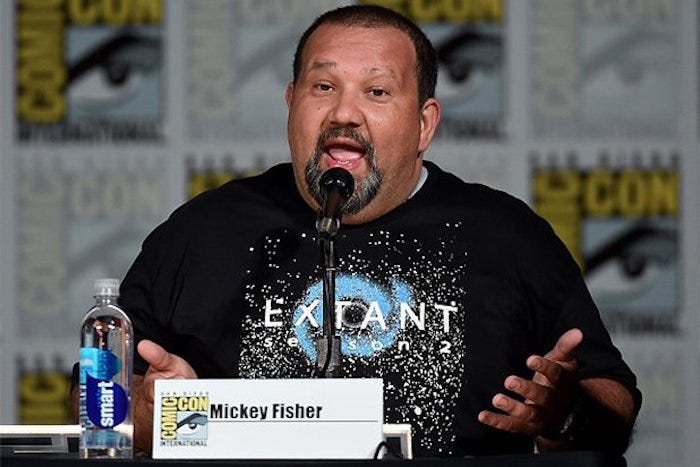
Such is the case right now as Hollywood froths over a 56-page spec TV pilot “Extant” written by newcomer Mickey Fisher. Background from TheWrap [emphasis added]:
Mickey Fisher, an unknown and unsigned writer until recently, has film studios drooling over his script “Extant” for weeks. There’s just one twist: it’s not a film script.
Fisher wrote “Extant” as a TV pilot. It’s a one-hour sci-fi drama about John and Molly Watts and their son, a human-like robot named Ethan. Molly, the space-traveling wife, is also pregnant with a baby that is part human and part alien. The family intrigue deepens in subsequent episodes.
Multiple agencies sought to sign the writer after reading the script, and WME won out. WME and manager Brooklyn Weaver, who discovered Fisher, sent the script around to the studios who are hot to trot for a high-concept script mixing sci-fi and familial drama.
“Everyone is freaking out about it,” an agent at a rival firm said. “It’s ‘A.I.’ as a TV series.”
— —
Warner Bros. still made an offer to acquire the project and turn it into a movie, according to multiple individuals inside and outside the studio, but now the studio is talking with Fisher about acquiring a different pitch. The studio declined to comment.
WME and Weaver always harbored dreams of turning “Extant” into a TV series with Steven Spielberg producing. They are halfway there: Amblin TV, which produced “ER” and “The Americans,” is developing and packaging it. It remains unclear if Spielberg will take a credit, though his involvement would make it even more attractive to networks.
Here is Mickey Fisher. Apparently he is a Hollywood outsider. He writes a spec TV pilot script. It turns the town on its head. Now he has interest from movie studios. TV networks. Perhaps “acquiring a different pitch.” Steven Freaking Spielberg.
That script turned into a CBS series which ran for two seasons.
In 2016, Mickey Fisher — a long-time fan of the blog — posted this:
It’s a tremendous read with lots of information and insights into the craft, so I reached out to Mickey and he agreed to let me serialize his entire missive. It’s a great story and I’ll use the opportunity to spotlight the many takeaways Mickey touches on in his observations.
Today in Part 2, Mickey reveals what happened after he wrote the script and how that jump-started a process which eventually led to “Extant” becoming a prime-time major broadcast network TV series.
AFTER THE SCRIPT WAS FINISHED
I finished the script in late spring of 2012. I believed it was the best thing I’d ever written, and when I read the pilots that were being sold around that time, I thought it could go toe to toe with most of them. My ability was finally matching my ambition and I was writing up to an industry standard. Then PROMETHEUS came out and it featured an immaculate conception with an astronaut in space and I thought, “That’s it, any chance of selling this is dead. At least it will be a good sample and maybe help me get a job on staff somewhere.” But I didn’t know anyone who could really help make that happen so it went on a shelf.
Late fall 2012 I entered a feature contest sponsored by The Writer’s Store in Burbank, called The Industry Insider Contest. Long story short, I was a finalist and spent a few months working with one of their mentors to write a feature comedy spec called THE MARGINAL WAY, based on a logline suggested by the awesome Susannah Grant. I treated the contest like it was a studio job, taking notes from my mentor Kay Tuxford and working like crazy to make it as good as it could be. This was around the time I started writing seven days a week. I worked on Christmas and New Year’s Day, and a few months later it all paid off.
A few days before Christmas I lost a job that was half of my income. I knew I’d have to get another job after New Year’s but I had another option: sell my Can-Am Spyder, which I’d won in another contest. It would be enough to fund a few months of being a full-time writer. So I did it and decided to invest some of the money to get my work out there.
I was living in Orange County at the time and knew less than a handful of people in Hollywood, so I looked for ways to get my scripts into the hands of people who could do something with them. I’ve been entering contests for years. I’d been a Project Greenlight 2 Semi-Finalist and a Nicholl Fellowship semi-finalist, so I was getting signs and signals here and there that I was at least in the game. One of the contests I’d been reading about on websites like Done Deal was The Tracking B Contest and they had a reputation for helping writers find representation. Their TV Pilot Contest deadline was just coming so I decided to take EXTANT off the shelf and give it a shot.
Spring of 2013, The Blacklist website was picking up steam and starting to open doors for writers from anywhere. This is when they were still only doing features. I paid to upload a few scripts and get reads, hoping to be included in their weekly email blast to agents, managers and producers. The three scripts were wildly different: one was a crime fiction drama, another was an epic animated Christmas adventure and eventually I also uploaded the comedy I wrote for the Industry Insider Contest. A few weeks later, I scored my first ever meeting with a manager who responded to the crime fiction story.
At that meeting, we talked about the script he liked, then he asked me what everyone else asked me. It’s the question you will undoubtedly get as well. “What else do you have?” My answer was: “I’ve got this animated thing, a backstage comedy, a sci-fi spec pilot…” I could see the change in his face and knew the meeting had taken a turn. He said, “It sounds like you don’t know who you are, yet.” He offered to read the other material and see where he thought I might fit but after I sent those scripts to him I never heard back. I knew I’d made a crucial mistake. It looked like I was trying to be all things because in fact, I WAS trying to be all things. I was trying any and every avenue I could to break in. But once that meeting went downhill I decided to answer that question a different way. From then on, when someone asked “What else do you have,” I answered with “A lot more of that thing you liked.”
A few weeks later, everything started to break open. On a Friday afternoon I got the call that I WON the Industry Insider Feature Contest. The prize was lunch with the awesome Susannah Grant and a meeting with a manager at a well known company. I was thrilled. Relentless dedication and my investment in myself was paying off. On the next Wednesday I got a call from The Tracking B TV Pilot Contest: I was one of their finalists and I should expect to start getting emails and calls from managers over the next few days. And I did.
The next day, Thursday, my girlfriend Julie and I spent the day at Universal Studios. In between rides I was getting emails and voice messages from managers looking to set up meetings for the following week. Later that afternoon, we took the tram tour and while it was rolling around the backlot I spotted the sign for Amblin Drive. I pointed it out to Julie, yelling “THAT’S WHERE STEVEN SPIELBERG IS!” I had no idea that just a few short weeks later I’d be headed to a meeting there.
Throughout this time, the Tracking B contest organizer was guiding me and helping me strategize, walking me through the surreal process. They couldn’t have been more helpful, generous and encouraging. On Saturday, I got a call from a manager named Brooklyn Weaver, from Energy Entertainment. I recognized his name right away. Back on the Project Greenlight message boards writers brought his name up as he was someone you could email a quick logline to and he would give you a prompt “send” or “pass”. Lately, I’d been reading about him in The Scoggins Report, and knew that at that particular time he was selling feature specs left and right. His assistant at the time, David Binns (now VP of Development) had read the script and I spent an hour talking to him while sitting on the roof of my parking garage so I wouldn’t lose a signal. We ended the conversation by agreeing to let him rep me and the script. He suggested a few quick tweaks, mostly to further highlight some important moments. This mostly amounted to bolding and underlining big beats that might easily be missed by assistants and creative execs burning through their tenth script of the day. It’s a lesson I still take to heart before every script goes out. That night, my script began showing up in the inboxes of people who would go on to change my life. From that day on, Brooklyn became a close creative partner. He’s the only manager I’ve worked with but I feel like the best of them are part military strategist, part dramaturge, part hype man, part psychologist. And lots more parts.
Takeaways:
- Then PROMETHEUS came out and it featured an immaculate conception with an astronaut in space and I thought, “That’s it, any chance of selling this is dead”: As I have been saying for 8+ years on this blog, the Hollywood development systems operates on the principle of ‘similar but different’, and you’d be surprised at how often parallel projects are more similar than different. It’s how studios play it safe, minimize risk, and make their marketing efforts easier by drafting on preexisting movies and TV series.
- …so it went on a shelf: This is one of the values of a spec script: Even if it doesn’t sell, it is an asset, a tangible product which may at some point in time slot into an emerging market need.
- Late fall 2012 I entered a feature contest: I’m not a fan of the whole screenwriting contest industry. If you choose to go down this path, do your research and pick ones which have a proven track record as well as access to significant managers, agents, and producers.
- This was around the time I started writing seven days a week. I worked on Christmas and New Year’s Day: Think about this: When you’re not writing, somebody else is. Like it or not, breaking in as a screenwriter or TV writer is a competition. And once you do get your start, it continues to be competitive. If you want to succeed in this business, ‘work’ cannot be a four-letter word to you.
- I knew I’d have to get another job after New Year’s but I had another option: sell my Can-Am Spyder: Along with embracing the concept of ‘work’, here’s another thing you need to make friends with: Sacrifice.
- Their TV Pilot Contest deadline was just coming so I decided to take EXTANT off the shelf and give it a shot: In the spirit of the spec, the last step is often the most challenging: Put it out there. That takes courage. However as in baseball, you cannot have an opportunity to get a hit unless you step into the batter’s box.
- Spring of 2013, The Black List website was picking up steam and starting to open doors for writers from anywhere: Keep track of new and emerging avenues into Hollywood, and this means keeping track of what’s going on in the screenwriting universe. If only there were a blog which would cover that on a daily basis…
- A few weeks later, I scored my first ever meeting with a manager… we talked about the script he liked, then he asked me what everyone else asked me. It’s the question you will undoubtedly get as well. “What else do you have”: Yes, indeed, you will be asked that question which is why you must be ready to answer it.
- My answer was: “I’ve got this animated thing, a backstage comedy, a sci-fi spec pilot…” I could see the change in his face and knew the meeting had taken a turn: The path of least resistance to getting representation — as I have blogged about before — is three finished scripts and multiple treatments, all in the same genre. If you’re all over the place, they don’t know how to sell you.
- He said, “It sounds like you don’t know who you are, yet”: One of the most important things a manager or agent is looking for in a prospective writer client is a unique voice. To develop one, you need to live life, feed your creative soul through books, art, music, and over time discover who you are.
- This mostly amounted to bolding and underlining big beats that might easily be missed by assistants and creative execs burning through their tenth script of the day: Make your script a ‘good read’, easy on the eyes of a script reader, lots of white space with action clearly articulated on the page.
- I feel like the best of them [managers] are part military strategist, part dramaturge, part hype man, part psychologist: It varies from manager to manager and can evolve as your career does, but be prepared for your reps to become a significant part of your writing life.
And there’s this:
The next day, Thursday, my girlfriend Julie and I spent the day at Universal Studios. In between rides I was getting emails and voice messages from managers looking to set up meetings for the following week. Later that afternoon, we took the tram tour and while it was rolling around the backlot I spotted the sign for Amblin Drive. I pointed it out to Julie, yelling “THAT’S WHERE STEVEN SPIELBERG IS!” I had no idea that just a few short weeks later I’d be headed to a meeting there.
The odds are long… very long… against this type of thing happening. However the simple fact is — as Mickey’s experience demonstrates — it can happen. You have to have talent, persistence, passion, and a drive like Mickey has to push yourself to be the best writer you can be.
Tomorrow in Part 3, Mickey reveals how the “Extant” team came together.
For Part 1 of this series, go here.
Mickey is repped by WME and Energy Entertainment.
Twitter: @MickeyFisher73.