Memorable Monologues in 2023 Movies
This L.A. Times article features some “meaty speeches” from some of last year’s most notable movies.

This L.A. Times article features some “meaty speeches” from some of last year’s most notable movies.
This week, journalist Hugh Hart (@hughhart) wrote an excellent piece in the L.A. Times: How these meaty speeches drive home the point in this season’s awards films. Some excerpts:
“Show, don’t tell” dictum aside, there’s nothing like a meaty speech to push a movie into overdrive. Last summer, Oscar nominee America Ferrera’s “Barbie” performance elicited whoops and hollers from moviegoers when her character, Gloria, railed at length against the impossible expectations faced by contemporary women. Arguably 2023’s most celebrated example of unapologetic speechifying, Gloria and her rant join the ranks of great movie talkers who’ve wowed crowds since the dawn of talkies.
Consider Jimmy Stewart’s “Mr. Smith Goes to Washington” impassioned plea to Congress, Bette Davis’ aging actress monologue in “All About Eve,” Peter Finch’s “mad as hell” tirade in “Network,” Sally Field’s fierce defiance as union organizer “Norma Rae,” Al Pacino’s “Any Given Sunday” pep talk-to-end-all-pep talks, Samuel L. Jackson’s pre-execution Bible-quotes in “Pulp Fiction” and Meryl Streep’s withering “cerulean blue” origins story from “The Devil Wears Prada.”
Extending that grand oratorical tradition, actors in current Oscar-season movies enjoyed ample opportunity to wax eloquent via riled-up characters who simply cannot contain themselves any longer. Here’s a look at some of this season’s great moments in speechifying.
Hart’s article features several examples from movies including Maestro, The Color Purple, Killers of the Flower Moon, Anatomy of a Fall, Rustin, The Holdovers, and — of course — Barbie.
Written by: Greta Gerwig and Noah Baumbach
Who’s talking: America Ferrera as Mattel employee Gloria
Who’s listening: Stereotypical Barbie (Margot Robbie) and her fellow Barbies
Subtext: Gloria stifled her dreams to accommodate the men she works for until she bonds with Barbie and unloads on the facts of misogynistic life.
Text: “You’re supposed to be thin but not too thin, and you can never say you want to be thin, you have to say you want to be healthy, but you also have to be thin. You have to have money, but you can’t ask for money, because that’s crass. You have to be a boss, but you can’t be mean. You’re supposed to lead, but you can’t squash other people’s ideas. You’re supposed to love being a mother but don’t talk about your kids all the damn time. You’re supposed to be a career woman but always be looking out for other people. You have to answer for men’s bad behavior, which is insane, but if you point that out, you’re accused of complaining. You’re supposed to stay pretty for men but not so pretty that you tempt them too much or that you threaten other women, because you’re supposed to be a part of the sisterhood. … You have to never get old, never be rude, never show off, never be selfish, never fall down, never fail, never show fear, never get out of line.”
Here is that speech from the movie:
There’s a subset of these type of character monologues which I wrote about in this blog article: Confession as Narrative Device.
In writing my book ‘The Protagonist’s Journey: Character Driven Screenwriting and Storytelling,’ I have had an interesting experience making connections between disparate cinematic stories. Sometimes movies from considerably different genres share the same narrative device with a similar story function.
For example, it occurred to me that the drama The King’s Speech and the thriller The Silence of the Lambs both feature a Protagonist character making a ‘confession’ to a Mentor figure: Bertie to Lionel / Clarice to Lecter.
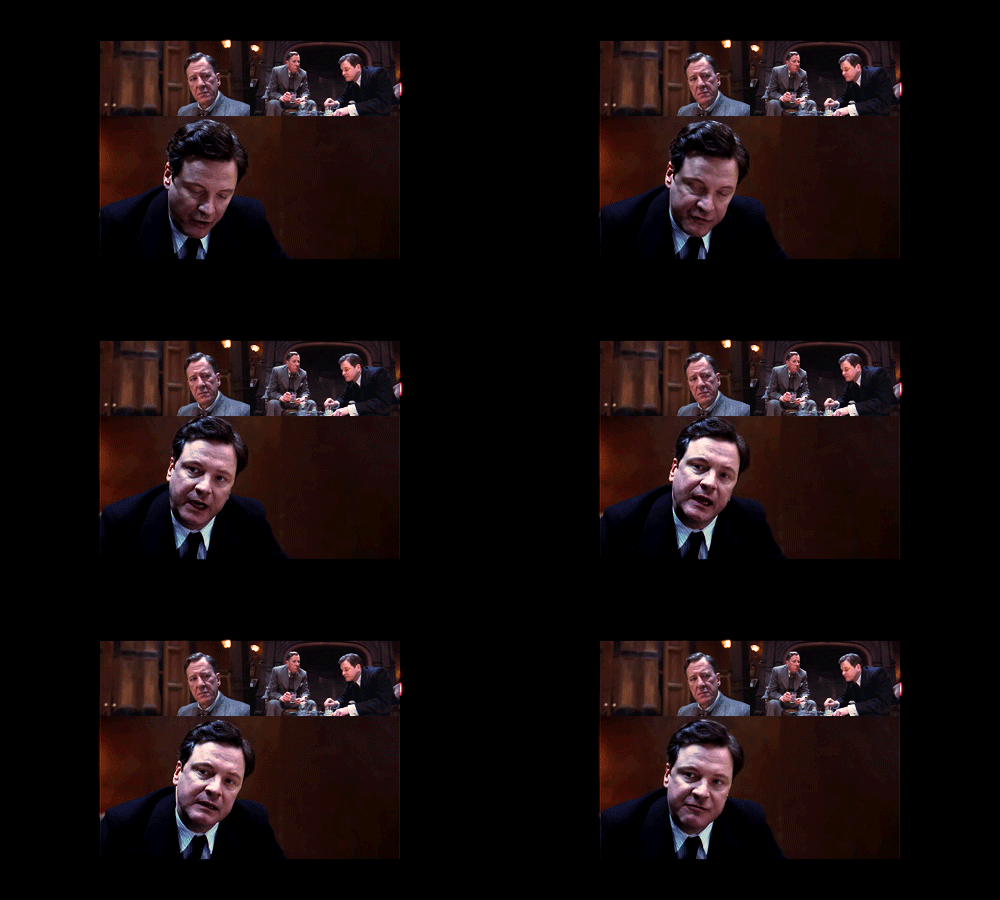

By confession, I mean a scene in which one character reveals a deep inner truth which has up to that point in the story been hidden, shrouded in the recesses of the character’s psyche. Sometimes that shrouded state is a conscious act of the character’s will. Sometimes it is an unconscious instinct to protect one’s self from judgment. But in all cases, when a character confesses this inner truth, bringing it forth into the light of consciousness, the moment represents a significant turning point in the character’s psychological metamorphosis.
Consider this scene in The King’s Speech.
By this point in the story, Lionel has gained Bertie’s trust. The scene is framed around a B.O.B. (Bit Of Business) — Bertie finds himself distracted by Lionel’s son’s model airplanes. In this moment, Bertie confesses two dark secrets from his past:
- How his first nanny in effect abused him as a toddler… pinching him to make him cry… withholding food from him as punishment. As a result, Bertie developed some stomach issues, a physical manifestation of the psychological trauma created within his psyche by the tyrannical influence of his nanny.
- How his brother Johnny, hidden from view to the public due to his epilepsy, died at the age of thirteen. In revealing this backstory, we can see in Bertie’s face both a sad tenderness in remembering his brother… and a fear that Johnny’s medical condition looms as a threat to Bertie (“I’m told it’s not catching”.) He also identifies with Johnny (“And he’s… different”) as Bertie — due to his stuttering — is ‘different.’
This confession fits the overall tone of the story: A drama featuring two principal characters and the evolving bond they develop. Subdued. Reflective. Leading to this exchange:
Lionel: What are friends for?
Bertie: I wouldn’t know.
Perhaps the single most profound moment in Bertie’s confession. For my sense is what Lionel takes away from this confession scene is two things:
- Bertie has survived psychologically in large part due to courage he doesn’t even know he has.
- Bertie’s trust in Lionel affords him the opportunity to challenge Bertie in ways the future King has never had to face.
It all leads to this pivotal scene:
Lionel as Mentor could never have probed, prodded, and provoked Bertie to proclaim, “I have a voice” had Bertie not confessed some hidden inner truths in that previous scene.
You can read the rest of the article to see my analysis of The Silence of the Lambs. I appreciate Hart’s L.A. Times article. It not only highlights the work of screenwriters who penned those “meaty speeches,” it also points to the multiple ways we can say it and not show it … to great dramatic effect.
For the rest of the L.A. Times article, go here.