L.A. Times: Media and Entertainment Company Executive Compensation
“Of the top 30 highest-paid CEOs in America, 27% come from the media and entertainment space, even though the entertainment and media…
“Of the top 30 highest-paid CEOs in America, 27% come from the media and entertainment space, even though the entertainment and media sector accounts for only about 7% of the GDP.”
Some issues the Writers Guild is striking about may be a bit too complex for the typical movie and television audience to grasp. But this point isn’t: Why are CEOs of entertainment and media companies receiving so much compensation with increasing pay over the last several years while claiming their companies cannot afford to pay writers?
The Los Angeles Times featured an article yesterday: Hollywood writers say the bosses make too much. This is what our analysis found. Some excerpts:
Many of the concerns motivating the current Writers Guild of America’s strike — from streaming residuals to the looming threat of AI displacement — are distinctly 2023 problems.
But, speaking from a picket line outside Fox Studios in Century City, Mike Royce framed the WGA’s campaign in terms of a more timeless struggle: Workers make too little, and bosses too much.
“If they don’t have any money to give us raises, then how did they — the executives in the C-suite — amass such record salaries?” asked Royce, co-creator of TNT’s “Men of a Certain Age” and the co-showrunner behind Netflix’s “One Day at a Time” reboot. “The difference between CEO pay and worker pay has never been greater in most industries, but in this industry it’s even worse.”
It’s a recurring theme on picket lines across Los Angeles and New York: writers say they’ve been shortchanged by the streaming revolution even as their employers were richly rewarded. “We Just Want 2% From the 1%,” read one recent picket sign that reflected the Occupy Wall Street-esque rhetoric used by the WGA.
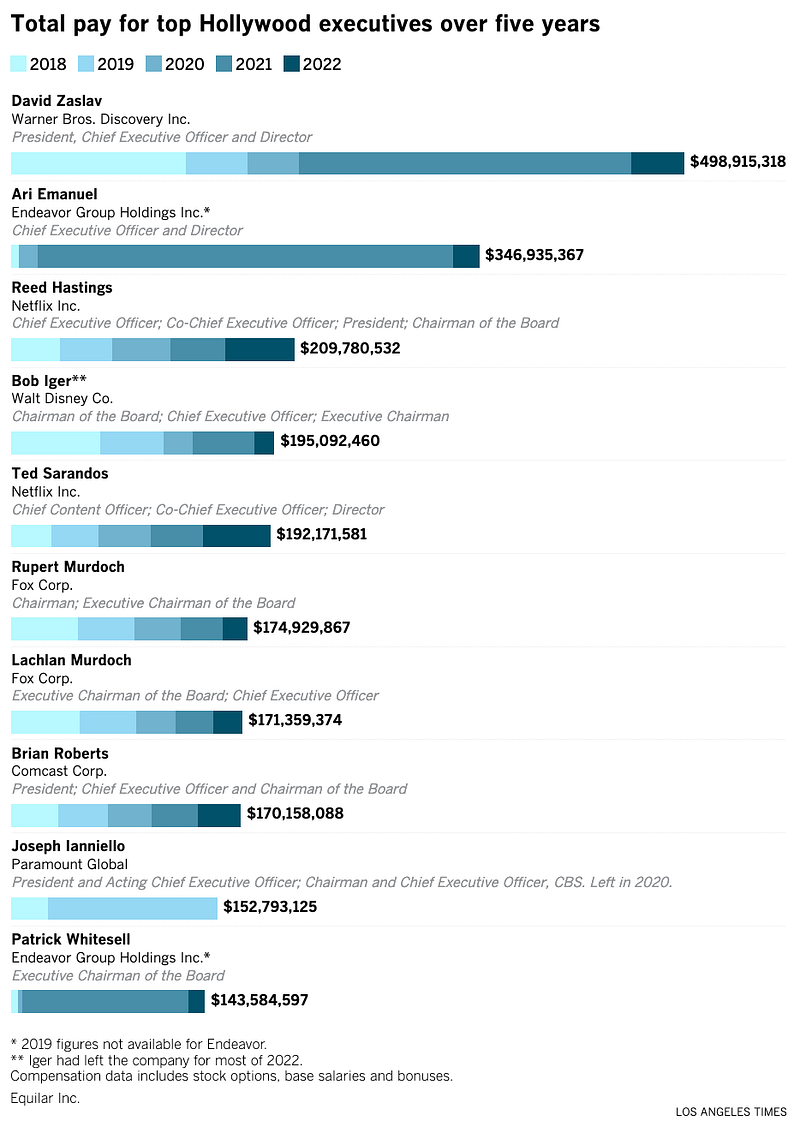
A Times review of executive compensation at 10 publicly held media and entertainment companies supports that narrative.
Pay for Hollywood’s top executives soared during the height of the pandemic, climbing to $1.43 billion in 2021, up 50% from total pay in 2018, according to a Times analysis of data compiled by the research firm Equilar Inc. [emphasis added]
— —
“They don’t call it Tinseltown for nothing — but the tinsel in this case is platinum,” said Lloyd Greif, chief executive of Los Angeles-based investment bank Greif & Co. “They’re well-heeled. The writers are right to be turning the Hollywood spotlight onto the compensation of the people at the top of the ladder, because certainly the folks farther down aren’t sharing in the spoils.”
— —
“Do we think Ted Sarandos would be making that much money without the hard work of all the writers that are working on the shows that go on Netflix? Absolutely not,” said Evan Shapiro, a former NBCUniversal executive who now runs his own company.
— —
Even in a country racked by economic inequality, Hollywood’s pay scales are unique. Of the top 30 highest-paid CEOs in America, 27% come from the media and entertainment space, even though the entertainment and media sector accounts for only about 7% of the GDP, Greif said.
“There’s no rhyme or reason to it, other than I think being tone-deaf in the boardrooms and the executive suites of Hollywood,” he added. “If nothing else comes out of the writers’ strike, having this focus on that gross disparity in pay, I think, is going to be productive.”
A related Hollywood Reporter article — Writers Guild Targets Executive Pay in Letters to Netflix, Comcast Shareholders — cites the WGA letters.
As you prepare for Netflix’s annual shareholders meeting on June 1st, on behalf of writers represented by the Writers Guild of America, West (WGAW), I urge you to vote against Proposal 3, the company’s proposal for advisory approval of Named Executive Officer compensation. Approval of this compensation package is inappropriate in light of the ongoing WGA writers’ strike and the associated risks that Netflix executives are creating for investors. Shareholders should send a message to Netflix that if the company could afford to spend $166 million on executive compensation last year, it can afford to pay the estimated $68 million per year that writers are asking for in contract improvements and put an end to the disruptive strike.
— —
As you prepare for Comcast’s annual shareholders meeting on June 7th, on behalf of writers represented by the Writers Guild of America, West (WGAW), I urge you to vote against Proposal 5, the company’s proposal for advisory approval of executive compensation. Approval of this compensation package is inappropriate in light of the ongoing WGA writers’ strike and the associated risks that Comcast executives are creating for investors. Shareholders should send a message to Comcast that if the company could afford to spend $130 million on executive compensation last year, it can afford to pay the estimated $34 million per year that writers are asking for in contract improvements and put an end to this disruptive strike.
Both letters are signed by Meredith Stiehm, WGA West President.
The WGA strike is a push-back against a decades-long pattern of wealth inequity in the U.S. between the 1% and the rest of us. For example:
- The wealth of the top 1% increased by $6.5 trillion last year, mainly driven by soaring stock prices and financial markets, according to the Federal Reserve.
- The stock portfolios of the top 1% are now worth $23 trillion, and they own a record 53.9% of individually held shares, according to the central bank.
- “Rising wealth inequality drives the stock market, which then drives more wealth inequality,” said Edward Wolff, professor of economics at New York University.
The compensation of entertainment and media CEOs is not just about greed gone wild. The unwillingness of the AMPTP members to accept the fair and reasonable wage propositions by the Guild demonstrates their lack of appreciation and understanding of the value writers bring with their creativity and hard work.
For the rest of the L.A. Times article, go here.
For The Hollywood Reporter, go here.
For the latest updates on the strike and news resources, go here.