Keith Richards and the Importance of Rhythm in Storytelling
The ageless lead guitarist for The Rolling Stones has some emphatic thoughts about the importance of rhythm … and not just about music.
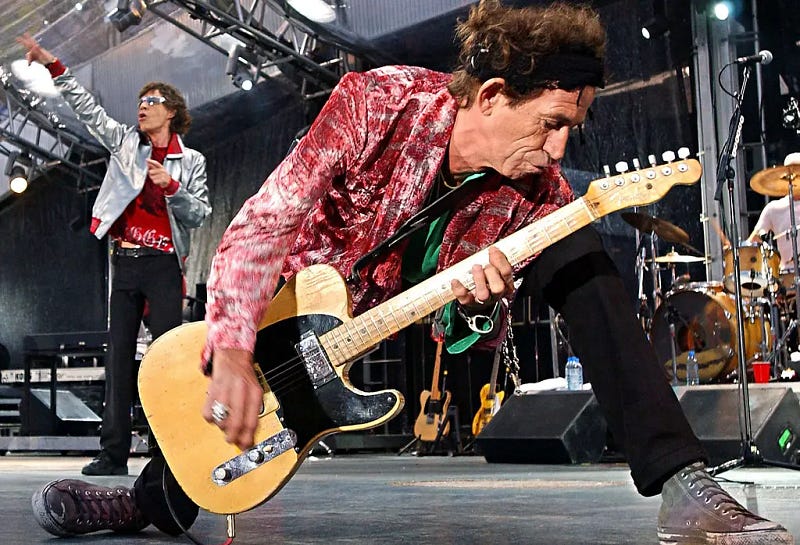
The ageless lead guitarist for The Rolling Stones has some emphatic thoughts about the importance of rhythm … and not just about music.
There’s an article in today’s New York Times: The Rolling Stones on Starting Up Again. In it, the band’s lead guitarist and co-writer of most of their songs is quoted as saying this:
“Rhythm is the most important thing in your goddamn life,” Richards said. “A lot of what you hear ain’t what you hear — it’s what you feel. And that’s a matter of rhythm.”
Richards is a master at creating what musicians call “guitar riff.” Generally, it’s a motif which is repeated over and over, and defines the song’s hook. Here is a classic example of a guitar riff created by Richards in the Stones’ song Jumpin’ Jack Flash.
That “dum-dum, da-da-dum, da-da-dum, da-da-da-dum-dum” motif via Richards’ guitar is one of my favorite rock riffs. And that’s because in large part, it speaks to Richards’ comments about rhythm. As soon as you hear it, you start moving in rhythm with it. Witness the audience reaction in the video above as soon as they hear that guitar riff.
What if we were to apply Richards’ observations about rhythm to storytelling, specifically screenwriting?
We may first think about the script’s pace. Action scenes may move fast. Interaction scenes my slow down. Revelation scenes … Exposition scenes … Establishing scenes … and all the rest … when we string them together, one after the other, we create a rhythm reflected in the pace of the narrative.
There’s also rhythm when it comes to dialogue. I wrote an article on this last year: How Aaron Sorkin Creates Musical Dialogue. In it, I quoted Sorkin in an interview:
“It’s not just that dialogue sounds like music. To me, it actually is music. Any time that you’re speaking out loud for the sake of performance, those words what you’re saying have all of the properties of music. Dialogue has rhythm, pitch, tone, volume, and meter, and it absolutely has all the properties of music.”
“Dialogue has rhythm.” The article goes into depth analyzing key scenes from The Social Network how Sorkin varies the “pitch, tone, volume, and meter” to create a sense of rhythm.
Rhythm as applied to pace and dialogue makes sense. But it’s this point Richard makes that struck me the most: “A lot of what you hear ain’t what you hear — it’s what you feel. And that’s a matter of rhythm.”
It’s what you feel.
When a song starts on the radio, your smart phone, your computer, wherever, and you hear a guitar riff … or a motif on a keyboard … or a recurring drum pattern …
And your body responds.
Toes tapping. Hips swiveling. Fingers snapping. Arms swaying.
You’re hearing it, yes, but at a deeper, primal level, you’re feeling it.
And THAT’S the reaction we want a reader to feel when they read our script. We want them to feel something. We want them to sync up with the propulsive drive of narrative and “dance” along with it. Fast. Slow. Loud. Quiet. Whatever the genre, whatever the character dynamics … we want to create a sense of rhythm which gets the reader moving with the story.
How best to do this?
Like this will come as a surprise to Go Into The Story and readers of my book The Protagonist’s Journey: An Introduction to Character-Driven Screenwriting and Storytelling.
We find the rhythm of a story through our CHARACTERS! Most importantly, our Protagonist and their beating heart.
- The Protagonist’s Conscious Goal: What is the specific nature of their Want by the end of Act One? That provides the end point of their journey.
- The Protagonist’s Unconscious Goal: What is the specific nature of their deepest Need within their inner self? This is the reason why they enter into the journey they take: They need to become aware of, confront, and integrate that need. This psychological process as it plays out through the unfolding narrative provides the fuel for the character’s journey.
- The Protagonist’s Metamorphosis: Between their Conscious Goal (Want) and Unconscious Goal (Need), over the course of the story, the Protagonist goes through a psychological transformation. In the most common narrative archetype, the Unity Arc, they begin in a state of Disunity, go through a process of Deconstruction, then Reconstruction, and eventually move toward a state of Unity.
If written well, the reader will get swept up in that emotional journey and feel the rhythm of that unfolding psychological process.
Just like another great Keith Richards guitar riff:
The Stones have a new album out called Hackney Diamonds. Here’s a video for their song Angry.
And there’s that rhythm again!
To read the rest of the New York Times article, go here.