Is My Screenplay Big Enough to Be a Movie, Part 5: Stakes
This is a fundamental question screenwriters must ask themselves at all stages of a screenplay’s development and writing. Why? Because…
This is a fundamental question screenwriters must ask themselves at all stages of a screenplay’s development and writing. Why? Because it’s a question movie studio execs will ask as one of the key determining factors whether to say ‘yes’ or ‘no’ to buy your script.
“Is my screenplay big enough to be a movie?”
This is a fundamental question screenwriters must ask themselves at all stages of a screenplay’s development and writing. Why? Because it’s a question movie studio execs will ask as one of the key determining factors whether to say ‘yes’ or ‘no’ to buy your script.
For years, movies have been known as playing on “The Big Screen,” as opposed to TV (the “small” screen). Typically movies have big budgets, big marketing campaigns, and big stars. Their running times, clocking in at an average of two hours, are big. The film industry is our nation’s second biggest export business (behind airplane manufacturing). So much about movies is about being big.
Being ‘big enough’ pertains not only to huge blockbuster action-thrillers, but also to small character-driven scripts. While the plot may be ‘small’ in scope, what happens and what those events mean to the story’s characters must have a ‘big’ enough meaning and emotional resonance with a big enough potential audience to warrant a studio’s green light.
The central question here — Is my script big enough to be a movie — is a… well… big topic. What I’ve done is put together 10 questions you can ask in relation to any of your writing projects, current and future, to test if it’s big enough to be a movie. I’ll be posting these questions over the next few weeks.
PART 5: DOES MY SCREENPLAY HAVE BIG ENOUGH STAKES?
This is a way of summing up the previous four questions — because story concept, characters, set pieces and conflict combine to create a sense of what stakes are involved. But it’s such a fundamental issue, that I think many writers may overlook it, so it’s worth parsing out on its own.
Ask this question: What can be ‘won’ in my script? How significant is a ‘victory’ going to mean for the Protagonist? How big will that be in transforming their lives? If you have a hard time going there, try imagining what the Denouement is because that should be the physicalization of what the Protagonist’s ‘victory’ means.
Conversely, what can be ‘lost’ in your script? If the Protagonist were to fail in their struggle, what would that mean? Consider the life of your P after FADE OUT: If they ‘lost’, how might you envision that existence?
Note how in answering this question, I went to the Internal World of the script, the emotional life of the story. In Adaptation, there’s this whole slew of plot ‘stuff’ that goes on throughout Act II and especially Act III, and yet in a way, all that services the tiny little subplot between Charlie and the woman he loves and wants to love: By the Denouement, he’s vanquished some of his demons and gathered enough wisdom and strength of character from his now dead brother that he’s able to screw up the courage to express his feelings for his Attractor character (Amelia).
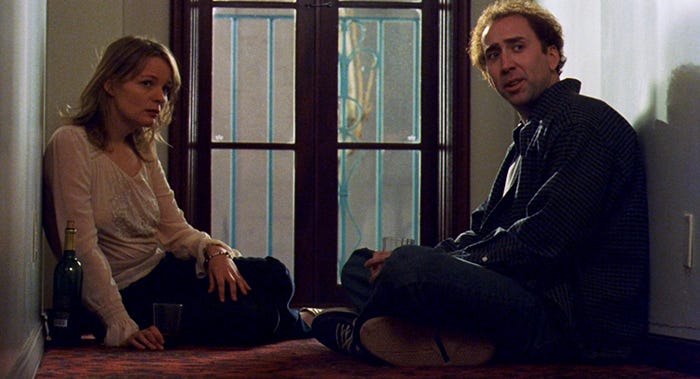
Obviously, in a movie like Armageddon, the stakes aren’t so much about guy gets girl as guy gets asteroid. If you’re writing that type of movie, you’d think you can answer this question in seconds and move on.

But for ‘smaller’ character-driven movies and yes, even big blow-up blockbuster type flicks, stakes like everything else in a screenplay work on two levels: The External World of the Plotline and the Internal World of the Themeline. So when you consider stakes, figure out what they are for both and ask yourself if they’re big enough on both fronts.
Next Monday: Does my script have a big enough visual style?
Part 1: Does my screenplay have a big enough story concept?
Part 2: Does my screenplay have big enough characters?
Part 3: Does my screenplay have big enough set pieces?
Part 4: Does my screenplay have big enough conflict?