Is My Screenplay Big Enough to Be a Movie, Part 2: Characters
This is a fundamental question screenwriters must ask themselves at all stages of a screenplay’s development and writing. Why? Because it’s…
This is a fundamental question screenwriters must ask themselves at all stages of a screenplay’s development and writing. Why? Because it’s a question movie studio execs will ask as one of the key determining factors whether to say ‘yes’ or ‘no’ to buy your script.
“Is my screenplay big enough to be a movie?”
This is a fundamental question screenwriters must ask themselves at all stages of a screenplay’s development and writing. Why? Because it’s a question movie studio execs will ask as one of the key determining factors whether to say ‘yes’ or ‘no’ to buy your script.
For years, movies have been known as playing on “The Big Screen,” as opposed to TV (the “small” screen). Typically movies have big budgets, big marketing campaigns, and big stars. Their running times, clocking in at an average of two hours, are big. The film industry is our nation’s second biggest export business (behind airplane manufacturing). So much about movies is about being big.
Being ‘big enough’ pertains not only to huge blockbuster action-thrillers, but also to small character-driven scripts. While the plot may be ‘small’ in scope, what happens and what those events mean to the story’s characters must have a ‘big’ enough meaning and emotional resonance with a big enough potential audience to warrant a studio’s green light.
The central question here — Is my script big enough to be a movie — is a… well… big topic. What I’ve done is put together 10 questions you can ask in relation to any of your writing projects, current and future, to test if it’s big enough to be a movie. I’ll be posting these questions over the next few weeks.
PART 2: DOES MY SCRIPT HAVE BIG ENOUGH CHARACTERS?
It’s easy to look at Indiana Jones, Rambo, and “Dirty” Harry Callahan and figure that they’re ‘big enough’ to deserve film treatment. But what about Red and Andy in The Shawshank Redemption, Malcolm Crowe and Cole Sears in The Sixth Sense, or Crash Davis and Annie Savoy in Bull Durham? Why are they ‘big enough’ characters to work on The Big Screen?
In the case of both Red and Andy, and Malcolm and Cole, it’s the plot, driven by the underlying story concept, which helps to make them big: In the former, a pair of convicts, one of them innocent, who manages to escape; in the latter, Cole sees “dead people”, one of which turns out to be Malcolm. But Crash Davis and Annie Savoy are just two characters in a ‘small’ Rom-Com set in the world of minor league baseball. Not major league baseball, mind you, which might be ‘big’, but minor league.
What did writer-director, Ron Shelton, do to make this pair of characters ‘big enough’? He created what I like to call “atypical typical characters”.The typical part are those aspects of a character with which the reader / audience can identify, the part of who we are represented on the page / the silver screen. The atypical part are those aspects of a character to which the reader / audience might aspire, we wish we were that smart, that talented, that insightful. So even though the character is someone whose typical-ness we can relate to, their atypical-ness transforms them into larger than life.
Consider Annie Savoy. She’s a baseball fan. How many people do we know, including perhaps yourself, who are sports fans? That’s rather typical. She lives in a modest home in a modest city. Again, typical. And yet Annie has a unique world view, a life-philosophy based upon and infused with her passion for baseball. She is, or at least likes to think of herself, as a sage, a wisdom figure of sorts, interpreting reality through baseball tinted glasses. Oh, and there’s the sex thing: Every season, she chooses one new minor league baseball player to partake in her wisdom as well as her body. Decidedly atypical.
A WALL COVERED WITH BASEBALL PICTURES behind a small
table covered with objects and lit candles. A
baseball, an old baseball card, a broken bat, a rosin
bag, a jar of pine tar -- also a peacock feather, a
silk shawl, a picture of Isadora Duncan. Clearly, the
arrangement is -- A SHRINE -- And it glows with the
candles like some religious altar.
We hear a woman's voice in a North Carolina accent.
ANNIE (V.O.)
I believe in the Church of Baseball.
(beat)
I've tried all the major religions
and most of the minor ones -- I've
worshipped Buddha, Allah, Brahma,
Vishnu, Shiva, trees, mushrooms, and
Isadora Duncan...
PAN AWAY FROM THE SHRINE across the room. Late
afternoon light spills into the room, across fine old
furniture, to a small dressing table. A WOMAN applies
make up.
ANNIE SAVOY, mid 30's, touches up her face. Very
pretty, knowing, outwardly confident. Words flow from
her Southern lips with ease, but her view of the
world crosses Southern, National and International
borders. She's cosmic.
ANNIE (V.O.)
I know things. For instance --
(beat)
There are 108 beads in a Catholic
rosary. And --
(beat)
There are 108 stitches in a baseball.
(beat)
When I learned that, I gave Jesus a
chance.
(beat)
But it just didn't work out between
us. The Lord laid too much guilt on
me. I prefer metaphysics to theology.
(beat)
You see, there's no guilt in
baseball... and it's never boring.
ANNIE OPENS A CLOSET DOOR -- Dozens of shoes hang
from the door. She chooses a pair of RED HIGH HEELS,
with thin straps. She sits on a bench and
ANNIE
Which makes it like sex.
(beat)
There's never been a ballplayer slept
with me who didn't have the best
year of his career.
(beat)
Making love is like hitting a baseball --
you just got to relax and concentrate.
ANNIE SLIPS ON THE RED HIGH HEELS -- Smoothing her
hands up her calves as she does.
ANNIE
Besides, I'd never sleep with a player
hitting under .250 unless he had a
lot of R.B.I.'s or was a great glove
man up the middle.
(beat)
A woman's got to have standards.
SHE HOLDS OUR HER LEGS DISPLAYING THE HEELS, side by
side. Like a little girl showing off her new shoes.
ANNIE
The young players start off full of
enthusiasm and energy but they don't
realize that come July and August
when the weather is hot it's hard to
perform at your peak level.
(beat)
The veterans pace themselves better.
They finish stronger. They're great
in September.
(beat)
While I don't believe a woman needs
a man to be fulfilled, I do confess
an interest in finding the ultimate
guy -- he'd have that youthful
exuberance but the veteran's sense
of timing...
ANNIE STARTS PACKING A HUGE HANDBAG -- With fruit, an
official scorebook, binoculars, a radar gun, and
lipstick.
ANNIE
Y'see there's a certain amount of
"life-wisdom" I give these boys.
(beat)
I can expand their minds. Sometimes
when I've got a ballplayer alone
I'll just read Emily Dickinson or
Walt Whitman to him. The guys are so
sweet -- they always stay and listen.
(beat)
Of course a guy will listen to
anything if he thinks it's foreplay.
ANNIE TOUCHES PERFUME BEHIND HER EARS and, ever so
slightly, in her cleavage.
ANNIE
I make then feel confident. They
make me feel safe. And pretty.
ANNIE POSES IN FRONT OF THE MIRROR -- She smoothes
her dress along her hips. And puts on a flashy pair
of sunglasses. Stylish and slightly mad.
ANNIE
What I give them lasts a life-time.
What they give me lasts 142 games.
Sometimes it seems like a bad trade.
(quickly rebounding)
But bad trades are part of baseball --
who can forget Frank Robinson or
Milt Pappas, for Godsakes!
(beat)
It's a long season and you got to
trust it.
ANNIE STARTS FOR THE DOOR and grabs her baseball
glove...
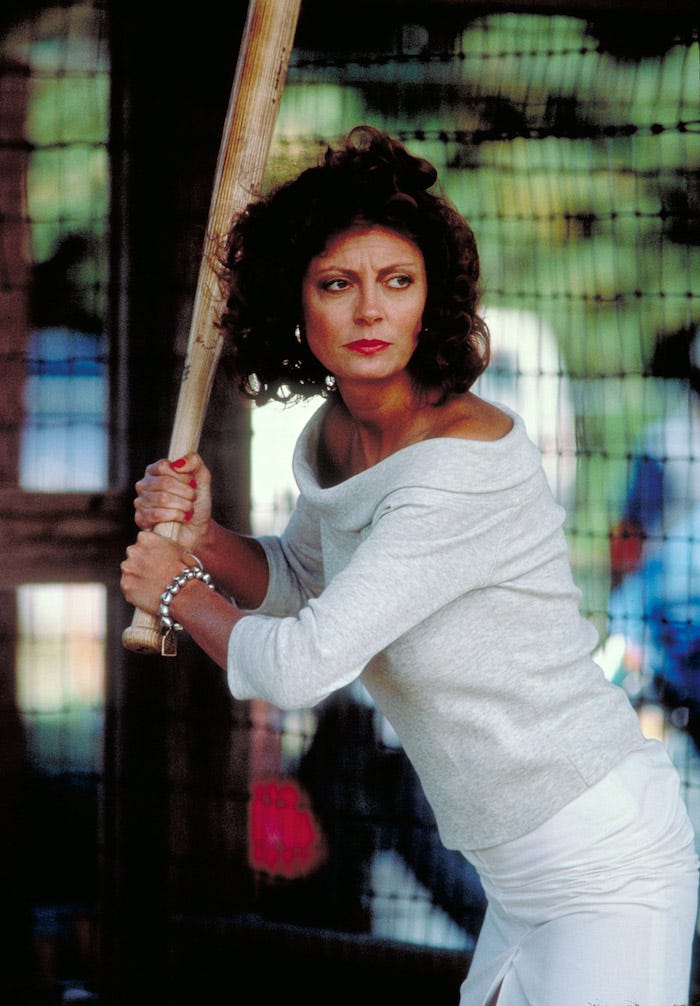
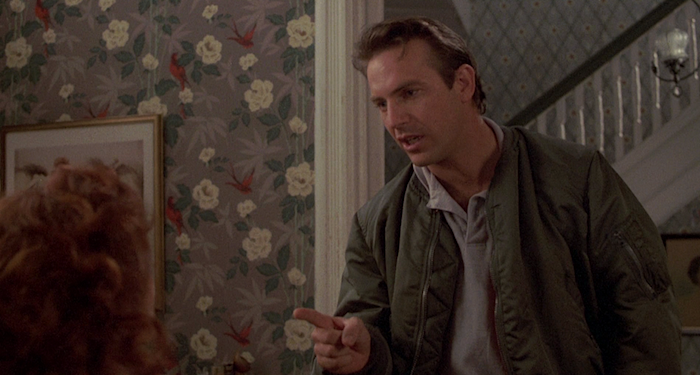
Now consider Crash Davis. He’s spent the better part of 15 years playing baseball in the minor leagues. Not typical you say, but the way Crash carries himself, baseball, at this point in his life, has evolved into a job. And what started out with such promise has lost its sheen. Can any of you relate to that emotional place regarding a line of work you’ve been in for any length of time? Crash Davis stands in the tradition of Willy Loman, the indefatigable salesman, whose product they’re hawking is their Self — and like Willy, Crash sees the writing on the wall and the future doesn’t look pretty. That experience is very typical for many moviegoers. But then, Crash gets brought in to train crazy rookie phenom, Nuke LaLoosh. Furthermore, he gets involved in a mangled romantic triangle with these two off-beat characters. And just to round out the character set-up, Shelton gives Crash his own life-philosophy, also grounded in baseball, but of a more cynical sort, interwoven with romanticism. Not typical.
Crash at the door. Annie's question is slightly
taunting. He stops, and speaks with both aloofness
and passion:
CRASH
I believe in the soul, the cock, the
pussy, the small of a woman's back,
the hanging curve ball, high fiber,
good scotch, long foreplay, show
tunes, and that the novels of Thomas
Pynchon are self-indulgent, overrated
crap.
(beat)
I believe that Lee Harvey Oswald
acted alone, I believe that there
oughtta be a constitutional amendment
outlawing astro-turf and the
designated hitter, I believe in the
"sweet spot", voting every election,
soft core pornography, chocolate
chip cookies, opening your presents
on Christmas morning rather than
Christmas eve, and I believe in long,
slow, deep, soft, wet kisses that
last for 7 days.
So are your characters ‘big enough’? If not, perhaps you should dig into them more to create atypical typical characters.
Tomorrow another question: “Does my script have big enough set pieces?”