Interviews: Jonathan Glazer
Conversations with the writer-director of The Zone of Interest, nominated for five Academy Awards.
Conversations with the writer-director of The Zone of Interest, nominated for five Academy Awards.
As readers of Go Into The Story know, I normally feature interviews with screenwriters or writer-directors which focus on the writing of the script. With the film The Zone of Interest, I am including here two interviews with writer-director Jonathan Glazer which spotlight two different aspects of the filmmaking process: directing and sound.
Plot summary: Auschwitz commandant Rudolf Höss and his wife Hedwig strive to build a dream life for their family in a house and garden beside the camp.
The Zone of Interest is perhaps the most powerful movie I saw from 2023. The screenplay, adapted by Glazer from a Martin Amis novel, has been nominated for a Best Adapted Screenplay Oscar, but also for Best Sound and Best Directing.
Here is an excerpt from a Vanity Fair interview with Glazer and cinematographer Łukasz Żal.
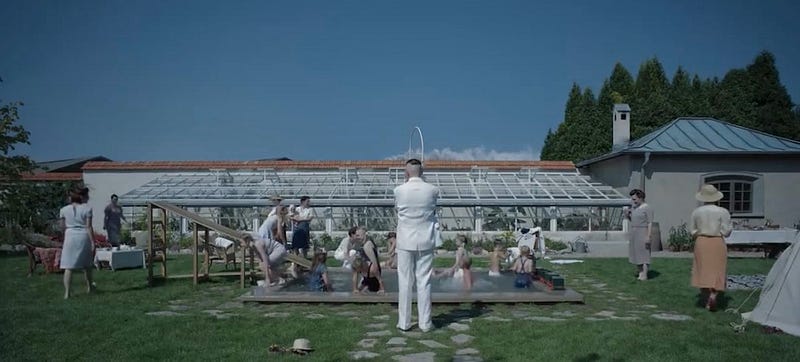
Jonathan Glazer: One of the most fundamental bits of research to the way we made this film were images, photographs, in the Höss family album. Something like 26 pictures, most of which were in the public domain. What they show is this housewife with her children playing in a swimming pool, kids going down the slide, running around, playing with the rabbits in this garden. What you’re seeing in this image here is a very faithful recreation, or simulation, of the real Höss greenhouse and garden and swimming pool. If you were to go online and have a look at the images of Hedwig Höss in her garden — and they would’ve been photographs taken by Rudolph Höss — it would look pretty identical to this image.
Interestingly, he never photographed the reverse of this shot — and the reverse of this shot shows the camp. What you’re looking at in this image is a house that could be anywhere with a well-stocked greenhouse. There’s house staff preparing a garden party and here’s a woman proudly showing her mother around her estate. It could be anywhere. That’s what they wanted to see and that’s what they wanted to show to themselves, I think. But that’s why he didn’t shoot any photographs looking in a reverse angle of this. But we did.
Łukasz Żal: I think also it’s a perfect example of how we approach this in terms of composition and placing our cameras. Very often we were just trying to be as objective as possible, trying not to compose in any way. Just as John said, with this family album, these pictures, we wanted to recreate this way of showing them in the most simple way. Very often we’re placing our characters in the middle. We’re trying to find a symmetry. We’re trying to find the frames where our manipulation will be invisible. We have this in a front light, not very attractive light. Everything is in focus. It’s exactly like a snapshot. That’s probably the best explanation. Without any kind of fancy interpretation. It’s how a normal person would show this reality.
I remember one of the first days when we were prepping the film, we were going to locations and we were talking about one scene. I proposed a portrait and John told me, “But that might be very emotional. We do not need that. We don’t want to be emotional, we don’t want to manipulate. Just let’s show it in a wide shot.”

Glazer: This scene started with Hedwig and her mother, Lena, coming out of the house and ending up having a conversation under the gazebo at the back end of the garden in real time. We had 10 cameras to play with there. So where should the cameras be to record their journey from A to Z, over the course of about five and a half minutes, which this scene is? Those are your considerations. How do we do it in a way that is consistent with the visual language that we’ve already established thus far with other scenes we’ve already shot?
This is a dolly shot — a rare one…. Everything had to be functional, essential. But a lot of work goes into this. A lot of work goes into achieving simplicity. You end with simplicity. You don’t start with it.
Żal: Even composing in the middle, which is so obvious. We keep the people in the middle because your eye has the highest resolution in the middle. We’re composing and trying to keep people in the middle of the frame. If you take a picture as an amateur or if you take a snapshot, you’d probably compose it in this way.
Glazer: But now that you’ve seen this side of it, you see the reverse of “it could be anywhere.” It is the context that bears down on everything in this film always, whether it’s visually or sightly, but the foreground is intentionally, largely absent of drama…. We shot some scenes that were dramatic scenes, and they were like oil to the water of what this scene needed to be. So none of them made it into the final cut. They were a distraction. They felt artificial by comparison. Everything mundane was made extraordinary through context, through proximity.
Żal: What is so important, too, is the wall is new. This is ’43, it was brand new here, which looks a bit different than in [other] Holocaust films, I think. They always have a patina, it looks old or looks cinematic — it looks more interesting, more beautiful because it’s old and we like old things because they have this nice patina. But here everything is brand new.
Glazer: She talks about in this very scene that this was a field three years ago, and they put an extra floor on the house. She’s talking like any sort of petty bourgeois person who’s explaining their renovations. There’s nothing that people can’t see themselves relating to there.
I was struck by how there are hardly any close-ups in movie and given the comments in this interview, the physical distance between the camera and the actors exists in order to convey a sense of emotional distance. The result is this cold, dispassionate narrative … all the while, an unspeakable horror plays out beyond the wall and in our imagination.
The fact that the audience does imagine what is transpires beyond the wall is enhanced in a significant way by the use of sound. In this video, you can hear Glazer discuss how they approached sound to create a foreboding sense of ongoing death in the prison camp.
The combination of visual and sound, along with the performances of the actors creates a compelling drama which at its core is really a horror movie.
Here is a trailer for The Zone of Interest:
This is a must-see movie … as hard as it is to absorb what you are watching … and hearing.
For the rest of the Vanity Fair interview, go here.
For 100s more interviews with screenwriters and filmmakers, go here.