Interview (Written): Tony Gilroy
The noted screenwriter and filmmaker discusses the screenplay he wrote for the movie Beirut.
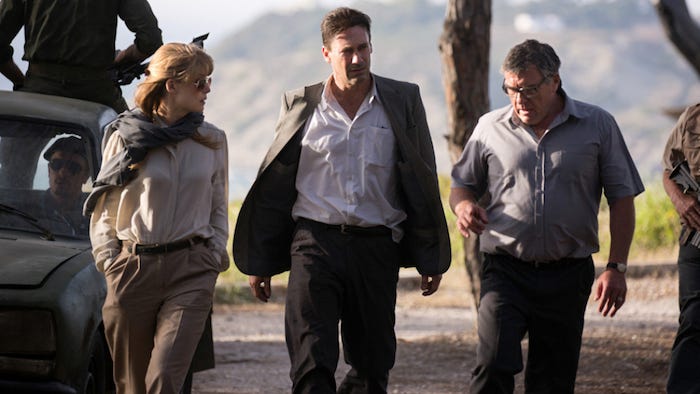
The noted screenwriter and filmmaker discusses the screenplay he wrote for the movie Beirut.
Tony Gilroy’s screenwriting credits include The Bourne Identity, The Bourne Supremacy, The Bourne Ultimatum, Michael Clayton, and Rogue One: A Star Wars Story. In this Playlist interview, Gilroy talks about how a script he wrote all the way back in 1991 was produced as the movie Beirut:
The “Beirut” script is practically ancient.
Yeah, 1991. This was pretty shocking. Interscope had it. They were an enormous company in the nineties, just huge. I had different companies I worked for a while in the late ’80s and early ’90s and Interscope was one of them. Two of the producers, Mike Weber and Ted Field, dug it out of a drawer a couple years ago and they said, “If we go to Jon Hamm and Brad [Anderson] will you help us out?” I was like, “sure,” but I never thought it would happen, but they just kept going and here we are.
Unearthing a mid-range political drama from the 90s, the kind of movies that have shifted to TV, feels like a bit of a miracle right now. I’m a little surprised this movie was even made.
There’s a trajectory of momentum that things have and if they don’t achieve critical mass at a certain point, they disappear. And you think of all the amazing properties that are lying around that just couldn’t catch their moment or couldn’t find the right piece of casting at the moment they needed it. I think there’s a lot of potential things lying around that people haven’t fully developed, but it takes real determination to get them made. We couldn’t even find my contracts that’s how far back this goes. We couldn’t find the paperwork. [editor’s note: Gilroy had to be made a producer on the film to get any kind of credit or compensation since all the contracts had gone AWOL].
How much did the script from change? And for you, how different do you think the political climate is now?
Well, politically, the film takes place in 1982 and I wrote it in 1991. And the politics of it… my scholarship on this — and I had to research this twice — is really, really dead-on. I stand behind it. And in the intervening years, things that were seemingly radioactive to audiences politically, or the jury was still out or people were still arguing about some things in 1991 that are politically alive in the script, the verdict was in 20 years later on all those topics and there wasn’t much debate.
So it stalled.
A lot of people interested in the script at the time, and it really helped me out career-wise as a calling card, but in the intervening years, not only did the issues resolve, but it actually got more relevant in a way. Because it takes place in the winter of 1982 in Beirut and that moment was chosen because it was so potent and such an electric fulcrum kind of moment [two months before Israel invaded Lebanon]. Israel is going to invade a month or two after the movie ends, and Hezbollah is going to come in and all of a sudden, the story’s going to become about religion and not proxy wars, it’s really a last exit story. So, the movie has more political resonance now than it did then in a strange way.
Here is a trailer for the movie:
For the rest of the Playlist interview, go here.
For hundreds more interviews with screenwriters and filmmakers aggregated in the Go Into The Story archives, go here.
Twiter: @ThePlaylist.