Interview (Written): Suzanne Allain
A conversation with the novelist and screenwriter of Mr. Malcolm’s List.
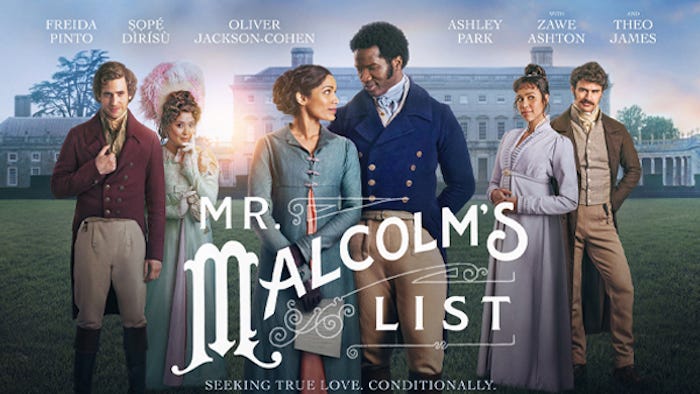
A conversation with the novelist and screenwriter of Mr. Malcolm’s List.
The movie Mr. Malcolm’s List hits theaters in North America this weekend. Here are excerpts of a /film interview with Suzanne Allain who wrote the novel and the screenplay adaptation.
Obviously this is a project that has been years in the making — I heard like 20 years for you.
Yes, that’s when I originally wrote the book was 20 years ago. So yes, it’s been a long process.
I absolutely love how your work can translate so seamlessly from the early 2000s romcom structure to the 19th century. How did you know that historical romance was the genre for you?
Well, it’s the genre I’ve always loved. I was a huge fan of Jane Austen. There’s another writer, Georgette Heyer, that was kind of like the first historical romance writer. She wrote Regency romances. She was the first one. She wrote them about 100 years after Jane Austen wrote “Pride and Prejudice.” So yeah, I was just a big fan of the genre. I also am a big fan of more comedic writers, like P.G. Wodehouse, Oscar Wilde. What I wanted was the historical time period, Jane Austen’s era, mixed with being a little more farcical and comedic perhaps than hers — although her works are extremely hilarious as well.
I’m also so in awe of the fact that you adapted your novel for the film because screenplays, they are an entirely different animal from novels. How did you approach the process of adapting your work?
Well, it was funny. I really didn’t know a lot about screenwriting when I adapted it. It was my very first script I had ever written or attempted to write. So … I actually don’t know. It was funny. I was so naive at that point. I didn’t even have Final Draft. I researched how to format. I remember I was reading all this “How to format a screenplay” stuff and I didn’t want to necessarily invest in the software because I didn’t know if this was what I was going to be doing. So I just tried to format it myself in Word. [Laughs] It was definitely a learning process. But I think that because I enjoy writing dialogue so much anyway — like even in writing novels, that was my favorite part, writing dialogue. So I feel like it was just a good fit for me and my particular skill set. And then I feel, too, my characters speak to me and they kind of live in my head. So it was easy to envision them in a film, in a movie.
But I did a lot of research. I read a lot of other really good scripts. So I took lessons from really good screenwriters and scripts that were very successful and well-written. So I read a lot of those. I did a lot of homework as far as reading books on screenwriting. And so I really tried to educate myself. And then I, originally, I kind of just entered a few free contests, like Amazon Studios at that time was just developing and searching for new talent. They had some free screenwriting contests that I entered. And “Mr. Malcolm’s List” placed, it was a semifinalist. So I was like, “Oh! Okay, well … maybe I should pursue this.” And so then I uploaded it to The Black List website and that’s eventually what took us to this point today. The director heard the table read that The Black List Table Read Podcast and she became attached, Emma Holly Jones. And then that’s how we got here.
Imagine trying to do screenplay formatting on Word. Takes me back to when I first started writing scripts back in 1986, only back then there were no screenwriting software programs!
Once Emma Holly Jones took on the project, she created a short film to help raise funds to make the movie. Here is that short film.
Here is a trailer for the feature film.
Mr. Malcolm’s List is yet another feature film which was discovered via the Black List website. It’s great to see alternate avenues like the Black List for screenplays to find their way to filmmakers, then eventually into movie theaters.
For the rest of the /film interview, go here.
Twitter: @suzanneallain, @emmahollyjones, @MrMalcolmsList.
For 100s more interviews with screenwriters and filmmakers, go here.