Interview (Written): Richard Linklater and Darryl Ponicsan
Co-writers of the Amazon Studios movie Last Flag Flying.
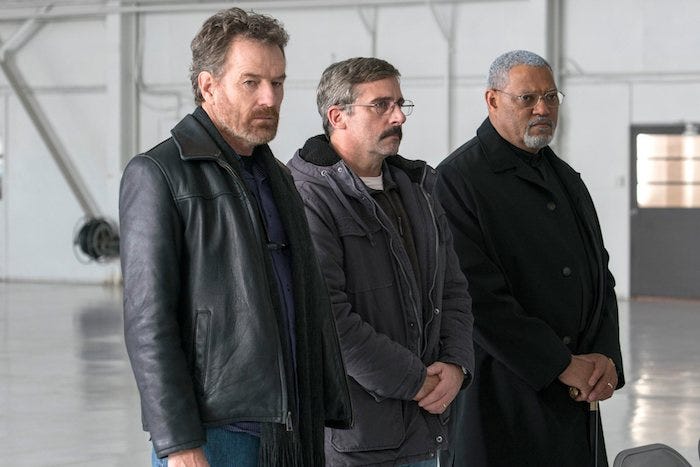
Co-writers of the Amazon Studios movie Last Flag Flying.
Via the Writers Guild of America, East:
LAST FLAG FLYING (Amazon Studios) is a war movie that’s not really a war movie, and a sequel that’s not really a sequel. It is a period piece about Vietnam War veterans that takes place during the Iraq War, and is not about either of those wars in particular as much as it is about both of those wars in general.
In 2003, 30 years after they served together in the Vietnam War, former Navy Corps medic Richard “Doc” Shepherd (Steve Carell) re-unites with ex-Marines Sal (Bryan Cranston) and Mueller (Laurence Fishburne) for a different type of mission: to bury Doc’s son, a young Marine killed in the Iraq War. Doc decides to forgo burial at Arlington Cemetery and, with the help of his old buddies, takes the casket on a bittersweet trip up the East Coast to his home in suburban New Hampshire. Along the way, Doc, Sal and Mueller reminisce and come to terms with shared experiences of the war that continue to shape their lives.
Director Richard Linklater and author Darryl Ponicsan collaborated on the screenplay which follows the trio as they wrestle with the pangs of war both past and present.
We spoke to Richard and Darryl about their collaboration and adaptation process; the inextricable relationship between the Iraq and Vietnam wars; and the importance of truth — in this story, and in our collective one.
What was the genesis of LAST FLAG FLYING?
Darryl: You have to go back to 1970 when my first novel, The Last Detail, was published. In 1973, The Last Detail was adapted into a film directed by Hal Ashby and written by Robert Towne. Thirty-four years passed with a friend urging me to write a sequel to the movie. I didn’t want to write a screenplay, so instead, I wrote a sequel to the novel which was heavily influenced by the film. Thomas Wright, who became the Executive Producer on LAST FLAG FLYING, took the novel to Sony, which had the right of first refusal. Sony passed on it and we took it to Paramount, who optioned it in the hopes of getting the cast from THE LAST DETAIL — Jack Nicholson, Randy Quaid. Otis Young, who also starred in the film, had passed away, but Morgan Freeman agreed to take on the role. Long story short, Nicholson decided to do THE BUCKET LIST. I thought we were dead in the water, then Richard and I started talking about how we can make LAST FLAG FLYING a standalone film, still based upon the book. In the end, we wound up with a film that is not a sequel to a film, but rather an adaption of a sequel to a book.
Richard, when did you read Darryl’s book for the first time?
Richard: I read Last Flag Flying for the first time when it came out in 2005.
Darryl: It was a very limited publication.
Richard: There weren’t many original copies, but Harry Gittes floated a copy my way. I read it and really liked it. I was excited about it. I came on board because I loved the characters. They were so alive, and the story was a nice reflection of these two wars. It seemed like a meditation on time, mortality, and middle age.
What was your process for adapting the book, and for collaborating on the screenplay?
Richard: It was pretty lengthy. It sort of shifted and turned, and happened in a couple chunks, over time. I remember reading the book a second time, and just outlining all the stuff I would love to be in a movie — what would work in the movie, what wouldn’t. Streamlining. It’s all about storytelling and structure, I believe in that, and we had such a good road map with the book.
Darryl: It happened over the course of ten years. We never did the traditional 3×5 cards sort of thing. If I recall, we started with the first scene in the book, and then let it evolve into the movie as we went along. There were sections that clearly weren’t going to make it in the film, and they didn’t have to. The script took on an evolution and a growth of its own. The process was that I would write something and send it to Richard, and he would rewrite that and send his rewrites to me, then I would rewrite him — it went on and on like that.
Richard: That was over ten years ago, when we wrote our first draft, and then some time went by. The script went through two little incarnations. The first draft was a little more faithful to the book. The second draft was much shorter than the first, but important — the years went by, and that was when we introduced some new elements. The writing never really stopped.
Darryl: No, it never did stop. Even during the shooting, I would wake up from a dream and call Richard up, and say, “Can you do this?”
Richard: Yeah, and it would be a great idea. It was fun to collaborate with someone who so embodied it in that way. Darryl would have a great line which would just come out of nowhere when he’d wake up — a line like “You see these faces? They’ve already been spited,” for instance. I’d tell Bryan [Cranston] about it, and he’d like it, so we’d work it into the shooting.
A trailer for the movie:
For the rest of the WGA, East interview with Richard Linklater and Darryl Ponicsan, go here.