Interview (Written): Rian Johnson
A conversation with the writer-director of Glass Onion: A Knives Out Mystery.
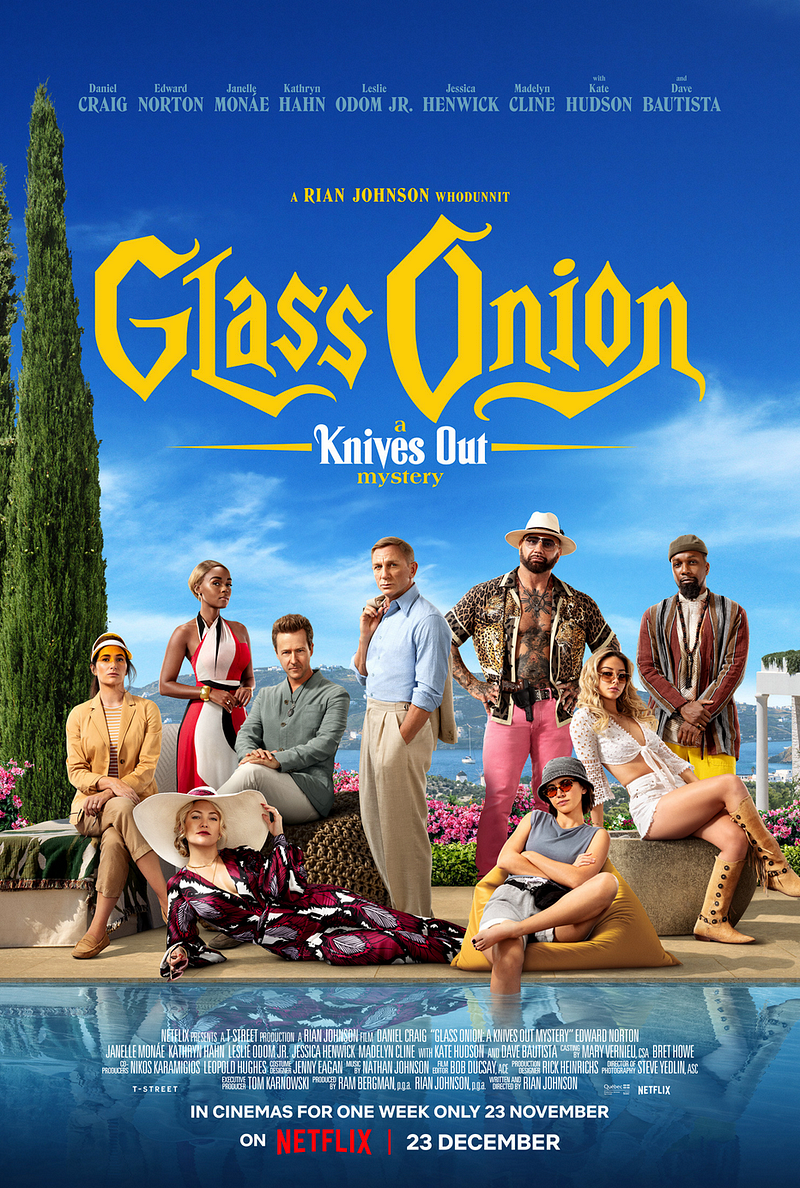
A conversation with the writer-director of Glass Onion: A Knives Out Mystery.
Rian Johnson has a remarkable track record as a filmmaker. His screenwriting credits include Brick, The Brothers Bloom, Looper, Star Wars: Episode VIII — The Last Jedi, and Knives Out. His latest movie: Glass Onion: A Knives Out Mystery, the first of two movie sequels in the Knives Out story universe as part of a $400M+ deal with Netflix.
Recently, Vulture conducted a lengthy interview with Johnson. Here is an excerpt.
The maiden Knives Out is critically acclaimed, widely beloved by folks who are really into the murder-mystery genre and also people who are not super-familiar with the genre. It is a meme machine. I believe I saw two Chris Evans sweaters this past Halloween. Were you surprised by the strong response to the first movie?
I was coming off of the Star Wars movie, which was obviously the biggest thing I’ll ever do in my life, when I sat down and wrote this murder mystery. The genre was something that — there were good examples of it being done, but it wasn’t something that was really at the forefront. It had been lying there for a bit and getting a little dusty. Even friends of mine who really enjoyed the script when I showed it to them were like, “Are you sure you want to do a murder mystery?” There was the idea that I could take a bigger swing. But I just loved this genre so much, having grown up sitting around the TV with my family and watching Death on the Nile with Peter Ustinov and just feeling like that’s the most fun a movie can possibly be. You have an all-star cast, and every single new face that pops up is like you’re leaning forward. I just thought, This is something that I know I’ll enjoy, but I have no idea whether audiences still want it.
All to say it was a big surprise.
— —
Was there any moment in the process of writing it when you thought you might take a swipe at the Agatha Christie universe? Maybe Kenneth Branagh had not yet done Murder on the Orient Express?
Growing up, I had thought at different times about how you would translate — to any Agatha Christie heads in the audience — the twist at the end of The Murder of Roger Ackroyd to a visual medium in a way that works. That could be really interesting. I’m a huge Agatha Christie fan. I love Kenneth Branagh’s Poirot. I think he’s hilarious. I’m a junkie. I just watched See How They Run. I really, really loved that. I’ll just watch every whodunit that comes out. I love them.
The whodunit is this perfectly engineered machine to engage with culture. It’s an ensemble, and each one of the characters kind of represents a different little slice of this microcosm of society. There’s a power structure inherent with the suspects and then there’s somebody at the top who everybody has a motive to kill. But Christie’s work is so enveloped in this fog of nostalgia at this point. We’ve spent years watching these adaptations, which are excellent and good and super-fun and I love them — but they’re set in the hazy past. Christie wasn’t doing that; she was writing to her culture. Her very first book, The Mysterious Affair at Styles, when we meet Hastings, he’s home from the Western Front with an injury. That’s why he’s at this country house. She wrote it in 1916. It’s not like she was an incredibly political writer, but she was always engaging with what was happening at that moment.
The fact that this genre that’s uniquely suited to do that had not been doing that for a long while got me very excited. What if we just unabashedly said, “Yeah, Knives Out is set in America right now, and I’m not going to worry about making it timeless. I’m just gonna talk literally about whatever we’re talking about in the moment.” It’s a way to engage with stuff that’s happening right now in this comforting, candy coating of a murder mystery.
That’s the other aspect of it: I love that candy coating. If you read analysis of murder mysteries and you think about the times where the murder mystery has kind of sprung up in the culture, the golden age of detective fiction was the 1930s.
Here is a trailer for Glass Onion: A Knives Out Mystery:
You may read the rest of the Vulture interview here.
Twitter: @rianjohnson
For 100s more interviews with screenwriters and filmmakers, go here.