Interview (Written): Phil Johnston and Rich Moore
Conversation with the co-directors of Ralph Breaks the Internet.
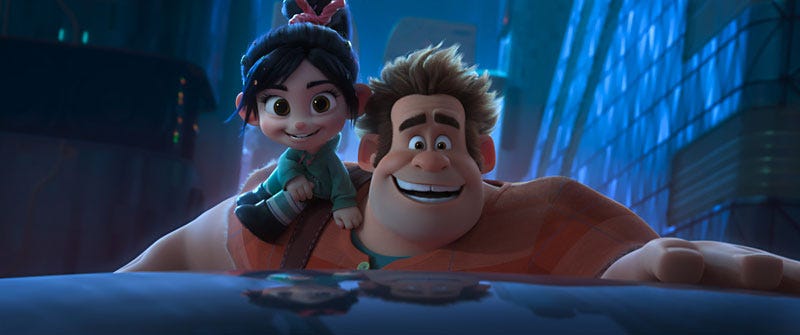
Conversation with the co-directors of Ralph Breaks the Internet.
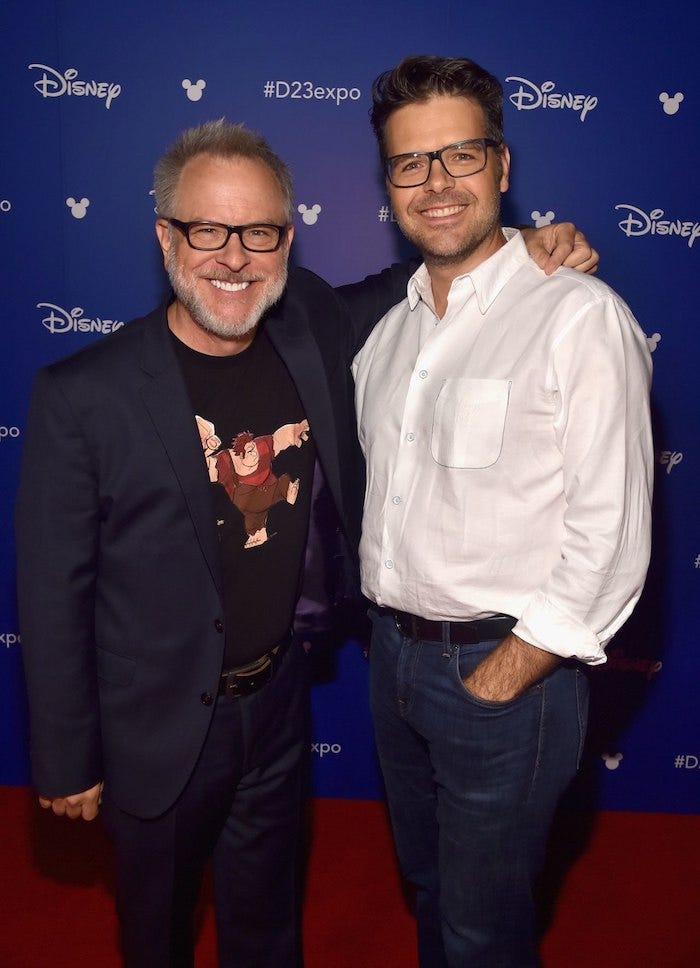
An Animation World Network interview with Rich Moore and Phil Johnston, co-directors of the movie Ralph Breaks the Internet. Johnston also co-wrote the screenplay. The interview was conducted by AWN publisher and editor-at-large Dan Sarto. Here’s an excerpt:
Dan Sarto: If there was ever a concept that could prove too difficult to visualize, it would be the ‘Internet.’ How did you approach the idea, the vastness, the design of such an abstract concept? How did you bring it down to the size needed to tell your story?
Phil Johnston: You break things into two buckets: story and visuals. And, the technology that went into creating the visuals. For us, initially, the thing that was quite overwhelming about the movie was, as you say, how big the world was. But not just that. What story are we telling within the Internet? I’ve used this analogy before. It’s like saying ‘We want to make a movie about New York City.’ OK, cool. Well, is it about the Lower East Side? Is it about Harlem? Is it about Crown Heights? Is it this, is it that? There are eight million stories, and eight million visuals. So, for us, the real question was, ‘How do we simplify everything into a story about a friendship…a friendship that is going to fracture within this journey. And then, we want to heal that fracture.
From a story standpoint, every decision we made about where they go in the Internet, the people they meet, and the things they encounter, all had to bounce off that core idea of this friendship. How do we make things as challenging and unpleasant as possible for Ralph, and how can we help him and Vanellope find their way through it?
Rich Moore: It’s so strange that these films keep getting bigger and bigger. You would think that after Zootopia we would stop there. That was a big world with a lot of characters and huge challenges. But, here we’ve done it again. It’s about the Internet. Well, that’s a big world. We have to build that out, we have to show it. You can’t just say, ‘Ooh, this is a very big world!’ We’ve got to put it on screen. As far as designing it, there aren’t a lot of reference points or footholds to give you traction. It’s not like Zootopia where we could say, ‘OK, imagine New York, or Tokyo, or Paris but animals built it.’ And you’d think, ‘I can picture that.’
So, for us, it’s the Internet, but it’s a city. Well, the Internet is just a screen that I look at, or it’s servers and wires in a building. At first, it was very uncomfortable. Doing this job, I know that there are going to be lots of uncomfortable moments where you have to sit in the creative process and wait for the right idea to bubble up. That’s what makes the movies here very special — we’re allowed to sit in those kinds of uncomfortable moments and wait for the soup to present the idea.
This was the first time that it felt like we were creating in an absolute void, as far as what does the Internet look like. And that moment of discomfort went on much longer than it usually does. It was many, many moments of, ‘OK, it’s going to show itself. It will show itself. Trust the process.’ We say that a lot, and this film put that to the test for me. There were moments when I questioned myself, thinking ‘Have we bit off more than we can chew?’ We want it to be perfect. We want it to be great.
PJ: There was a moment where it felt like, ‘I don’t know if this is going to come. I don’t know if that bolt out of the blue is going to hit.’ And then it finally did. But I’m a firm believer in if you give it time, the idea will show itself. You just have to wait for the miracle to happen…and be there to grab it when it comes.
RM: The way that we were able to stay on course was showing it often to our colleagues and getting the benefit of their fresh eyes. Like you say, this film was big in scope and sometimes you can’t see the forest from the trees. It could get so overwhelming. We would watch it together with our colleagues, and if we got the comment, ‘It’s very funny and really exciting, but I’m just not feeling for the two of them,’ to me, that was the devastating note to get. In a movie like this, if you don’t care about the characters, then all the great visuals, all the bells and whistles, they mean nothing. When you have friends and colleagues whose words you really respect, and they give you that note, that’s when you know, ‘OK, it needs to be more intimate. We need more of their emotional story up front because, without it, the whole thing just kind of falls apart.’
“We need more of their emotional story up front because, without it, the whole thing just kind of falls apart.”
Amen to that! One of the writing mantras I wrote years ago speaks to this: “Every story has a physical journey and a psychological journey. The former has no meaning without the latter.”
Look at what Rich and Phil say about Ralph Breaks the Internet: “For us, initially, the thing that was quite overwhelming about the movie was, as you say, how big the world was. But not just that. What story are we telling within the Internet… So, for us, the real question was, ‘How do we simplify everything into a story about a friendship…a friendship that is going to fracture within this journey. And then, we want to heal that fracture.”
Big story. Small story. The big story is the physical journey. With the Ralph sequel, that’s the characters journey through the Internet. The small story is the psychological journey, that’s the story “about a friendship” between Ralph and Venellope. Evidently, the filmmakers did a good job meshing the physical and psychological journeys as the movie is not only a commercial success, but also a critical one.
Here is a fun scene from the movie known as the ‘Disney princess scene’:
Takeaway: In a movie, action is meaningless without meaningful characters. Ground the action in the story’s physical journey in the characters’ lives and experiences in their psychological journey.
For links to 100s more interviews with screenwriters, TV writers and producers, filmmakers, and industry insiders, go here.