Interview (Written): Lulu Wang
A conversation with the writer-director of the indie film The Farewell.
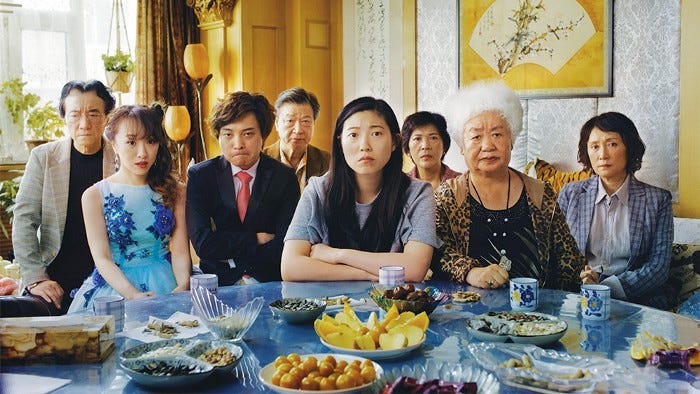
A conversation with the writer-director of the indie film The Farewell.
A great roundtable confersation hosted by the Black List blog’s Kate Hagen with The Farewell writer-director Lulu Wang, and film critics Carla Renata and Thuc Doan Nguyen. Some excerpts:
KH: I was at the premiere of THE FAREWELL at Sundance, which was full of rapturous applause and sniffles. Sundance is such a landmark achievement for independent filmmakers — what was it like to premiere the film in Park City, and how was it watching the movie with an audience for the first time?
LW: Just getting in was so surreal and such a dream. [Sundance] is such a loving atmosphere — it’s all film lovers, it’s a very special place, it’s like a winter camp for cinephiles! And I was there the year before with my production company and just loved it, you know? I didn’t expect to be there, but everybody kept saying, “You’ll be coming back,” but I didn’t want to think about it. So actually being there and seeing the reactions…it was really surreal. You’re so loved and so well taken care of by Sundance, they’re like a family too — they’re people who love movies, and they get this kind of a movie. But you wonder if it’s going to work in the rest of the world, so that was always in the back of my mind — enjoy this moment, because it may not be the same when we’re out of Sundance, and you need to be prepared for that.
TDN: How long did the first draft take you to write? Did you use the notecard method?
LW: I used notecards at some points, but I spent really only about a year and a half developing this script, because I knew the story so well, I had many different versions of it already. By the time we were developing the movie, it was more about throwing everything up on a board and seeing which scenes could be combined, what could be trimmed down, and what could be cut out entirely. But the heart of the movie was always there, and it very much follows the emotions dynamics and arcs of my real family.
KH: Since we’re talking about the script, I was curious to know what the most challenging part of writing this screenplay was, especially as compared to crafting this story as a This American Life episode first. What was that like, the transition from story to This American Life to script to finished film?
LW: With This American Life, they’re journalists so they have a very investigative approach — I sort of wrote the story down, but they encouraged me to go deeper. They said: “We need to situate YOU in the scene,” because so often I was writing about a scene based on what I was observing, but I’m not observing myself, right? So, they’re the ones that really got me to ask: “Where are you in this scene? How are you feeling?” And even if you’re not directly interacting with the family and you’re observing, we need to feel that too. And so we went through the entire story and really crafted my presence in all of the scenes.
In terms of the challenges in adapting the story for the screen…movies always come with a market thing — instead of going “Tell me what happened, this is so interesting,” it was like, “Well, who is this story for?” Luckily, once I did This American Life, those questions weren’t being asked anymore. But the challenge then became well, this is a very intimate story that works for radio, but how do you get it to work on a bigger scale? And I didn’t always have the answers to certain questions — in the radio story, the protagonist is not very active. And in my real life, the protagonist is not active. [laughs]
That is the challenge: Billi cannot be an active protagonist because her very presence in the movie is to be inactive, to not talk, to not do anything crazy. There was a push to go, “Well, that’s not gonna work for a movie” because for a movie the protagonist has to be doing something, you can’t just have her sitting around. But then, anything that I made her do felt very artificial. So, I was trying to balance that tension, as well as the question of “How do you make a film visually interesting when you don’t have an active protagonist?” How do you carry that tension from scene to scene without people feeling that it gets repetitive, how do you do that visually? How do you do humor visually when you’re telling a joke? And I didn’t want to rely on characters doing a schtick or telling a joke.
KH: Everyone’s just spouting one-liners…
LW: Exactly, or like falling down the stairs. [laughs]
Here is a trailer for The Farewell:
For the rest of the Black List blog interview, go here.
For 100s more interviews with screenwriters and filmmakers, go here.