Interview (Written): Kurt Vonnegut
A 1973 Playboy interview with the renowned author of such books as Slaughterhouse-Five and Breakfast of Champions.
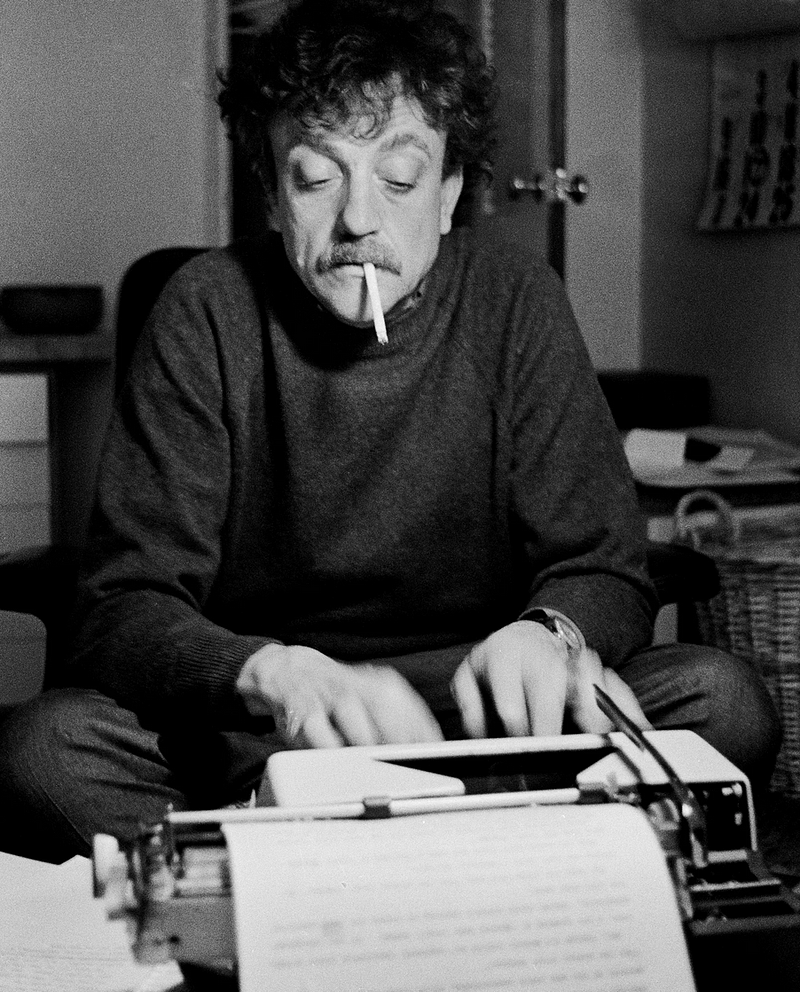
A 1973 Playboy interview with the renowned author of such books as Slaughterhouse-Five and Breakfast of Champions.
The documentary Kurt Vonnegut: Unstuck in Time is scheduled to be released on November 19, 2021, so I thought it would be a good time to learn more about one of the 20th century’s most notable authors. His novels include Player Piano, The Sirens of Titan, Mother Night, Cat’s Cradle, Slaughterhouse-Five, Breakfast of Champions, Jailbird, Deadeye Dick, and Bluebeard
Here is an excerpt from a 1973 interview with Playboy magazine.
Playboy: The Vietnam war has cost us even more than the space program. What do you think it’s done to us?
Vonnegut: It’s broken our hearts. It prolonged something we started to do to ourselves at Hiroshima; it’s simply a continuation of that: an awareness of how ruthless we are. And it’s taken away the illusion that we have some control over our Government. I think we have lost control of our Government. Vietnam made it clear that the ordinary citizen had no way to approach his Government, not even by civil disobedience or by mass demonstration. The Government wasn’t going to respond, no matter what the citizen did. That was a withering lesson. A while ago, I met Hans Morgenthau at a symposium at the United Nations and I was telling him that when I taught at Iowa and Harvard, the students could write beautifully but they had nothing to write about. Part of this is because we’ve learned over the past eight years that the Government will not respond to what we think and what we say. It simply is not interested. Quite possibly, the Government has never been interested, but it has never made it so clear before that our opinions don’t matter. And Morgenthau was saying that he was about to start another book, but he was really wondering whether it was worth the trouble. If nobody’s paying attention, why bother? It’s a hell of a lot more fun to write a book that influences affairs in some way, that influences people’s thinking. But the President has made it perfectly clear that he’s insulated from such influences.
Playboy: What’s your opinion of Nixon?
Vonnegut: Well, I don’t think he’s evil. But I think he dislikes the American people, and this depresses us. The President, particularly because of television, is in the position to be an extraordinarily effective teacher. I don’t know exactly how much Executive responsibility a President has, or how much the Government runs itself, but I do know that he can influence our behavior for good and ill tremendously. If he teaches us something tonight, we will behave according to that tomorrow. All he has to do is say it on television. If he tells us about our neighbors in trouble, if he tells us to treat them better tomorrow, why, we’ll all try. But the lessons Nixon has taught us have been so mean. He’s taught us to resent the poor for not solving their own problems. He’s taught us to like prosperous people better than unprosperous people. He could make us so humane and optimistic with a single television appearance. He could teach us Confucianism.
Playboy: Confucianism?
Vonnegut: How to be polite to one another — no matter how angry or disappointed we may be — how to respect the old.
Playboy: Humanity and optimism was the message that George McGovern was trying to get across. How do you account for his spectacular failure?
Vonnegut: He failed as an actor. He couldn’t create on camera a character we could love or hate. So America voted to have his show taken off the air. The American audience doesn’t care about an actor’s private life, doesn’t want his show continued simply because he’s honorable and truthful and has the best interests of the nation at heart in private life. Only one thing matters: Can he jazz us up on camera? This is a national tragedy, of course — that we’ve changed from a society to an audience. And poor McGovern did what any actor would have done with a failing show. He blamed the scripts, junked a lot of his old material, which was actually beautiful, called for new material, which was actually old material that other performers had had some luck with. He probably couldn’t have won, though, even if he had been Clark Gable. His opponent had too powerful an issue: the terror and guilt and hatred white people feel for the descendants of victims of an unbelievable crime we committed not long ago — human slavery. How’s that for science fiction? There was this modern country with a wonderful Constitution, and it kidnaped human beings and used them as machines. It stopped it after a while, but by then it had millions of descendants of those kidnaped people all over the country. What if they turned out to be so human that they wanted revenge of some kind? McGovern’s opinion was that they should be treated like anybody else. It was the opinion of the white electorate that this was a dangerous thing to do.
Playboy: If you had been the Democratic nominee, how would you have campaigned against Nixon?
Vonnegut: I would have set the poor against the rich. I would have made the poor admit that they’re poor. Archie Bunker has no sense of being poor, but he obviously is a frightened, poor man. I would convince Archie Bunker that he was poor and getting poorer, that the ruling class was robbing him and lying to him. I was invited to submit ideas to the McGovern campaign. Nothing was done with my suggestions. I wanted Sarge Shriver to say, “You’re not happy, are you? Nobody in this country is happy but the rich people. Something is wrong. I’ll tell you what’s wrong: We’re lonesome! We’re being kept apart from our neighbors. Why? Because the rich people can go on taking our money away if we don’t hang together. They can go on taking our power away. They want us lonesome; they want us huddled in our houses with just our wives and kids, watching television, because they can manipulate us then. They can make us buy anything, they can make us vote any way they want. How did Americans beat the Great Depression? We banded together. In those days, members of unions called each other ‘brother’ and ‘sister,’ and they meant it. We’re going to bring that spirit back. Brother and sister! We’re going to vote in George McGovern, and then we’re going to get this country on the road again. We are going to band together with our neighbors to clean up our neighborhoods, to get the crooks out of the unions, to get the prices down in the meat markets. Here’s a war cry for the American people: ‘Lonesome no more!’ “ That’s the kind of demagoguery I approve of.
These insights are as relevant today as they were then, perhaps even more so.
Here is a trailer for the documentary Kurt Vonnegut: Unstuck in Time.
Here is a video in which Vonnegut discusses the eight shapes of story.
This is the lecture where Vonnegut talks about the eight shapes of story:
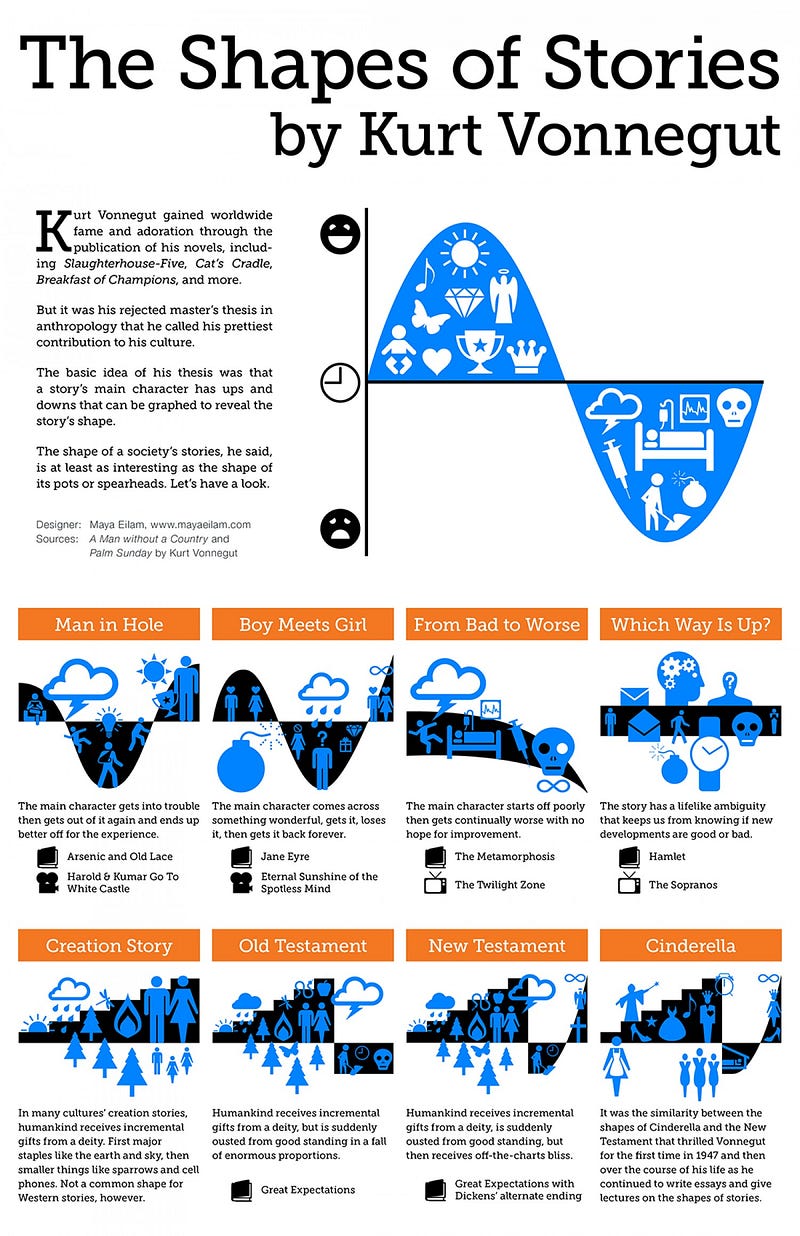
Vonnegut was an amazing writer and it’s fascinating to glimpse into his mind via interviews and lectures.
For the rest of the Playboy interview, go here.
For the documentary website hosted by IFC Films which is distributing the film, go here.
For 100s more interviews with screenwriters, writers, and filmmakers, go here.