Interview (Written): Krysty Wilson-Cairns
In-depth conversation with the screenwriter of the movie 1917.
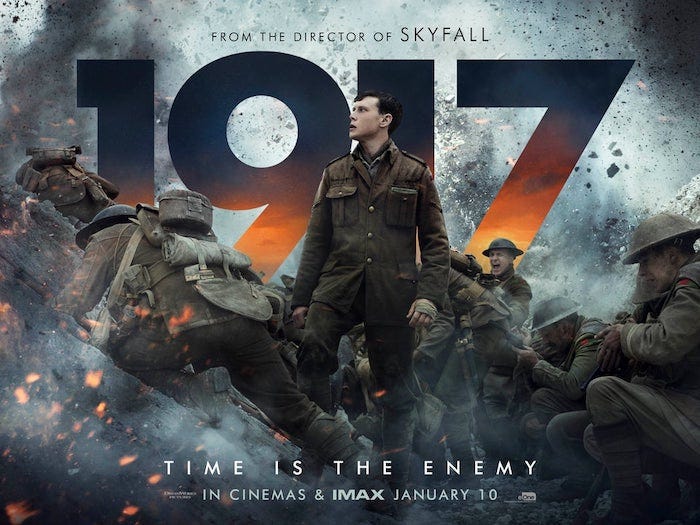
In-depth conversation with the screenwriter of the movie 1917.
Trained at the National Film and Television School in London, Krysty Wilson-Cairns (@WeWriteAtDawn) was a staff writer on the TV series Penny Dreadful. She, along with director Sam Mendes, wrote the screenplay for the World War I action-drama 1917.
IMDb plot summary: Two young British privates during the First World War are given an impossible mission: deliver a message deep in enemy territory that will stop 1,600 men, and one of the soldier’s brothers, from walking straight into a deadly trap.
Here is an excerpt from an in-depth Polygon conversation with Wilson-Cairns.
Polygon: How did you and Sam start working together in the first place?
Krysty Wilson-Cairns: I wrote a script called Aether that made it to the Black List, which was very nice. I was still a bartender when I wrote that script. That was 2014, and John Logan read that, and our agents convened because he was looking for writers on Penny Dreadful’s third season. We ended up having a long conversation, and I subsequently found out that he didn’t understand any of what I said because of the combination of the phone line connection and my mad accent. He was like, “The script was enough for me to hire you.” He gave that to Neal Street, Sam’s company, and head of development Julie Pastor wanted to meet me to talk it over. I kept in touch with them during Penny Dreadful, sent them another script I’d written for Darren Aronofsky, and after that, Sam asked me to co-write Voyeur’s Motel.
It was such an easy collaboration with him. Sometimes, as a woman, you get nervous walking into rooms full of experienced men that they’ll just disregard your opinion. That’s happened, but with Sam, it’s a completely different experience. You feel so safe that you can even pitch your terrible ideas, and sometimes your terrible ideas contain the kernel of a good idea. You have to have that comfort. In one way or another, I’ve been working with or for him my entire career.
You mentioned during a 1917 panel that your first pass at the script had a lot more gristle to it. Can you talk at all about that?
I don’t know if I can even tell you what isn’t in the film, to be honest. The actual structure of the film has remained unchanged the whole way through. Sam told me his idea was to build the script around the one-shot technique. I turned up at his house two days later and we sat down at his kitchen table. He had the idea of messengers going across no man’s land to deliver vital information. What happens to them on that journey? We made a wishlist of what we wanted to see in a World War I movie, dream immersive scenario, and that came together in about four hours. That never changed. So there’s not a lot left out of the movie. I think what he toned down was any impulse to go over the top. We had to be careful about the arc of the story. This was an intricate push and pull.
This script must have required lots of tiny adjustments, because the action on the page has to fill a precise amount of time on camera. Were you on set rejiggering writing during shooting?
Every day. I was in every rehearsal, at every set, on every location. I was with Sam in his garden, and we’d test how far we could walk while saying different dialogue. Lots of tinkering, fine-tuning. The editor, Lee Smith, is critically involved in the sense that he binds the film together, but there’s really no editing in the traditional sense of configuring a scene. What I mean will become more obvious in time. It’s like this: if a line didn’t work, if it wasn’t delivered right, doesn’t matter if that take’s perfect. That one’s going in the trash. There’s no fixing things when you’re working in long takes like this. You can’t cut around it!
Screenwriting Takeaway: When you come up with a story concept, such as a World War I movie in which “messengers [go] across no man’s land to deliver vital information,” one of the earliest steps in the process is brainstorm scenes, e.g., “We made a wish list of what we wanted to see in a World War I movie, dream immersive scenario, and that came together in about four hours.” Well, maybe your brainstorming process won’t lay out the overall structure of the story in four hours, but almost certainly, one scene or sequence idea will lead to another… and another. Eventually, you will have the raw material you can use to flesh out your story structure.
BUT…
You must ground the action in the psychological lives of your characters. In 1917, there are two key dynamics which Mendes and Wilson-Cairns could explore with the lead characters: Schofield and Blake. First, the mission itself which includes a ticking clock, huge stakes, and enormous odds against success. Second, Blake’s own brother is one of the soldiers whose life is at stake unless Black and Schofield succeed in their mission. Those two narrative elements are a great starting point to delve into the inner lives of this pair of characters.
For the rest of the Polygon interview, go here.
For 100s more interviews with screenwriters and filmmakers, go here.